Thirty-Two People Between Us and the Moon
NASA's lunar habitat recruitment drive opens a 26-day application window — November 7 to December 3, 2026 — for the 25th astronaut class, targeting crews who will live at the Moon's South Pole for up to twelve months. Starting salary: $164,395. Odds of selection: roughly one in eight hundred.
Count them. Thirty-two. That is the entire active NASA astronaut corps right now — thirty-two people, spread across training rotations, International Space Station assignments, and desk work in Houston, standing between humanity and its stated ambition to build a permanent home on another world. The number lands with a strange weight when you hold it next to the scale of what is planned.
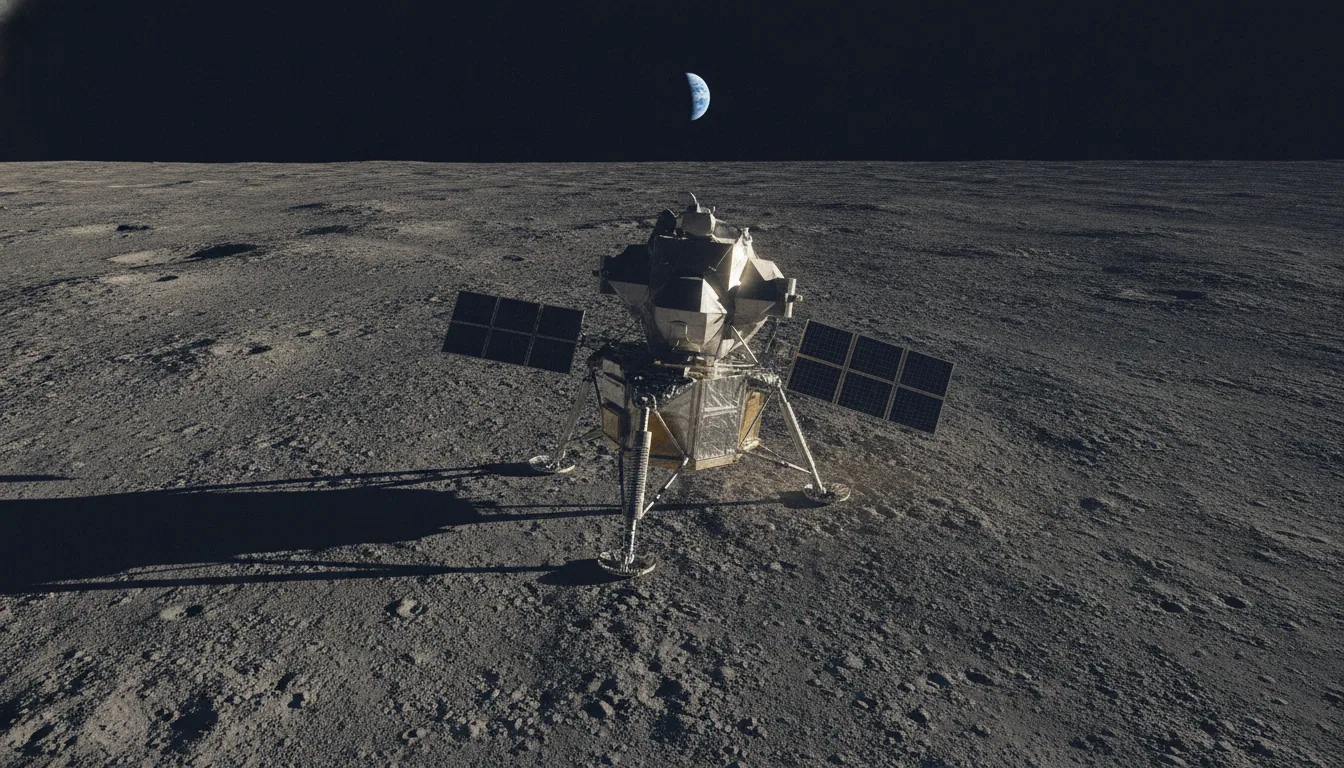
Here is the strange part. The Artemis program is not talking about brief visits, the flags-and-footprints sprint of the Apollo era. It is talking about lunar residency — crews living and working at the Moon's South Pole for months at a stretch, maintaining a base, running science, testing the systems that will one day push further still, toward Mars. And the workforce behind that vision, today, would not fill a city bus.
The pipeline that feeds the corps is tighter than the corps itself. In 2024, more than 8,000 people applied to become NASA astronauts. Ten were selected. That is an acceptance rate of roughly one in eight hundred — narrower than almost any medical school, narrower than most of the things we instinctively call impossible to get into. Those ten are still in training.
Which is exactly why NASA opened applications for a fresh class on November 7, 2026. The goal is not to replace anyone. The goal is to grow — deliberately, specifically — for a mission type that has never existed before. Not a visitor. A resident. The 25th astronaut class will be recruited, trained, and pointed at a world that no human has yet called home, even temporarily. That gap between thirty-two people and an entire lunar outpost is the gap this recruitment cycle is designed to close.
The Difference Between a Visit and a Lunar Outpost
Apollo's crew left footprints. Twelve men walked on the Moon across six missions, spent a combined total of less than 80 hours on the surface, and came home. Every one of those missions was fundamentally an expedition: arrive, collect, depart. The Artemis program is built around a different verb entirely. The goal is residency.
NASA has named its address. The lunar South Pole carries something the Apollo landing sites near the equator never offered: the possibility of water. Permanently shadowed craters near the poles trap water-ice, shielded from the Sun for billions of years — and broken into hydrogen and oxygen, that ice becomes rocket propellant and breathable air. It becomes the difference between a base that must be resupplied from Earth at enormous cost and one that begins, incrementally, to sustain itself. Where you get your water determines whether you are camping or colonizing.
The infrastructure logic follows from the geology. NASA is opening commercial bidding under the Commercial Lunar Payload Services program, known as CLPS, to bring private contractors into the delivery chain. Companies bid for the contracts to haul equipment, habitats, and supplies to the surface. SpaceX and Blue Origin are already in the mix. This is not a footnote. It signals that NASA has decided the Moon is too large a construction project for a single agency to build alone, and it anchors the whole endeavor to something sturdier than any single budget cycle.
The conceptual gap between expedition and outpost turns out to be vast. The engineering is new. The medicine is new. And so, as it happens, is the kind of person NASA needs to send.
Who, Exactly, Do You Send to Live on the Moon?
The job posting reads almost normally, until it doesn't. U.S. citizenship: standard. A master's degree in a qualifying STEM field, plus at least three years of professional experience after that degree: demanding but familiar. Annual starting salary of $164,395: reasonable for a senior engineer, perhaps slightly modest for a person who will spend a year on the Moon. The gap between the compensation and the job description is its own kind of comedy.
Look closer at that STEM requirement, though, and you find something genuinely interesting. Nursing degrees now formally count — a signal that the agency is thinking less about flying to the Moon and more about living there. For most of NASA's history, the astronaut corps drew from a narrow well: test pilots, physicists, aerospace engineers, the occasional geologist. A permanent habitat breaks down. People get sick. Someone needs to know what to do when the nearest hospital is 384,000 kilometers away and the resupply window is months out.
For pilots, the path bends differently. Those with 750 to 1,500 flight hours in qualifying aircraft can substitute that experience for some educational requirements. The logic is old and sound: judgment built in a cockpit translates. But notice the direction of change overall. The broadening of credentials is a map of the mission. Engineers build the base; pilots fly to it; nurses, doctors, and caregivers keep the people inside it alive and functional across a twelve-month deployment. Each new credential type answers a specific question about what could go wrong far from home.
The previous recruitment cycle drew more than 8,000 applicants. It selected 10. The numbers ahead are unknown, but the ratio is a useful anchor for anyone weighing their odds.
The Job Description Nobody Has Ever Had Before
Ross Elder stepped out of the CHAPEA habitat in October 2026 after 378 days inside. No wind, no rain, no unscheduled human contact. The crew had rehearsed the loneliness of another world while technically standing in Houston. He looked like a man who had thought very hard, for a very long time, about the nature of a small room.
The astronauts NASA now recruits are being asked to go further. Twelve months on the Moon, or longer. That is not a typo and not a rounding error. No ISS crew has stayed that long. The isolation will be of a qualitatively different kind, because Mars is not calling back in real time and the Earth will be a bright, unhelpful dot in a black sky.
Before any of that, the body must pass muster. Candidates face a long-duration flight physical, a battery of psychological evaluations, and a swimming test. The physical requirements are what you might expect from an extreme expedition; the psychological ones are harder to define, because the science of extended lunar isolation is genuinely thin. NASA acknowledges it. How does a person hold together across twelve months of confinement with a crew of a few, under a sky that offers no horizon to walk toward? The honest answer is: we do not fully know yet.
That is not a failure of planning. It is a description of the actual frontier. The CHAPEA and HERA simulations exist precisely to push into that ignorance, one controlled month at a time, finding the cracks before the habitat is a quarter-million miles away and the cracks matter enormously.
Every hour logged inside a Houston analog is an hour the Moon does not have to teach the hard way.
Before the Moon, There Is Houston
Not everyone chasing the lunar habitat will get there by rocket. NASA is simultaneously recruiting paid research volunteers for a year-long ground simulation launching in August 2027, and the requirements will feel familiar: aged 30 to 55, a STEM master's degree, the same credentialing threshold that the astronaut candidate pool must clear. The parallel is not coincidental.
The simulation itself is called the Moon and Mars Exploration Analog, and it braids together two distinct Earth-based systems. HERA — the Human Exploration Research Analog — has long mimicked the claustrophobic transit legs of an interplanetary mission. CHAPEA, the Crew Health and Performance Exploration Analog, is a 3D-printed habitat designed to replicate life on a surface far from home. Running them together is new. It is an attempt to stitch the journey and the destination into a single continuous test, the way the real thing will feel.
Compare this to what Apollo offered as preparation: relatively short missions, a lunar surface stay measured in days, and a knowledge base built almost entirely after the fact. The analog pipeline inverts that logic entirely. Ross Elder and his CHAPEA crewmates spent 378 days inside a Houston simulation before anyone plants a flag on the South Pole in earnest. That mission concluded in October 2026, and the data it generated flows directly into the safety and operations design for the real habitat.
The ground simulation is, in this sense, the honest version of the dream — slower, unglamorous, and absolutely necessary.
The Clock Is Running: Dates, Decisions, and the Road to 2028
The window is narrow. Applications for NASA's 25th astronaut class opened November 7, 2026, and close at 11:59 p.m. EST on December 3, 2026 — 26 days to submit the paperwork that could end with your name on a lunar manifest. After that, the selection board works. Final candidates are expected to be named in late 2027, with formal training beginning in early 2028 at Johnson Space Center in Houston.
That compressed arc — roughly 14 months from application to first day of class — is not an accident. The Artemis buildout does not wait for comfortable timelines. The previous recruitment cycle, in 2024, drew more than 8,000 applicants and yielded exactly 10 selections. The odds were worse than getting into most medical schools.
What makes this cycle different is the destination. Earlier astronaut classes trained for the International Space Station, an address in low Earth orbit, 400 kilometers up and reachable by an emergency return vehicle within hours. The class of 2028 is being prepared for a Moon base with no return capsule on standby and a commute measured in days, not hours.
Somewhere in those 8,000-plus submitted files, the first person to hold a permanent mailing address that is not Earth may already be reading this sentence. That is what NASA's lunar habitat recruitment, in the end, is actually selecting for. We do not yet know their name. That is the part the calendar cannot fill in.