A Stack of Paper Taller Than a Person
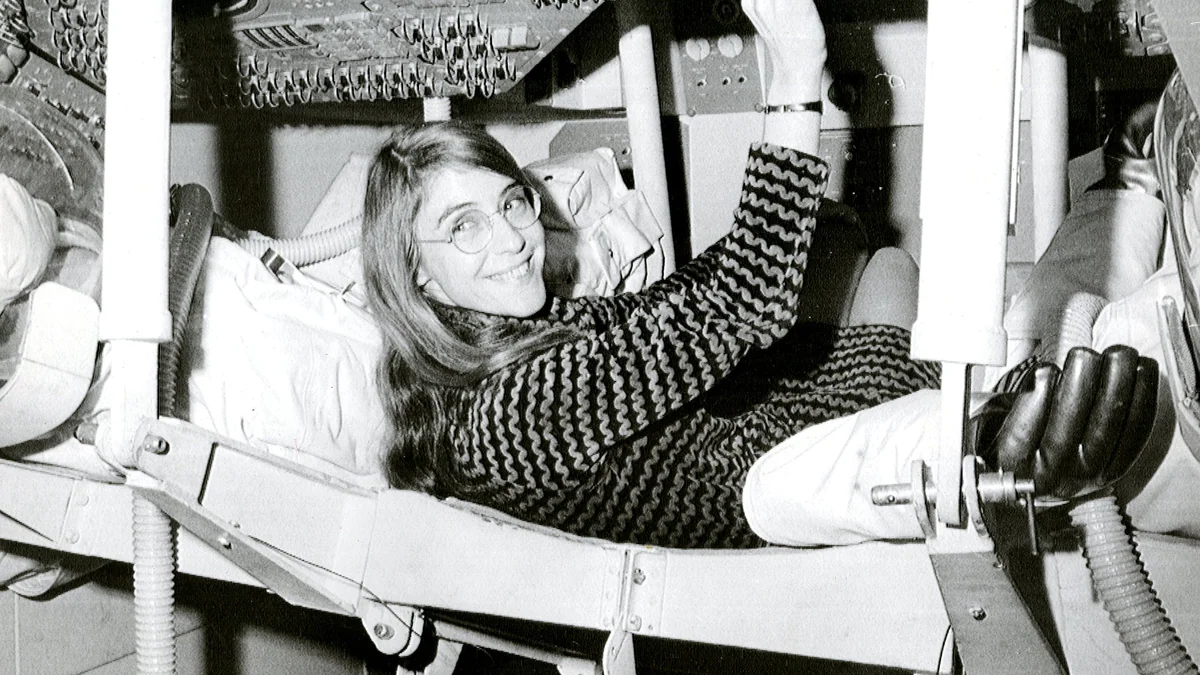
Look at the photograph — and you are looking at Margaret Hamilton's legacy before it had a name. A young woman stands beside a tower of paper that reaches past her shoulder, almost to her ear. She is not leaning on it for scale, the way tourists pose beside famous things. She looks calm, almost amused, as if she has simply come to collect something she built.
The tower is the software. Every page is code, printed and stacked, that will fly a spacecraft to the Moon and bring three men home alive.
Margaret Hamilton died on September 30, 2026, in Cambridge, Massachusetts. She was 90 years old. The Massachusetts Institute of Technology announced her death, and that institutional voice matters here: MIT was not just her employer. It was the place where she led the team that wrote the software for Apollo 11, and MIT's announcement carried the weight of an institution acknowledging that one of its genuinely world-altering chapters had closed.
The photograph was taken in 1969, when the word "software" was still new enough to make hardware engineers skeptical. Most people, if they thought about the Moon landing at all, imagined rockets, fuel, and the tremendous machinery of launch. The code was invisible, a thing no one could hold or point to.
That photograph answered a question that nobody had quite managed to ask yet: what does software actually look like? It looks, it turns out, like this. Like something a person stands next to. Like a structure with height and weight and consequence.
What She Was Building Before Anyone Had a Word for It
Margaret Hamilton arrived at MIT in 1959 with a background in mathematics and, initially, no intention of staying. She planned to leave for graduate school. She didn't leave.
When NASA contracted MIT to develop guidance software for the Apollo program in 1961, the MIT Instrumentation Laboratory became the unlikely address of a discipline that had no name yet. Hamilton was put in charge of the software development division — a title that carried genuine weight, because she directed a team of roughly 100 engineers writing code that would, eventually, carry three men toward the Moon.
The scale of the operation is easy to underestimate now. One hundred people, working on software, years before "software" had any standing as a serious engineering pursuit.
Here is the strange part. In the early 1960s, software was treated as the junior partner to hardware, something you sorted out after the real engineering was done. The machines were the achievement; the instructions you fed into them were closer to paperwork than to craft. Hamilton and her team were doing something that the broader engineering community had not yet decided was worth doing rigorously.
The MIT Instrumentation Laboratory was not a glamorous place to make history. It was a working research facility running tight against technical constraints that modern developers would find laughable — the Apollo Guidance Computer had memory measured in kilobytes. Into that constrained, uncharted space, Hamilton's team poured years of work, building systems that had to be right the first time, in the dark, far from home.
Why She Invented a Word
Names are tools. When Margaret Hamilton started calling what her team did "software engineering," she was not reaching for a catchy label. She was making an argument. The people writing code for the Apollo Guidance Computer were, in her view, doing work every bit as rigorous and consequential as the engineers bolting together the spacecraft around it. So she gave the discipline a name that said exactly that.
The word did not arrive at a conference. It spread from conversations inside MIT's Instrumentation Laboratory, where Hamilton led a team of roughly 100 people building something that had never existed before. Hardware engineers had professional status, institutional respect, university departments. Software writers had none of those things. They were often seen as programmers, which in the culture of the early 1960s carried the faint suggestion of skilled typists. Hamilton found that intolerable, and she did what humans have always done when they want to change how something is valued: she changed what it was called.
That may sound like a purely political move. It was also a technically honest one. The methods her team used — the rigorous testing, the error-tolerant architecture, the priority-based design — were genuine engineering in the deepest sense of the word. The name was not a promotion the field had not earned. It was a label that finally matched the reality.
Today, "software engineer" appears on the business cards of roughly 26 million people worldwide.
From one MIT hallway, the phrase moved into job titles, then into university curricula, then into every hiring document in the technology industry. Today, "software engineer" appears on the business cards of roughly 26 million people worldwide. Hamilton coined it because she wanted her colleagues taken seriously. It is hard to argue the project failed.
Twelve Minutes Above the Moon, and the Code That Chose What to Ignore
Four minutes before touchdown, Neil Armstrong and Buzz Aldrin were still two thousand feet above the lunar surface when the alarms started. First a 1202. Then a 1201. Neither astronaut had ever heard those codes in training. Neither had mission control.
The Apollo Guidance Computer was drowning. Someone on the crew had accidentally left a rendezvous radar switch in the wrong position, flooding the computer with a stream of data it had no reason to process — a simple human error, at the worst possible moment, fifty kilometers below orbital altitude. The machine was being asked to do more than it could hold.
What happened next is the reason the mission did not abort.
Years earlier, at a desk in Cambridge, Massachusetts, Hamilton and her team had built the flight software around a single governing idea: not all tasks are equal. The computer would rank every job it needed to do, from the critical business of flying the spacecraft to the background noise of optional housekeeping data. When overloaded, it would drop the low-priority work and defend the high-priority core. This is called priority-based task scheduling, and it sounds, in principle, obvious. Getting it right, in software that had to run on a machine with less memory than a modern wristwatch, was not.
When the 1202 alarm fired, the computer was not crashing. It was making a choice. It shed the radar data, cleared its own queue, and kept guiding the lander down. The alarms were, in a technical sense, the system working exactly as designed — a computer triage that kept the most important things alive under pressure. Flight controllers in Houston, who understood the alarm codes, gave the crew a calm "go" to continue.
Twelve minutes later, they landed.
After the Moon: Building Systems That Cannot Fail by Design
The Moon landing was done. The question Hamilton turned to next was: what do you do with an approach that just saved two men's lives, and how do you make it work everywhere?
In 1976, she founded Higher Order Software, her first company, to carry the engineering philosophy developed during Apollo into the private sector. Ten years later, in 1986, she founded Hamilton Technologies and developed the Universal Systems Language, a formal framework for modeling and building complex systems from the ground up. Where NASA's contract had been the forcing function, now she was building the methodology itself, distilling decades of hard-won insight into something teachable and transferable.
The core idea was called Development Before the Fact. The name is deliberate, almost stubborn. The standard approach to software reliability, then and now, is to build a system, test it, find the errors, fix them, and test again. Hamilton's approach was different in kind, not degree: design the system so that entire classes of error are structurally impossible before a single line of code is written. Compare that to the governing creed of modern Silicon Valley, "move fast and break things," and the contrast is almost philosophical. One tradition treats bugs as an inevitable cost of speed; the other treats them as a design failure, full stop.
The Apollo 11 landing did not succeed because Hamilton's team caught every bug in testing. It succeeded because the system knew, at the architecture level, exactly what mattered and what did not. That distinction, built once under pressure on a lunar trajectory, became a lifetime's work.
The Ledger of Margaret Hamilton's Legacy
The numbers are modest by some measures. In 2003, NASA gave Hamilton its Exceptional Space Act Award, the largest individual cash prize the agency had ever issued: $37,200. That figure is less than a mid-level programmer's monthly salary today. What it marks, precisely, is how recently the discipline she named was still treated as an afterthought.
The Presidential Medal of Freedom arrived on November 22, 2016, Barack Obama placing it around the neck of a woman who had written the code that kept two astronauts alive before most Americans knew software could be engineered at all. Then came the 2017 LEGO "Women of NASA" set, which included her figurine alongside astronauts and a telescope builder. Toy stores sold out within hours. The demand was not sentimental. It was recognition, arriving in plastic, from a generation that had grown up inside the discipline she built.
Her final major honor, the Michael Collins Trophy for lifetime achievement, came from the Smithsonian National Air and Space Museum in 2025. She was 89.
Every engineer who today writes fault-tolerant code, who builds a system that catches its own errors before they cascade, is working inside a philosophy Hamilton assembled by hand, on punch cards, against a deadline measured in a lunar orbit. Margaret Hamilton's legacy is not a monument — it is a method, still running. She never got to see what the next mistake in her field would be. That question belongs to us now.