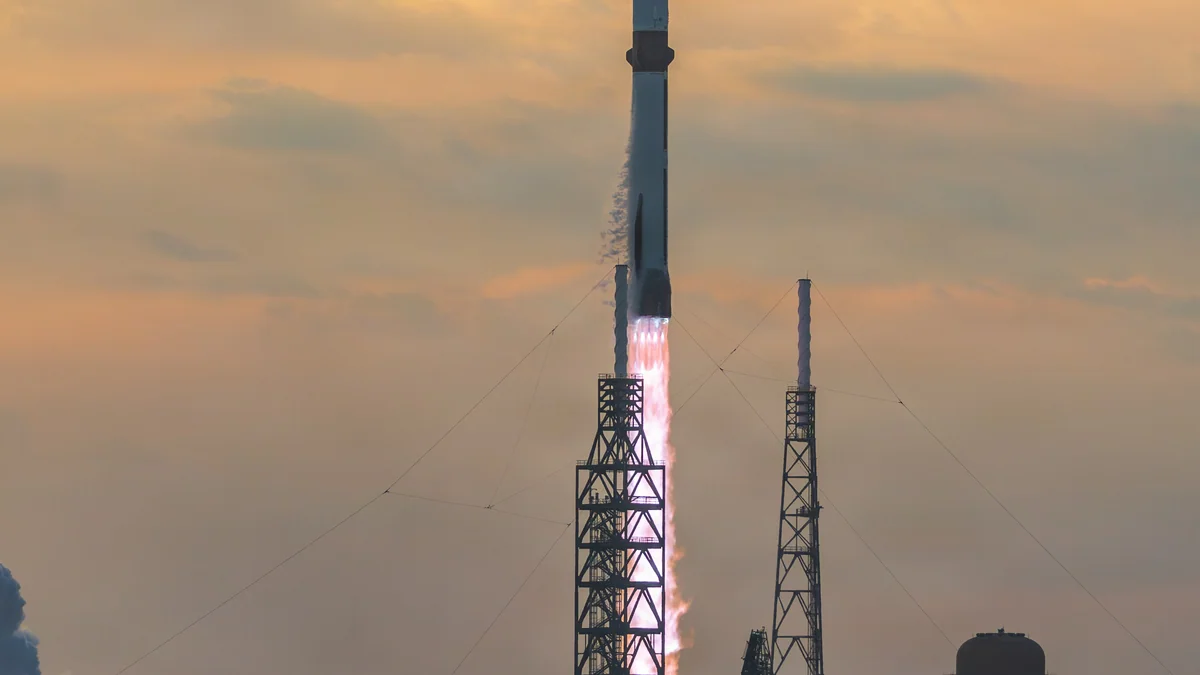
The New Glenn crisis was sparked by a massive engine explosion at Launch Complex 36 on May 28, 2026. This catastrophic failure destroyed Blue Origin’s heavy-lift booster and crippled its launch infrastructure, causing immediate delays to NASA’s Artemis lunar missions and Amazon’s Project Kuiper satellite deployment.
This failure means the 2028 Artemis IV crewed moon landing is now under official review as Blue Origin works to rebuild its pad and certify its BE-4 engines.
If you were standing on a balcony in Fort Pierce, Florida, that evening, the southern horizon did something impossible. A silent, brilliant flash of white-gold light bloomed against the dark Atlantic, visible 185 kilometers away. Seconds later, the air shuddered as the sound of distant violence finally caught up.
This was not a scheduled launch. At Launch Complex 36, Blue Origin was conducting a hot-fire test of its massive, 320-foot New Glenn booster. This ultimate dress rehearsal requires igniting engines at full power while the rocket remains bolted to the ground.
Here is the strange part. The test was meant to verify the seven BE-4 engines that power the first stage. These methane-fueled engines are the mechanical heart of Jeff Bezos’s lunar ambitions, but the evening ended in a catastrophic anomaly that lit up the coast.
The blast was powerful enough to shake homes and mangle the heavy steel of the launch infrastructure. Fortunately, despite the scale of the destruction, no personnel were injured. The humans survived, but the schedule for returning to the Moon just went up in smoke.
Now hold that thought. To understand why a single explosion in Florida matters to a precision factory in Tallinn, we have to look at how this machine was actually supposed to work.
Rockets are Hard: The Anatomy of a Methane Disaster
The heart of this disaster is the BE-4 engine, a masterpiece of engineering that burns liquid methane and oxygen. After a decade of development, these seven engines remain temperamental beasts that refuse to be fully tamed.
This was not the first sign of trouble for the program. In April 2026, New Glenn suffered a partial failure that left an Amazon BlueBird 7 satellite stranded in the wrong orbit. It was a subtle warning that the plumbing of a heavy-lift rocket is a delicate and dangerous web.
The Federal Aviation Administration (FAA) recently reviewed flight data and gave Blue Origin a green light to resume operations. That clearance lasted exactly seven days before the pad at Cape Canaveral became a furnace.
Now hold that thought. A rocket launch or a hot-fire test is a sequence of thousands of perfect events happening in a row. As Elon Musk noted after the blast, "Rockets are hard," because if one valve stutters, the energy of a small city is released instantly.
The disaster at LC-36 shows the yawning gap between a digital blueprint and a functioning machine.
Naming the technical term, the oxygen-rich staged combustion cycle, is easier than managing the literal fire it produces. Ten years of careful assembly were erased in a single, blinding heartbeat.
The New Glenn Crisis and the Artemis Domino Effect
Two days. That is how long the ink had been dry on NASA’s newest contracts with Blue Origin before Launch Complex 36 turned into a literal kiln. After greenlighting two lunar rover missions, the agency watched the vehicle meant to carry them scatter across the Florida scrub.
NASA does not just buy rockets; they buy a schedule. When a heavy-lift booster fails, it is not just one mission that pauses. It is a row of falling dominoes stretching from manufacturing floors to the lunar south pole.
Artemis III has already been downgraded to an Earth-orbit test mission for late 2027. Now, the 2028 target for Artemis IV, our first planned crewed landing since 1972, is under official review. Without a flight-proven New Glenn, that date feels more like a wish than a deadline.
Think of the Blue Moon lander as a specialized cargo ship that is physically married to the specific rocket it was designed to fit. It has no way to get to the water without New Glenn. If the "port" of Launch Complex 36 is closed for repairs, the lander becomes an expensive museum piece.
This reveals what engineers call platform concentration risk. This is the danger of putting all your lunar eggs in one or two very complex baskets. NASA Administrator Jared Isaacman noted the agency will work to assess near-term mission impacts through a thorough investigation.
Now hold that thought. The lunar schedule was already stretched thin before the explosion. This failure turns a necessary sprint into a frustrated crawl.
Amazon’s Empty Sky: The Kuiper Crisis
Imagine 48 grand pianos made of silicon and mirrors, stacked inside a 320-foot tall tube. These are the Project Kuiper satellites, the soldiers in Jeff Bezos’s multi-billion-dollar campaign to wrap the Earth in high-speed internet. When the New Glenn crisis erupted into a fireball, those satellites became high-tech paperweights.
Bezos is effectively racing against his own shadow. He is the founder of Blue Origin, the company that provides the ride, and the leader of Amazon, the customer waiting for it. When the pad turned into a kiln, he became both the grieving engineer and the frustrated client.
The original plan for 2026 was a conveyor belt of progress. Blue Origin aimed for 12 launches this year, a rhythm that would have seen a new rocket piercing the clouds every single month. Instead, the reality for Amazon is currently a hard, silent zero.
Now hold that thought. This is not just a corporate scheduling headache; it is a crisis of global competition. In the race to connect the world’s remote corners, every week of delay is a gift to competitors who already have thousands of satellites in orbit.
The Tallinn Connection: Precision in the Shadow of Giants
We often think of the space race as a duel between billionaires under the Florida sun. However, a critical piece of the lunar puzzle lives in a much quieter place: an industrial district in Tallinn. Here, CPI Vertex Estonia builds the high-precision reflector panels that allow NASA to talk to its lunar hardware.
Today, it is the quiet competence of Estonian engineering where Artur Prees leads a team producing critical equipment for NASA's Moon missions. It is a reminder that every giant leap requires thousands of smaller, perfect steps.
The factory produced two massive 20-meter antennas that serve as the ears of the Artemis program, catching whispers from the Moon. Without this precision, even the most powerful rocket is just a very expensive, very silent firework.
Here is the strange part. A disaster at Cape Canaveral vibrates all the way to the Baltic Sea. It proves that the modern space race is a global machine where every single gear must turn.
Rebuilding the Gateway: The Long Road Back to the Pad
The scale of the destruction at Launch Complex 36 is hard to overstate. When a 320-foot rocket fails during a hot-fire test, it behaves like a small, intentional earthquake. The ground infrastructure is not designed to survive the direct focus of seven BE-4 engines turning into an uncontrolled fireball.
The official damage report reads like a casualty list for heavy machinery. The transporter-erector, the massive steel spine used to lift the vehicle, suffered major structural damage. At least one of the site's lightning towers is now a skeleton of scorched metal.
We often focus on the rocket, but the pad is the real bottleneck. Historical data from SpaceX’s 2016 pad failure suggests a rebuilding timeline measured in many months, or even years. Rebuilding the infrastructure of a spaceport is a marathon of engineering and rigorous safety certifications.
The "why" remains the most elusive piece of the puzzle. We still don't know which specific valve, seal, or sensor within the engine section triggered the anomaly. That, honestly, is the best part of the long, difficult climb toward the stars.
Every era believes it has mastered the flame, yet the universe frequently reminds us of our place. This setback at the Cape is not a closed door, but a mirror reflecting the sheer scale of the task. The New Glenn crisis ensures the moon remains a distant, silent witness to what we still have to learn.