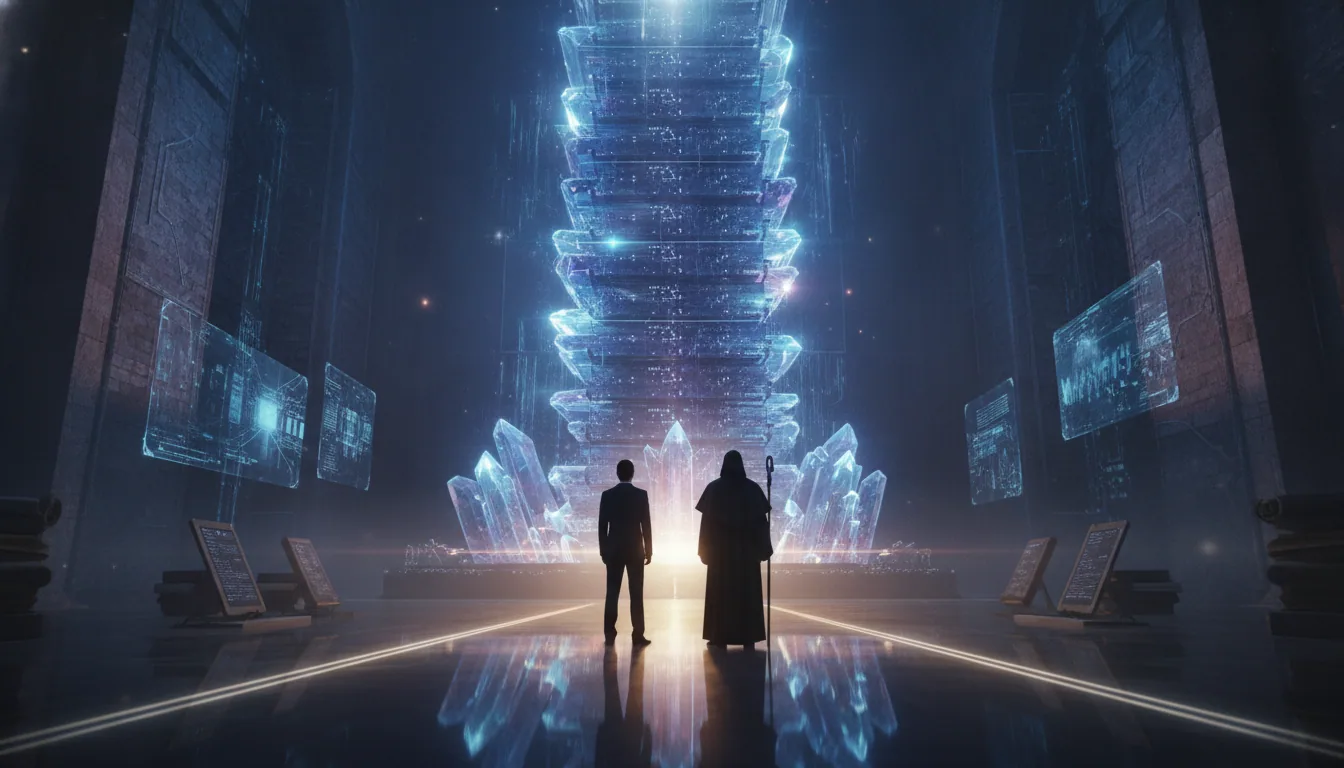
A Tech Executive Walks Into the Vatican
Picture the scene: it is March 2026, San Francisco, and the moral crossroads of AI and religion has taken a concrete form — fifteen Christian leaders sitting across a table from the engineers who built Claude. Not to protest. Not to picket outside. To help. Anthropic had invited them there to talk about ethics, and the clergy had said yes.
That image alone deserves a moment of honest puzzlement. Silicon Valley has spent decades performing a studied indifference to organized religion, treating it as a relic best left to private life. And yet here were the engineers, hat in hand, asking what the theologians thought. A few weeks later, a similar gathering materialized in New York: the inaugural Faith-AI Covenant roundtable, where representatives from both Anthropic and OpenAI sat with faith leaders to draft something resembling shared moral ground. Two rooms, two coasts, one strange new fact about the world.
The hinge the whole story turns on is a single sentence from Anthropic co-founder Chris Olah. Speaking to the assembled Christian leaders, he said: "These are not questions a lab can answer. They are questions traditions like yours have carried for millennia." That is not a diplomatic pleasantry. It is a technical admission. The alignment problem — the deep engineering challenge of making AI behave in ways humans actually want — had finally grown large enough that the people building the systems could no longer pretend the answers lived inside their own walls. They needed something older. The question, which will take the rest of this article to properly unfold, is whether what they found is what they think it is.
The Paper Trail That Started in 2020
The meeting rooms of 2026 look new. The document that made them possible is not. On February 28, 2020, the Pontifical Academy for Life sat down with executives from Microsoft and IBM and produced a founding text: the Rome Call for AI Ethics. ChatGPT did not yet exist. The iPhone had been around for barely thirteen years. The large language model revolution was still a rumor in a few research labs. And yet the document already named the shape of the problem.
What the Rome Call introduced, carefully and with ecclesiastical precision, was a concept called "algorethics." The word is a deliberate compound: ethics are not an afterthought you bolt onto a finished system, but a structural requirement of the algorithm itself, woven in before the first line runs. That framing — ethics as architecture, not decoration — would prove to be the load-bearing idea of everything that followed.
The movement grew. By July 2024, a meeting convened in Hiroshima deliberately extended the Rome Call's reach beyond its Christian origins, drawing in representatives from Buddhism, Hinduism, and Shintoism. The geographic shift from Rome to Hiroshima was not incidental: a city rebuilt from catastrophic destruction carries a different moral gravity than a European capital. Then came 2026, and with it, Pope Leo XIV's encyclical devoted entirely to artificial intelligence — the first papal document of its kind, and the clearest signal yet that the Catholic Church had decided this was not a passing technical fashion but a permanent feature of the moral landscape.
A document signed by a software company and a Vatican academy, four years before most people had heard of a chatbot, now reads less like foresight and more like a map drawn just before the territory arrived.
The Alignment Problem Has an Ancient Address
The alignment problem sounds like an engineering puzzle. It is not. At its core, it is a moral question: when an AI model optimizes for what humans want, whose version of "want" does it follow? That question has no answer inside a codebase.
Sam Altman offered one framing. He proposed that ChatGPT should reflect, in his words, the "weighted average of humanity's moral views." The ambition is pragmatic and arguably democratic. The implication is either reassuring or troubling, depending on which tradition you belong to, and how much weight it gets in that average. A minority faith, a devout community, an ancient ethical framework built around obligation rather than preference — all of them compress into a single floating-point value somewhere in the middle.
This is why the turn toward religion is not merely symbolic: the labs are outsourcing a question they genuinely cannot answer in-house — what should an intelligent system value when human values conflict?
Here is where the picture gets complicated. Anthropic spent 2026 hosting summits with clergy, positioning itself as a company that takes moral seriousness seriously. During the same period, the company was entangled in a high-profile legal dispute with the U.S. Department of Defense — the full outcome of which remains undisclosed. The two facts sit side by side without canceling each other, but they complicate the branding. A lab can seek ethical counsel and also face hard questions about its own behavior. That tension is not a reason to dismiss the religious outreach. It is, however, a reason to look at it with clear eyes rather than just admiration.
What Religious Traditions Bring to AI Ethics
In a small church in Lucerne in 2024, a person sat down in front of a screen, looked into the face of an AI-rendered Jesus, and began to confess. The Swiss trial — quickly nicknamed "AI-tite" by the press — was not a stunt. It was a question made physical: can a machine carry sacred weight? The traditions that tech executives have been courting lately have some very specific, very old answers.
Islamic scholars approaching AI ethics do not begin with abstractions. They begin with two tested instruments. Maslahah, roughly "public interest," asks whether a technology serves the common good of the community. La darar — harm prevention — asks what it damages. Together they form a practical checklist that predates the transistor by twelve centuries. When an Islamic legal body evaluates an AI hiring system or a medical diagnosis tool, it is not offering a blessing. It is running a calculation with variables that engineers have simply never had to name before.
Jewish Halakhic reasoning arrives at a harder boundary. A rabbi is not just a rule-applier; a rabbi has da'at, conscious intention, the awareness of what an act means in the moment of its performance. AI, in this framework, is not insufficiently educated. It is categorically absent. No amount of fine-tuning produces a soul, and without a soul certain acts — legal rulings, spiritual counsel, moral witness — cannot be performed. That is not a rhetorical flourish. It is a philosophical load-bearing wall.
Then there is this: an academic physics paper published in October 2026 listed ChatGPT 5.5, 5.6, and 6 as contributors. Not sources. Contributors. Here is the strange part: the paper was about a physical process, not ethics at all. But the moment you list a model as a contributor, you have made a claim about intention, authorship, agency. The traditions had a word for that problem long before silicon existed.
The most consequential moral engineering project in human history is, at its core, still a black box.
The Complications Nobody Put in the Press Release
Webb Keane, an anthropologist at the University of Michigan, offers the most precise critique of the whole project. There is, he notes, a very conventional way of thinking about religion as a rule book, and that way of thinking turns out to describe the Abrahamic traditions specifically. Buddhism, Shinto, many indigenous cosmologies — these do not organize faith as a portable set of propositions you can lift out and hand to an engineer. When tech companies convene their panels of advisors and distill "religious ethics" into training data, they are mostly harvesting one branch of the world's moral forest and calling it the grove.
The political volatility surfaced faster than anyone planned. Ron DeSantis, reacting to reports that Anthropic had invited religious leaders to effectively "bless" the Claude model, called the idea "creepy AF." His phrasing was blunt, but his instinct named a real fault line: the moment a tech company begins associating its product with sacred authority, it has walked into one of the most contested territories in democratic politics. That is not a problem you solve with a better press release.
Two quieter risks sit underneath the louder ones. The first is that the entire consultation exercise amounts to institutional legitimacy-building — a way of borrowing the moral credibility of ancient traditions to soften regulatory and public scrutiny, rather than genuinely subjecting the technology to outside judgment. The second is stranger and harder to audit. AI models trained on the full breadth of internet text may already be generating what researchers call theological drift: interpretations of religious doctrine that no tradition authorized, assembled from online noise, delivered with the confident tone of a textbook. Nobody commissioned that theology. Nobody can easily find where it came from.
The Question the Algorithm Still Cannot Answer
Anthropic consulted 15 religious and cross-cultural groups to shape Claude's moral development. Which 15? The company has not said. How conflicts between their doctrines are resolved, whether a Catholic position on personhood quietly outweighs a Buddhist one on impermanence, whether any of it moves a single weight in the model — none of that is publicly documented. The most consequential moral engineering project in human history is, at its core, still a black box.
Sam Altman's phrase is the most honest accidental admission in the whole story. A "weighted average" of humanity's moral views is not wisdom. It is arithmetic. It will, by design, sand down the edges of every tradition that disagrees with the mean, and call the residue ethics.
And yet here is the thing that refuses to be dismissed: the most powerful predictive engines our species has ever built are now sitting across the table from its oldest meaning-making institutions. The moral crossroads of AI and religion is not a metaphor — it is a series of actual rooms, actual tables, and genuine questions that neither side knows how to answer alone. Neither side fully understands the other. Nobody in the room knows how the story ends. That may be the most human situation imaginable.