A Ceasefire Line Built to Be Disputed
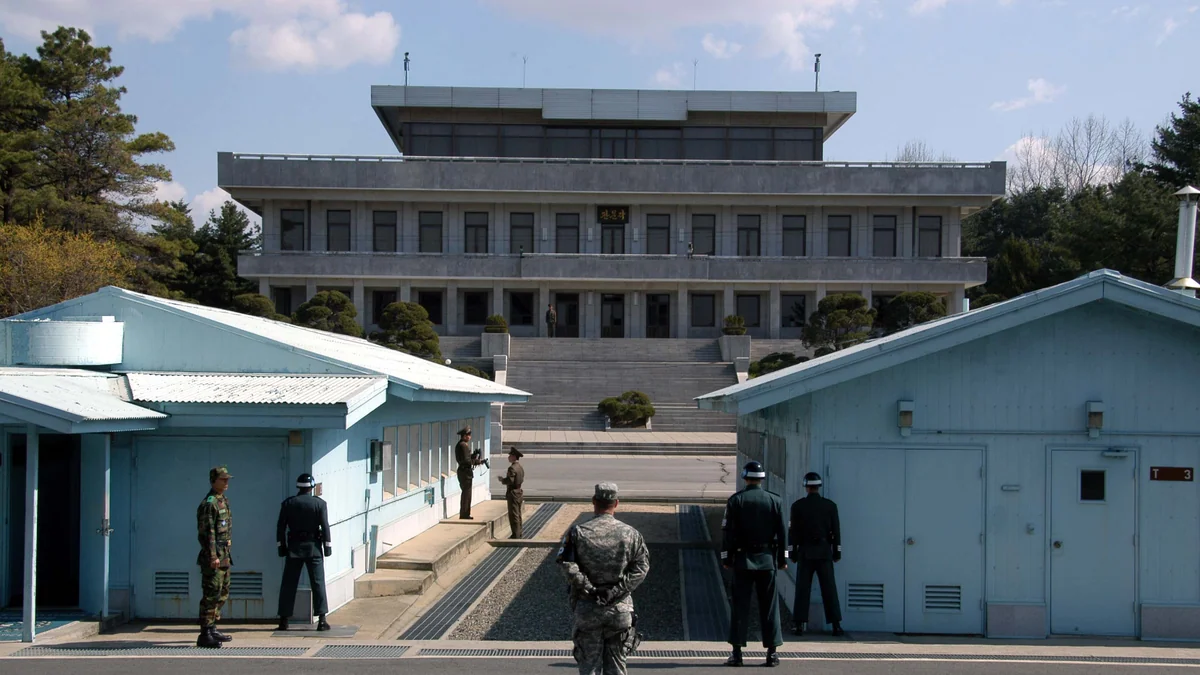
South Korea's proposal to North Korea — issued 23 October 2026 — is a request to find a line that both governments claim to know. The armistice signed at Panmunjom on 27 July 1953 ran to sixty-three pages and settled, among other things, the exact course of the Military Demarcation Line across the peninsula. It settled nothing else.
No peace treaty followed. The lawyers went home, the wire went quiet, and two states were left administering a technical war as though it were a permanent weather condition.
That condition has now lasted seventy years. The physical markers planted along the MDL in 1953 have not survived the intervening decades intact. Seasonal flooding shifts soil. Military engineering work moves earth. The markers that remain are not always where the maps say they are, and in several stretches of the western DMZ the question of exactly where the line runs is not cartographic pedantry but the difference between a patrol and an incursion.
This is not an accident of neglect. The armistice's load-bearing flaw was always the absence of a final political settlement to give the line legal permanence. What the agreement produced was a military convenience, not a recognised international boundary. North Korea crossed the MDL fifty times in 2024, Seoul reported, while conducting fortification work. Pyongyang's answer was that its army knows its own borderline. Both claims cannot be simultaneously verified, because no agreed verification mechanism exists. The 1953 document created the problem it was supposed to solve, and every subsequent decade of landmine-laying, flooding, and fortification has made the original ambiguity structurally load-bearing in a way neither side can now simply wish away.
What Seoul's Proposal to North Korea Actually Contains
The proposal itself is narrower than the political framing around it suggests. On 23 October, Deputy Minister Kim Hong-cheol stood before cameras and invited North Korean authorities to meet at Panmunjom for one specific purpose: to mutually confirm the precise location of the ground Military Demarcation Line. Not unification, not denuclearization, not a peace treaty. A surveying exercise, in effect — an acknowledgment that the line separating two armies has become, in places, genuinely uncertain.
Attached to that core request were two further elements. Seoul proposed restoring the military communication hotlines that Pyongyang severed, and establishing protocols to prevent accidental clashes. Kim Hong-cheol added that South Korea was open to three-way talks involving the United Nations Command, the body nominally responsible for the 1953 armistice. The UNC's inclusion is not decorative; it is the only mechanism that carries legal standing under the armistice framework, which no one has replaced in seventy years.
Behind the technical language sits a political architecture. President Lee Jae Myung, who took office in June 2025, proposed a formal end to the Korean War in August 2026, the first South Korean leader to frame the peninsula's problem explicitly as an unresolved war rather than a frozen unification contest. That framing matters. His predecessor, Yoon Suk Yeol, ran his inter-Korean policy under the banner of a "freedom-based unification" doctrine — a formulation Pyongyang predictably ignored.
Lee has changed the vocabulary. Pyongyang's disposition toward Seoul has not changed at all. The same capital, different Seoul: that asymmetry is the load-bearing fact, and the October proposal sits entirely within it.
The Ground That Prompted the Question
Three South Korean soldiers were wounded by landmine blasts in the western DMZ on 21 September 2026. The mines were North Korean. The precise locations where they were laid are not fully known — not to Seoul, not to Pyongyang, and not to the United Nations Command, because seasonal flooding shifts ordnance across terrain that no complete map covers. That is the operational reality behind the diplomatic language.
North Korea is estimated to have laid approximately one million landmines along the border. The number is an estimate because nobody has finished counting, and the counting cannot finish without access that does not exist. What is known is the pattern: in 2024 alone, North Korean soldiers crossed the Military Demarcation Line fifty times during fortification work. Fifty times, in a single year, on a border both governments claim to know precisely.
The physical construction tells its own story. Anti-tank walls, reinforced fencing, tactical roads — Pyongyang is not building infrastructure for a border it expects to dissolve. It is building infrastructure for a border it intends to hold permanently, and has said so explicitly since early 2024, when it abandoned reunification as a stated goal and designated South Korea its primary enemy.
Seoul's invitation to confirm the MDL's exact location is, read from this angle, a practical safety request wrapped in diplomatic form. Three wounded soldiers and a million mines of uncertain position have a way of concentrating the mind on cartography. The question Seoul is really asking is not about sovereignty — it is about which patch of ground will injure the next patrol.
Pyongyang's Answer, Delivered Before Seoul Finished Speaking
Kim Yo Jong called it "the climax of the farce." The phrase landed before any formal Pyongyang response had been issued, which was itself the response. On 21 October 2026, two days before Seoul's invitation was even on the table, North Korean military units moved into firing positions along the border. The sequence mattered: the counter-move preceded the move it was supposedly countering.
Pak Jong Chon, the senior military official, supplied the institutional gloss. "Our army knows where our borderline is better than any others." Taken literally, it is a cartographic claim. Taken structurally, it is a refusal to accept that any demarcation question exists at all — and therefore that any talks about it could be legitimate. Kim Yo Jong added the operational dimension: loudspeaker psychological warfare broadcasts would resume along the entire border in October 2026, every kilometre of it.
The backdrop against which all of this lands had been set two years earlier. In early 2024, North Korea formally abandoned the reunification goal it had carried, at least as nominal doctrine, since the division itself. South Korea was reclassified not as a wayward brother-nation but as the primary enemy. Monuments to reunification in Pyongyang came down. The constitutional amendment made the two-state reality permanent in law.
That is the load-bearing wall. Every dialogue offer Seoul has made since then, however modest in scope, arrives addressed to a state that has legislated the conversation out of existence.
Seoul asked about a surveying problem. Pyongyang repositioned its guns.
The Wider Board: Kyiv, Moscow, and a Submarine in the Sea of Japan
Read the Korean peninsula as its own story and you miss half the mechanism. Compare it to the European theatre and the mechanism becomes legible.
Russia has reportedly supplied electronic jamming equipment to North Korean forces — materiel tested in the Kyiv theatre, now cycling back toward the Yalu. The direction of that transfer matters more than its quantity. It describes a relationship no longer transactional but structural: Pyongyang is not a customer, it is a junior partner receiving technology it could not develop at the required pace, and junior partners accumulate obligations.
Seoul noticed. In October 2026, South Korea partially withdrew embassy staff from Ukraine over a diplomatic row concerning North Korean prisoners of war — a row that, whatever its proximate cause, sits at the intersection of three countries' secrets. How many North Koreans fought, under what command, and what Russia owes Pyongyang for the service: those are the questions neither Seoul nor Moscow has any interest in answering publicly, and the partial staff withdrawal signals that the answers have begun to surface.
On 22 October 2026, forty North Korean government websites went dark. The cause remains unconfirmed. The timing — one day before Seoul's formal inter-Korean dialogue offer, concurrent with Kim Yo Jong's loudspeaker announcement — was conspicuous enough that no intelligence service on the peninsula will have ignored it.
The Hero Kim Kun Ok, North Korea's largest submarine, fired cruise missiles into the Sea of Japan the same week. The message was not obscure. Somewhere a spreadsheet was quietly updated.
The One Line Worth Watching
As of 23 October 2026, Pyongyang has issued no formal reply to Seoul's October proposal through any official channel. That silence is data. A written refusal — Kim Yo Jong's preferred instrument — would at least confirm the message was received as a diplomatic act. Silence refuses even that acknowledgment.
The marker worth watching is not whether talks happen. It is the verb, if Pyongyang ever counters. Read the single operative clause in any North Korean response: if it says shall confirm the MDL's location, someone in Pyongyang has accepted a binding frame. If it says may discuss, the structure holds nothing.
Fifty MDL crossings in 2024, one million landmines with no shared map, three soldiers wounded in September — the operational risk is not theoretical. Yet the load-bearing wall here has never been cartographic. It has been the decision, made in Pyongyang and ratified in silence for seventy years, that technical war is preferable to any arrangement that requires recognising the other state as a state.
South Korea's proposal to North Korea to confirm the line amounts to a request that the postponement acknowledge itself. Seventy years of that arrangement is not stability. It is a postponement wearing stability's coat — and postponements, as the record shows, do not expire gracefully.