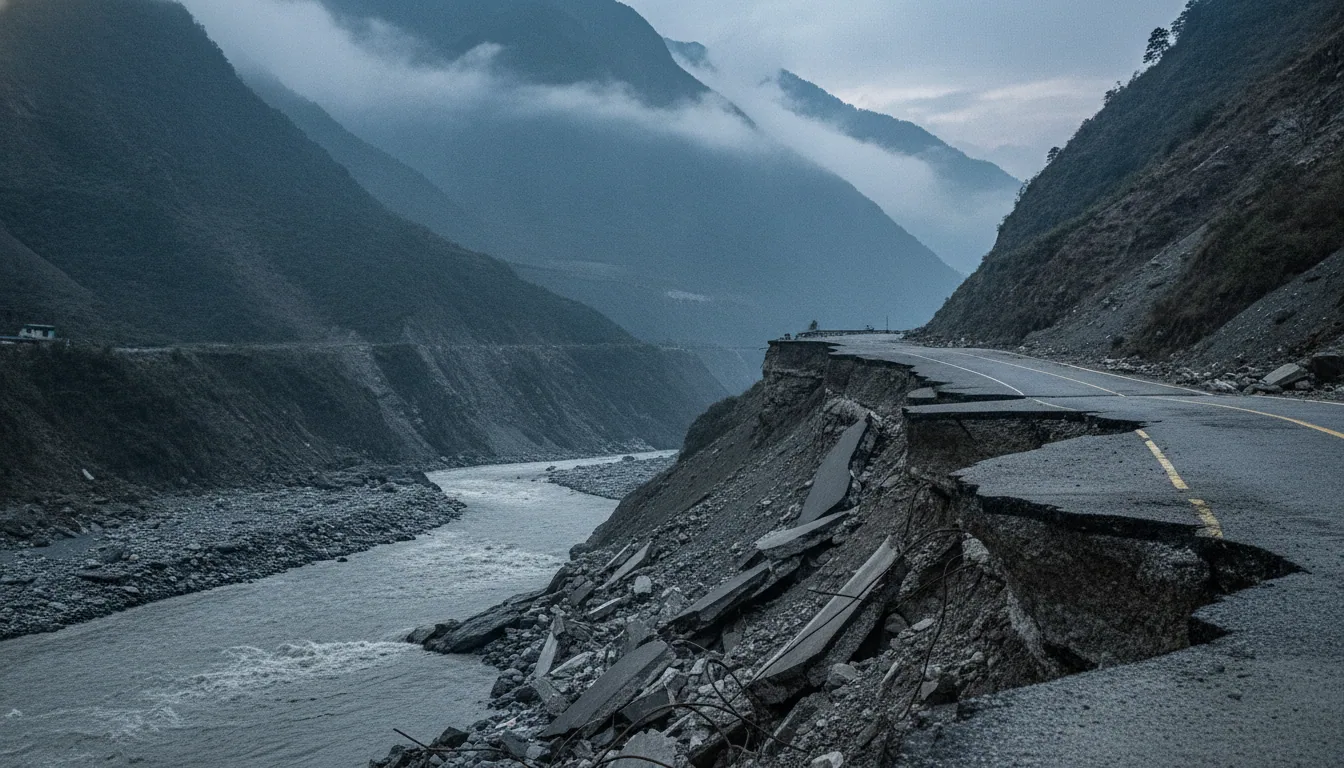
The Progress Is Real — and It Falls Short
Last year, renewable energy capacity grew three times faster than projections made a decade ago — progress that arrived too late to preserve the Paris Agreement's 1.5°C target. That is not a rounding error or an optimistic press release. It is a measured, verifiable shift in how quickly the world builds clean power when policy, finance, and falling costs align.
The policy signal is just as striking. Sixty-three countries cut their greenhouse gas emissions over the past decade through deliberate national measures, not by accident or economic collapse, but by choosing different levers. That is proof the mechanism works. Governments that decide to act can move the needle.
And yet the needle has not moved far enough. In 2025, total global greenhouse gas emissions fell by just 0.1 gigatonnes, a margin so thin it could disappear in a revision.
More telling: fossil fuel CO2 emissions did not fall at all. They rose. The energy transition and the combustion economy are running in opposite directions at roughly equal speed, and right now they are nearly canceling each other out.
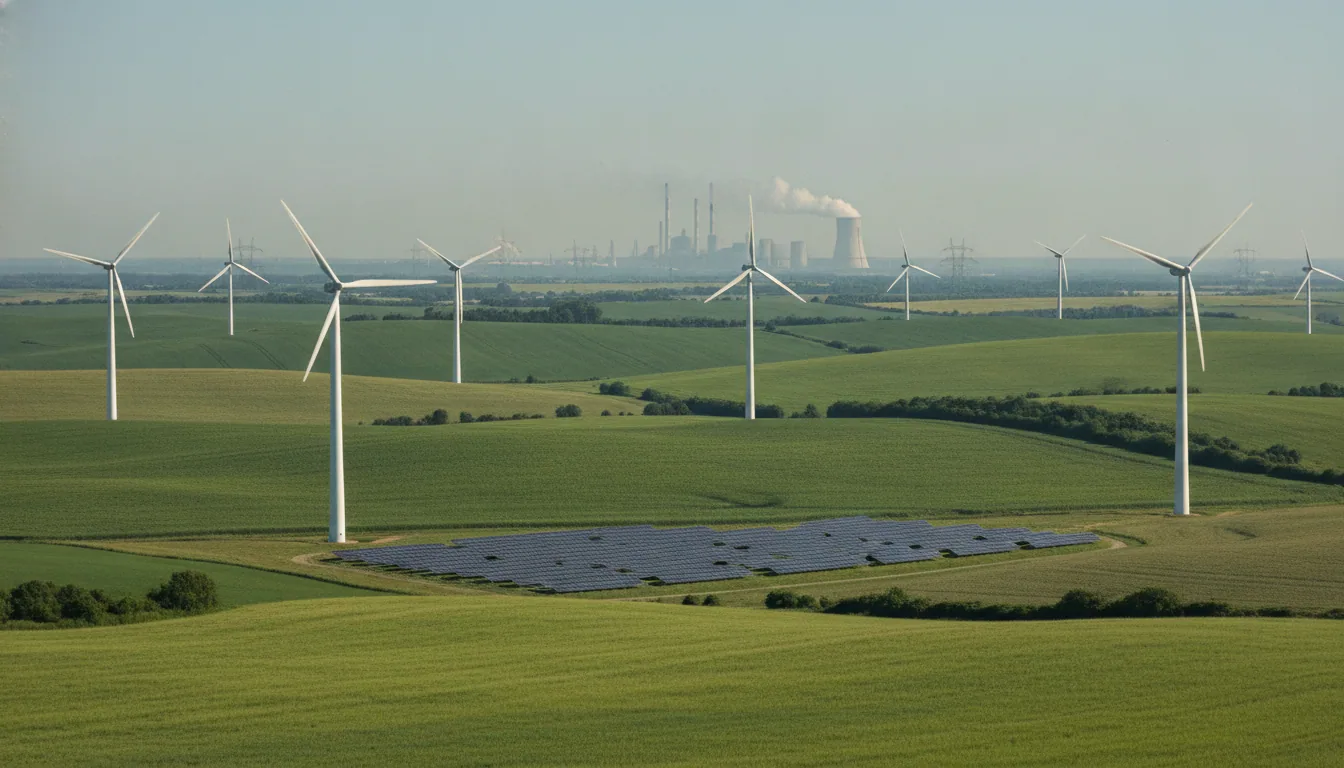
This is the split the data actually shows. Electricity grids are greening faster than anyone predicted. The rest of the economy, including heavy industry, shipping, agriculture, and road freight, is not. Renewables are a genuine lever. They are not yet a large enough one.
The honest read is neither despair nor celebration. A real and rapid transition is underway in one slice of the global energy system. It is not yet touching the slices that still drive the bulk of emissions. Understanding that gap is the only useful starting point for whatever comes next.
The Official End of the Paris Agreement's 1.5°C No-Overshoot Pathway
The calendar year 2024 ended at 1.55 to 1.60°C above pre-industrial levels, confirmed by the Copernicus Climate Change Service and the World Meteorological Organization. That made it the first full calendar year in recorded history to breach the 1.5-degree threshold. The number is striking, but it is not yet the legally meaningful one.
Scientists and policymakers have always used a 20-year running average to define the Paris climate accord's temperature ceiling, not a single anomalous year. One hot year does not officially close a target. What closes it is the longer trend, and on October 21, 2026, UNEP closed it formally: the "Emissions Gap Report 2026" states plainly that limiting warming to 1.5°C with no or limited overshoot is no longer viable. "The opportunity to bridge the 1.5°C emissions gap with 'no or limited' overshoot has been lost," the report reads.
The 20-year average is projected to permanently cross 1.5°C by May 2029. That is the breach with real consequences: the one that triggers the scientific consensus that the no-overshoot window is shut. The distinction matters because it separates a bad year from a structural shift.
This is the structural shift.
The practical difference between these two numbers is not academic. A calendar-year breach can be argued away as weather noise, an El Niño spike, a statistical outlier. A permanent 20-year average breach cannot.
It means the baseline has moved. Every fraction of a degree above that line, and every year spent there, raises the risk of crossing physical tipping points that no policy instrument can reverse.
The question is no longer whether we breach 1.5°C. It is how high we go and how fast we come back.
The New Best Case: Peak at 1.7°C, Then Back Down to 1.5°C by 2100
Two numbers define the new terrain. Under maximum government ambition — every major economy delivering on the strongest version of its pledges — temperatures peak at 1.7 to 1.8°C somewhere around mid-century before declining to 1.5°C by 2100. Under current national policies, the trajectory runs to 2.6 to 3.1°C by end of century. That is not a difference of degree. That is a difference of world.
The 1.7°C peak scenario is the best case, not the expected case. "If governments act with the highest possible ambition, we can halt global warming by mid-century close to 1.7°C," Bill Hare of Climate Analytics told reporters. Current national pledges would reduce emissions by only 11 to 15% by 2035, against the 45% the science requires.
Here is what the overshoot window means in practice. Every additional fraction of a degree, every additional year above 1.5°C, raises the probability of crossing irreversible tipping points — ice sheet destabilization, permafrost carbon release, coral system collapse. These are not reversible by a later return to 1.5°C.
The damage accumulated during the overshoot period is damage banked permanently. A temperature that comes back down does not un-bleach a reef or re-freeze a glacier.
The practical implication is blunt. The choice in front of governments is not between 1.5°C and something worse. It is between a manageable overshoot peaking near 1.7°C and a fundamentally different, more dangerous world settling above 2.6°C. The distance between those two outcomes is made entirely of policy decisions that have not yet been made.
The distance between those two outcomes is made entirely of policy decisions that have not yet been made.
The 320-Gigatonne Question: Carbon Removal Has Never Scaled
Picture a warehouse. Now picture 320 billion of them, each holding one tonne of CO2 pulled clean out of the sky. That is the arithmetic of return: to bring global temperatures back down to 1.5°C by 2100, roughly 320 gigatonnes of carbon dioxide must be physically extracted from the atmosphere. For scale, that is approximately five and a half years of every smokestack, tailpipe, and rice paddy on Earth running at once.
The technology to do this exists. Direct air capture machines are pulling CO2 out of ambient air in Iceland and Texas. Enhanced weathering is being tested on farms in the American Midwest.
Reforestation programs are planting at scale across three continents. None of them, individually or combined, have ever removed more than a few million tonnes in a single year.
A million tonnes sounds large. Against 320 billion, it is a rounding error. The honest case for Carbon Dioxide Removal is not that it is ready — it is that the math now requires it.
Every credible return pathway runs through CDR. It is no longer a backstop, the insurance policy nobody expected to use. It is load-bearing.
The question is not whether to build this industry but how fast, at what cost, and by whom — because those answers do not yet exist at the scale the physics demands. That gap between prototype and gigatonne is where the next decade of climate engineering either succeeds or quietly fails.
The Gap Between What Countries Promised and What Physics Requires
Compare the ambition on paper with the ambition the atmosphere requires, and the number that emerges is 16 gigatonnes per year. Current national pledges would cut emissions by only 11 to 15% by 2035. The return pathway demands 45% by 2035 and 69% by 2040, both measured against 2025 levels.
That gap does not close by distributing responsibility evenly. G20 nations account for 76% of total global emissions. They hold, therefore, exactly 76% of the practical mitigation potential. Every diplomatic framing that spreads the burden across 195 countries obscures a simpler arithmetic: the nations at that table are the lever, and the rest of the world cannot pull it for them.
The United States' retreat from climate policy in 2026 makes this concrete. A single actor's policy shift is estimated to add approximately 0.1°C to long-term warming projections. That fraction sounds small. It is the equivalent of partially erasing several years of collective decarbonization effort by every other country combined.
The science requires 18% cuts by 2030. Current pledges would deliver roughly half that. The honest framing is not that governments have failed to try — 63 countries reduced emissions over the past decade through real policy measures.
The honest framing is that trying at insufficient scale produces a gap as surely as not trying at all. Physics does not grade on effort.
That is not a gesture. That is a lever. And the lever is currently being held loosely, at the G20 level, in the years between now and COP31.
The Honest Scorecard: What Is Actually Worth Doing Before COP31
COP31 convenes in Turkey in November 2026. It is the next formal moment for governments to raise or confirm their ambition, and the math entering the room is unambiguous: current national pledges cover only 11 to 15 percent of the required 2035 emissions cut, leaving a 16-gigatonne gap. That gap does not close with consumer choices and corporate sustainability reports.
The lever is G20 governments. Twenty nations excluding the African Union account for 76 percent of total global emissions. A 45 percent cut in global emissions by 2035, relative to 2025 levels, is the minimum the physics requires to minimize overshoot. Every NDC that falls short of that target is not a stepping stone. It is arithmetic subtracted from a finite budget.
That's not a gesture. That's a lever. What moves the needle before COP31 is specific: governments must submit NDCs aligned with the 45 percent trajectory, unlock public finance for gigatonne-scale CDR, and stop subsidizing combustion.
Businesses can price carbon into capital allocation and fund removal credibly, not as an offset for continued emissions. Engaged citizens and advocacy organizations can push for those NDC revisions directly, since the 2026 submission window is open now.
The Paris Agreement's 1.5°C no-overshoot pathway is closed. The 1.7°C peak-and-return pathway is still open, but only if G20 ambition rises sharply in the next twelve months. That is the proportionate to-do list. It is not comfortable, but it is honest and it is actionable.