The Drone That Flew 1,250 Kilometres and Rewrote the Range Tables
On 18 January 2024, a Ukrainian drone struck the St. Petersburg area — approximately 1,250 kilometres from its launch point. Russia's air defence intercepted it. The debris fell on terminal grounds and caused an explosion anyway. Oleksandr Kamyshin, Ukraine's Minister of Strategic Industries, confirmed the range on the record, which is how we know the number is not a rumour.
That single flight rewrote the strategic map more quietly than any press conference could. St. Petersburg had functioned, for the first thousand days of the full-scale war, as a sanctuary city — too far, the assumption ran, for anything Ukraine could put in the air. The January drone retired that assumption. What interception proved, in the event, was not that the city was safe but that safety and interception are not the same thing.
The July 4 strike on the same terminal — Day 1,592 of the war, as EA WorldView logged it with the flat bookkeeping that long wars require — is best understood against that January baseline. It is not an aberration. It is a point on a line that has been drawing itself steadily northward and westward since the range tables changed. Repeat strikes on the same target rarely announce a capability; they demonstrate one, which is a different kind of statement. The January 2024 drone asked whether the distance was possible. The July 2026 strike, the second on this terminal in a single month, has moved on to a more practical question: what, exactly, can be taken apart from here, and at what pace.
What Happened on the Night of 4 July 2026
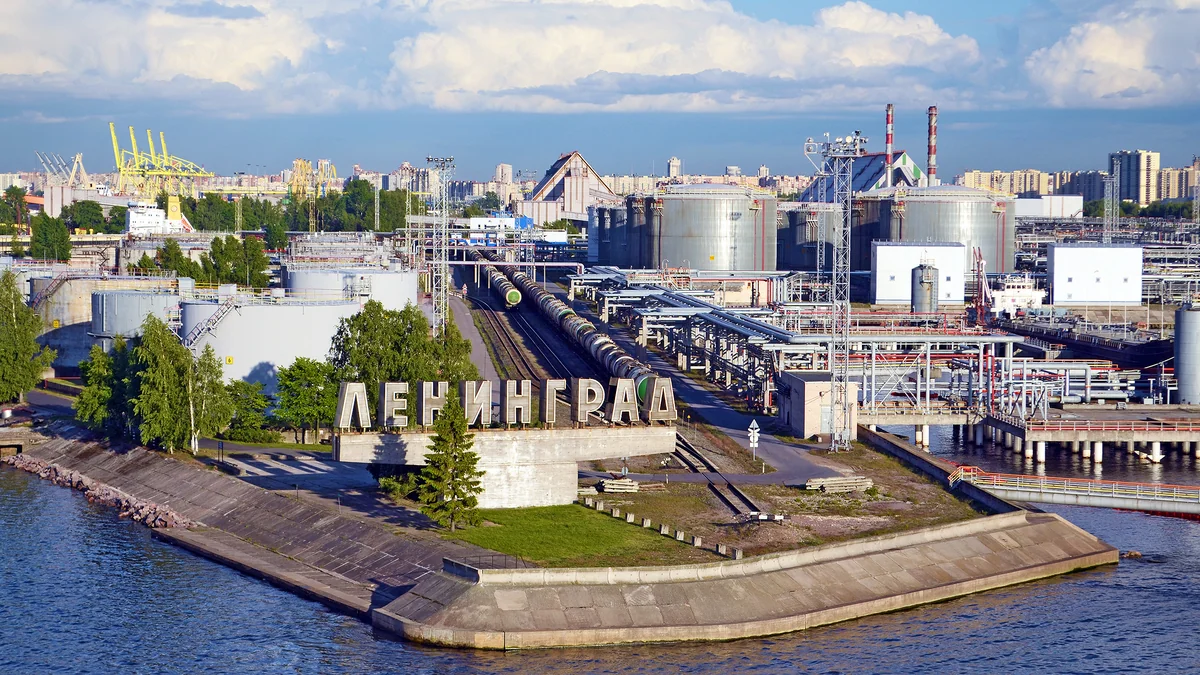
Ukrainian drones struck the St. Petersburg oil terminal on the night of 3–4 July 2026. The target was the Kirovsky district facility, one of the Baltic's largest petroleum transshipment nodes. Multiple fires broke out, confirmed independently by Reuters, the Kyiv Independent, and RBC Ukraine before the morning cables ran.
The operation was not improvised. Ukrainian Special Operations Forces, the unmanned systems forces, HUR and the SBU conducted the strike as a coordinated action. The SBU reported at least three separate fire seats on terminal territory — three points of ignition, not one lucky drone finding a tank farm.
Social media footage showed thick smoke rising over Ugolnaya Gavan, the Coal Harbour district, visible from across the water. Governor Alexander Beglov confirmed the attack on the Kirovsky district and stated there were no casualties. The second part of that statement is, at minimum, the part Russia controls.
Volodymyr Zelenskyy confirmed the operation and described it in two words: "long-range sanctions." The phrase is compressed but precise. Ukraine has no seat at the table where Russian petroleum revenues are counted. It is building its own accounting ledger.
Russia's Ministry of Defence claimed 72 drones were shot down over the Leningrad region. The claim does not preclude the fires — debris reaches targets, and the SBU's three confirmed fire seats were not Russian propaganda. The arithmetic of 72 intercepted drones and a burning terminal is not, in fact, contradictory. It is the arithmetic of saturation: you send enough, some arrive.
The drones flew over 850 kilometres to reach the terminal. A coordinated strike, three fire seats, the governor's own confirmation — the operational record is not ambiguous. What remains contested is the depth of the damage.
Ukraine's Drone Campaign: Seventy-Two Shot Down, Three Fires Still Burning
Russia's Ministry of Defence reported 72 drones intercepted over the Leningrad region on the night of 4 July. Three fire seats burned on the terminal grounds. The arithmetic is not as contradictory as the MoD intends it to sound.
The practical logic of a large swarm is not that every drone reaches its target. It is that a large enough wave degrades interceptor capacity — radar operators, missile stocks, processing time — so that the vehicles carrying the actual strike packages find degraded defences at the threshold. Attrition in transit is the expected cost of the design, not evidence that the design failed. The SBU's three confirmed fires are the result column; the 72 claimed intercepts are the input column.
The flight path adds a further layer. These drones crossed more than 850 kilometres to reach Kirovsky district — over contested airspace, through layered regional air defences, across a geography that narrows and complicates every routing decision. That they arrived at all says something measurable about the programme's current state. Kronstadt naval base was reportedly struck during the same night's operation, which suggests the wave was not aimed at a single node but at saturating the broader military-industrial geography of the Gulf of Finland.
Ignore the MoD's intercept headline. Watch instead the fire report. Seventy-two drones claimed and three fires confirmed is not a Russian success story. Somewhere a duty officer in Leningrad oblast filed a damage assessment that will not appear in the ministry's next press release.
When the Forum Opened, the Terminal Was Already Burning: The June Precedent
The St. Petersburg International Economic Forum opened on 3 June 2026 to the usual pageantry — ministers at podiums, investors in corridors, the ritual performance of Russian economic confidence. Across the city, the same oil terminal that would burn again on 4 July was already on fire. Thick smoke over Ugolnaya Gavan is not, as a rule, part of the investment brochure.
That same night, the drone wave that reached St. Petersburg also struck Moscow and hit a strategic military factory in Tambov oblast. It was not a single opportunistic probe. It was a coordinated campaign across multiple target sets, run in one night, against three separate nodes of Russia's war economy and political symbolism alike.
The timing of the June strike was not accidental. SPIEF is the Kremlin's flagship forum for projecting normalcy — the argument, rehearsed annually, that the Russian economy endures, that partners remain, that the war is a manageable condition and not a systemic wound. A burning terminal one district away makes that argument harder to sustain. Somewhere a communications official quietly revised the talking points.
What June established, July confirmed. Two strikes on the same terminal within thirty-one days is not coincidence and not opportunism. It is a pattern — deliberate, repeated, methodical. Ukraine is not probing for weakness in St. Petersburg's air defences. It has already found the target worth revisiting. The question the June precedent forces is not whether Kyiv can reach this terminal. It is whether Russia can repair it faster than Ukraine can burn it again.
Two strikes on the same terminal within thirty-one days is not coincidence and not opportunism. It is a pattern — deliberate, repeated, methodical.
The Load-Bearing Wall: What the St. Petersburg Terminal Actually Finances
Twelve and a half million tonnes of petroleum products per year. That is the terminal's listed throughput capacity, placing it among the largest transshipment hubs on the Baltic Sea. Compare it to a symbolic target — a railway bridge, a command building, a radar dish — and the distinction sharpens immediately: those are moulding. This is load-bearing.
RBC Ukraine described the facility plainly as an important source of revenue for Russia's military budget. The formulation is blunt by the standards of Ukrainian official communications, which tend toward the operationally cautious. When a state's own war journalists name an oil terminal as a direct line to the defence ledger, the logic of the target becomes less a matter of interpretation than arithmetic.
The September 2025 Kirishi strike belongs in the same column. Ukrainian drones hit the Kirishi oil refinery in Leningrad oblast on 14 September 2025, one of Russia's largest refining facilities. A terminal transships; a refinery processes. Together they represent consecutive links in the same chain — crude refined inland, product moved to port, revenue transferred to Moscow. Strike one link and the chain strains. Strike both, in the same oblast, within the same year, and a pattern of systematic interdiction replaces the language of isolated incidents.
The honest comparison is to the 1944 Allied oil campaign against German synthetic fuel plants — not because the scales are equivalent, but because the underlying logic is identical: a modern military runs on refined revenue, and the way to count its losses is not in soldiers but in barrels never loaded.
Watch the Shipment Data
The precise volume of petroleum destroyed or permanently lost across three documented strikes on the St. Petersburg terminal remains unconfirmed. Whether the facility resumed full operations between June and July 2026 is not publicly established. Those two gaps are not minor footnotes; they are the difference between a symbolic campaign and a structural one.
The specific drone models used on the night of 4 July are unknown. Whether Russia upgraded the terminal's air defences after the June strike is equally unresolved. Russia's Ministry of Defence claimed 72 drones shot down over the Leningrad region — a figure that is neither verifiable nor, by itself, meaningful, since debris from an intercepted drone reaches the ground regardless, and fires still burned in three documented locations on the terminal's territory.
The cumulative financial loss to Russian state revenues attributable to all three strikes has not been calculated in any public source. That number, when it surfaces, will matter more than any single night's smoke footage.
Ignore the damage assessments issued within hours of the strike. Watch Baltic Sea petroleum export volumes routed through St. Petersburg in the weeks that follow. The data exists: tanker-tracking services log departure volumes from the Great Port of St. Petersburg against declared cargo. If those figures fall and stay down through August, the Ukraine drone strikes are structural — the terminal's throughput capacity is genuinely degraded, not temporarily disrupted. If volumes recover within a fortnight, the damage is cosmetic. That is the one checkable marker. Everything else, for now, is moulding.