The One Color Stars Are Not Supposed to Be
Look up at a clear sky long enough and you will see red giants, blue-white supergiants, pale yellow dwarfs like our own Sun — but never a green star. Not because green light doesn't exist in starlight. It does. But the moment a star emits a broad thermal glow, the colors blend, and the human eye resolves the mixture into white or yellow or blue, depending on temperature. Green gets swallowed by its neighbors every time. The rule isn't a coincidence. It falls directly out of how hot objects radiate, the physics captured in Wien's displacement law: temperature sets the peak wavelength, but the full spectrum drowns the peak color before your eye can name it.
Amateur astronomers have reported "green stars" for centuries, of course. Each one turned out to be a trick of contrast, two stars in a binary pair where the orange companion makes the other look faintly greenish by comparison. Your eye fabricating a color the star wasn't actually producing.
On October 16, 2026, that long clean record broke. Astronomers announced WD J1330+6435, a white dwarf in the constellation Draco, between 280 and 326 light-years from Earth, that is genuinely, measurably, physically green. Not an illusion. Not a mismatched binary. The star itself wears chartreuse, and the reason it can do what no star was supposed to do is, honestly, stranger than the color itself.
A Small Chartreuse Light in the Dragon's Eye
The star's name is not poetic. WD J1330+6435 is a catalog designation, a string of coordinates that points a telescope toward the constellation Draco — the Dragon — where this anomaly quietly glows. The "WD" is the first useful piece: white dwarf, a stellar corpse. The numbers are its address.
It sits between 280 and 326 light-years from Earth. That range reflects the genuine uncertainty in the distance measurement, which is itself a kind of honesty you appreciate in a research paper. Close enough, in astronomical terms, to study in real detail. A photon leaving that star tonight will reach us sometime around the year 2326, assuming anyone is still pointing telescopes at it.
The team that found it was led by Dr. Mark Hollands, an astrophysicist at the University of Warwick, and their findings appeared in RAS Techniques and Instruments in October 2026. What they had was not a rumor or a suggestive data blip. It was a confirmed, peer-reviewed, chartreuse star.
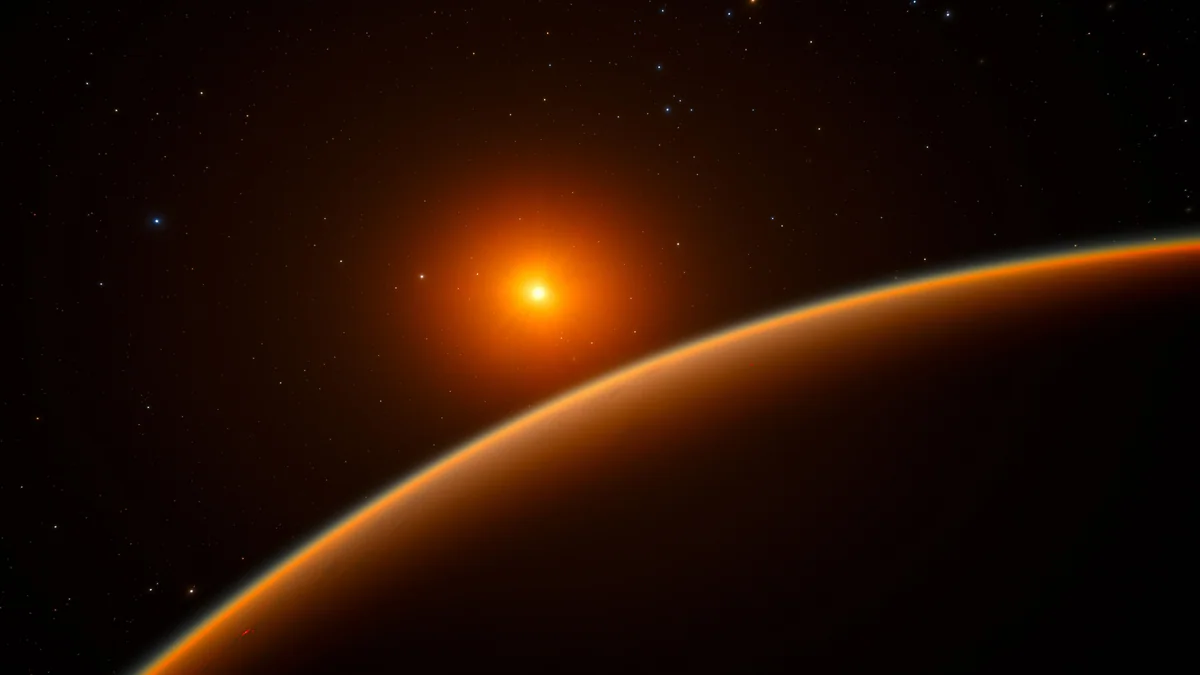
Here is what makes it physically remarkable, even before you get to the color question. With a surface temperature of roughly 4000 degrees Celsius, WD J1330+6435 ranks among the coolest white dwarfs known. For context, our own Sun burns at about 5500 degrees Celsius at its surface. Most white dwarfs at this temperature produce a dull, unremarkable reddish glow. This one does something that, by every standard rule of stellar physics, it should not.
Why the Rainbow Skips Green — Unless Something Interferes
Every star is a blackbody radiator. That sounds like a technical term, so here is the everyday picture: a blackbody is any object that glows purely because of its temperature, emitting light across a whole spread of wavelengths rather than at one single color. Heat a poker red-hot, then white-hot, and you are watching the principle in action. Stars are the same, just a few thousand degrees further along the dial.
Wien's displacement law tells us exactly where a star's emission peaks. Cool red dwarfs peak in the infrared. Our Sun, at roughly 5500 degrees Celsius, peaks in the yellow-green range. Hotter blue-white giants peak in the ultraviolet. A star at about 4000 degrees, like WD J1330+6435, peaks in the red-orange zone.
Here is the practical catch: peaking at one wavelength does not mean emitting only that wavelength. A star pumps out a broad, continuous spectrum, and the human eye receives the whole cocktail at once. Red plus blue plus green, mixed in the right proportions, registers as white or pale yellow. The green component is always present; it simply drowns in its neighbors. The rainbow skips green not because green isn't there, but because our eyes are blending machines.
Filtering, though, is a different game. WD J1330+6435 has an atmosphere of dense helium, and that matters precisely because helium is unreactive. It does not absorb the star's own light, which means any heavier atoms suspended in it stand out as clean, precise absorbers.
The helium atmosphere creates the conditions in which a single element, sodium, can step in, remove one slice of the spectrum, and tip the blended result into something the eye was never built to expect.
How a Dead Star Ate a Planet and Turned Green
Picture a world like ours: rock, iron, silicate crust, maybe once an ocean. Now picture the dead star at the center of that system pulling it apart, the way a tide pulls at sand but amplified to the point of violence. The planet does not fall whole. It shreds.
That debris spirals inward. And within it, sodium — the same element that makes table salt white and streetlamps orange — begins to accumulate in the white dwarf's outer atmosphere in concentrations far beyond anything a star could generate on its own. WD J1330+6435 had been eating its planetary system, and the evidence was now written in its light.
Here is what sodium does to light. Its atoms are exquisitely tuned to absorb one specific slice of the visible spectrum: orange. Not a smear of colors, not a broad band. Precisely orange, the way a keyhole admits exactly one key.
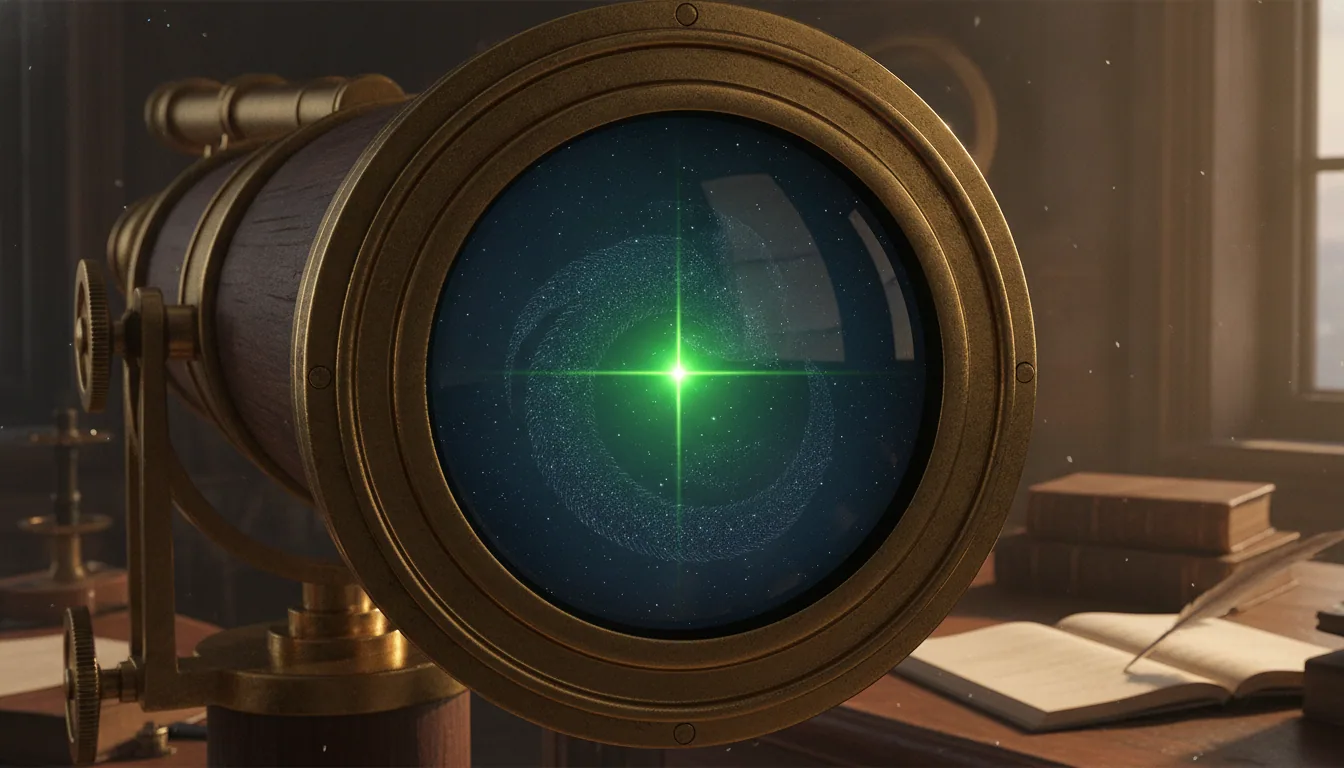
The star's output, already shaped by its 4000-degree surface, passed through that sodium filter. The orange was lifted out. What remained, the wavelengths that survived the journey to a human eye, assembled into chartreuse, a yellow-green that has no business appearing in a stellar spectrum. And yet there it was.
The mechanism feels almost too clean, like a magic trick explained in slow motion. The planet provided the filter. The filter removed the orange. The absence of orange constructed the green. A world that no longer exists gave the star its impossible color, surviving only as a chemical stain in the light of the thing that destroyed it.
A world that no longer exists gave the star its impossible color, surviving only as a chemical stain in the light of the thing that destroyed it.
The Stain Left by a Vanished World
Call it photospheric pollution — a name that sounds clinical until you understand what it means. A white dwarf's gravity is so fierce that any element heavier than hydrogen or helium should sink within days, dragged to the core before it can touch the light. The star's outer atmosphere stays pristine. Unless something falls in.
When a rocky planet spirals too close and breaks apart, its debris rains into the atmosphere and stays suspended long enough to leave a mark. That mark is chemical. Sodium absorbs orange light; carbon absorbs differently.
The stain in the starlight is a forensic record of a world that no longer exists.
Here is why this matters beyond one unusual color. The same mechanism that turns WD J1330+6435 green works in reverse as a diagnostic tool. Planetary scientists can read the absorption signature and reconstruct what the destroyed planet was made of — its sodium content, its carbon fraction, the whole elemental autobiography of a dead world.
The discovery team found a second exhibit forty-eight light-years away. WD J1011+2845 glows salmon-pink, not green, because carbon rather than sodium dominates its polluted atmosphere. Same mechanism, different element, completely different color.
Together these two stars demonstrate that the Hertzsprung-Russell diagram — the great map of stellar types, built on temperature and luminosity — was never wrong, only incomplete.
It described stars in isolation. It did not account for stars that eat.
What Comes After the Universe's First Green Star
WD J1330+6435 answers one question and immediately opens four more. We don't know how many planets it consumed, or how large they were. One rocky world? Six? A system shredded across millions of years? The sodium signal itself cannot tell us. It registers the chemistry of the wreckage, not the inventory.
We don't know how long the green will last. In a white dwarf's crushing gravity, heavy elements sink. The sodium currently painting that chartreuse light is temporary, suspended in the helium atmosphere like sediment mid-fall. On astronomical timescales, it will disappear below visibility. We simply don't know when.
Here is the stranger question: what else is possible? Sodium produces green. Carbon, as the pink star WD J1011+2845 demonstrates at just 48 light-years away, produces salmon. But the periodic table is long. No one yet knows whether other elements, in the right concentrations, in the right stellar atmosphere, could produce purple, or a true blue no normal star can wear.
Each gap in that list is a future discovery waiting to be named — the next universe's first green star, built from chemistry we haven't thought to look for yet.