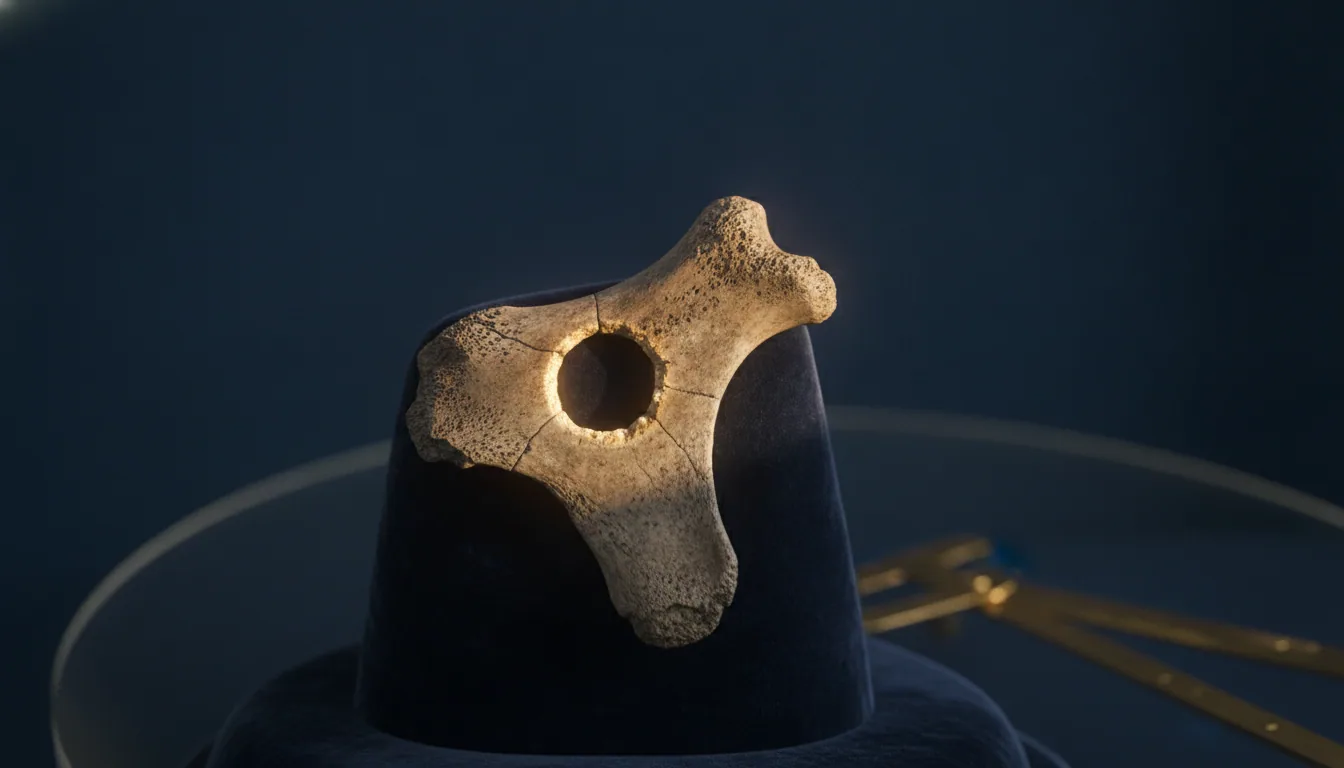
The Hole in the Shoulder Blade That Shouldn't Still Be Here
Fifteen millimeters. That is the diameter of the hole in the left shoulder blade of a Neanderthal who died roughly 75,000 years ago in a cave in the mountains of what is now Iraqi Kurdistan. Smaller than a coin. Perfectly round. It should not exist at all, because bone this old is usually powder, and meaning this specific is usually lost.
But it is there. And once paleoanthropologist Emma Pomeroy and her colleagues at Cambridge examined the geometry of that wound, the meaning became hard to argue with. The hole sits at an angle that traces a downward thrust, aimed directly at the heart, with enough force to pass clean through the body.
Pomeroy was blunt in her assessment: the position of the wound and the force required "bear the hallmarks of an intended kill shot directed towards the heart."
Here is the strange part. The individual known as Shanidar A was approximately 45 years old, a significant age for the Pleistocene, and had already survived a severe facial trauma that would have required weeks of care from others. Someone, or several someones, had kept this person alive through serious injury.
Then, at the end, a sharpened wooden spear ended that life in a single deliberate thrust.
Shanidar Cave deepens the unease. This is not an anonymous hole in random rubble — the site shows evidence of repeated, purposeful burials, which means the people who used this cave made intentional choices about the dead. The killing did not happen in empty wilderness; it happened somewhere that carried meaning.
The forensic precision of that 15 mm circle, preserved across 75,000 years, forces a question that will take the rest of this article to properly answer: what kind of creatures were the Neanderthals, really?
The Weapon That Leaves Almost No Trace
The bone displacement around that 15-millimeter hole tells a specific story. Fragments splinter inward along a smooth circular path, the signature of a round, unflaked tip driven with force. A stone-tipped spear leaves a different mark — irregular edges, micro-fractures from flint or obsidian geometry — and the Shanidar wound points unmistakably to wood.
That distinction matters more than it might sound. Archaeology is, in part, the science of what survives, and wood almost never does. It rots, burns, dissolves into the soil over decades.
Stone tools, by contrast, lie in sediment for hundreds of thousands of years waiting patiently to be found. The result is a record that is systematically biased toward lithic technology — not because Neanderthals preferred stone, but because stone is what time preserves. Every wooden tool that decomposed is a data point we will never recover.
The rare exceptions are revelatory. A single spear tip found at Clacton-on-Sea, England, is over 400,000 years old — the oldest known wooden weapon, proof that this technology predates our own species entirely. More striking still are the Schöningen spears from Germany, roughly 200,000 years old, aerodynamically balanced for throwing, with weight distributions comparable to a modern javelin.
These are not improvised sticks sharpened in a moment of desperation. They are the product of a long, refined craft tradition, passed down and improved across generations.
What the archaeological record shows, then, is not the full picture of Neanderthal capability — it is only the durable fraction of it. The weapon that killed Shanidar A left almost no trace by design. The bone, fortunately, kept a receipt.
One Life, Two Opposite Stories Written in the Same Bones
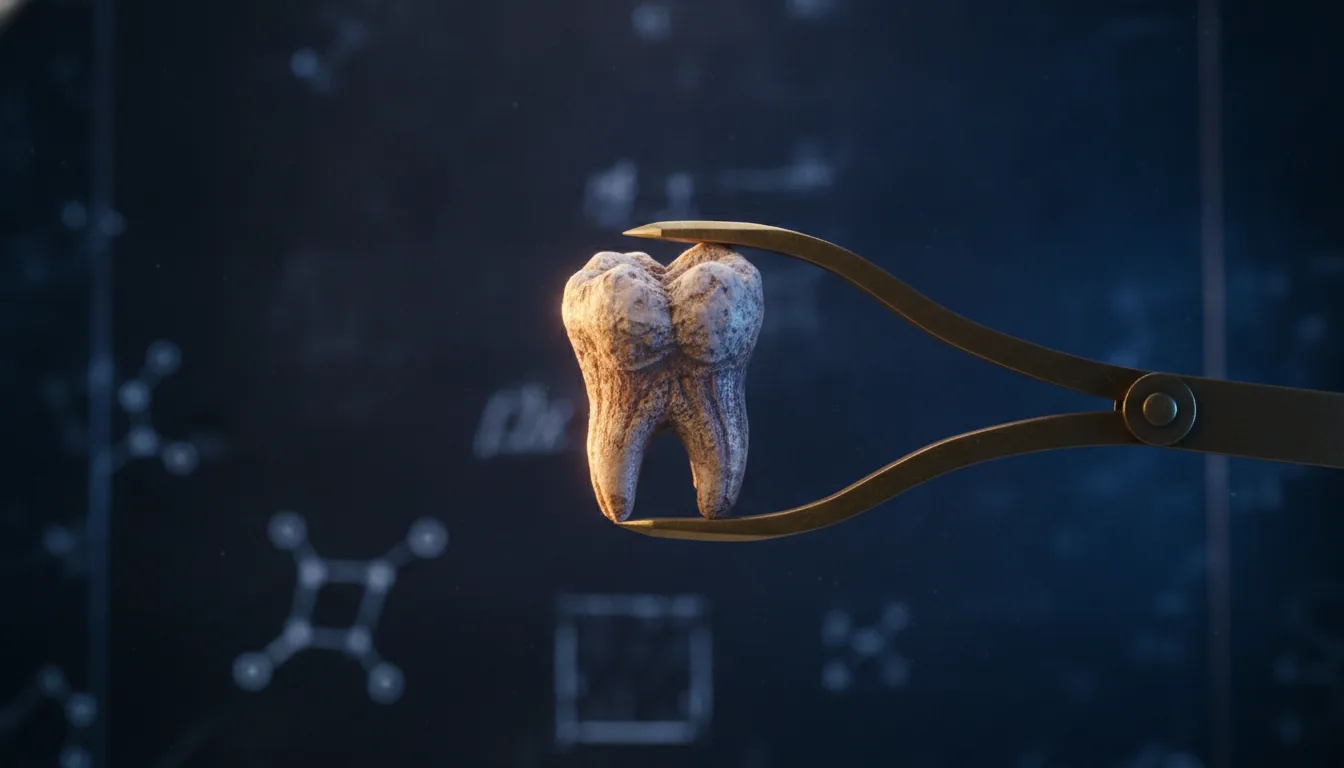
At some point before he died, Shanidar A split his front tooth clean through. Not a hairline crack — a severe facial trauma, the kind that would have left him unable to eat properly, possibly unable to speak without pain. Surviving an injury like that, paleoanthropologist Emma Pomeroy noted, would have caused absolute agony and required significant support from the group around him.
He did survive it. The tooth healed. Someone helped.
Then, around age 45, a wooden spear entered his chest from above and passed clean through.
These two facts live in the same skeleton. One tells a story of a community that chose to sustain a suffering individual for at least a year, absorbing the cost of that care. The other tells a story of deliberate, targeted killing — the downward angle of the wound directed precisely at the heart, not a lucky hit but an aimed one.
Graeme Barker, who led the excavations, put it plainly: it is fascinating to have evidence for both compassion and violence amongst Neanderthals embodied in a single individual.
What makes Shanidar A genuinely uncomfortable is the question that cannot be answered. The attacker's identity is unknown. Another Neanderthal is possible — an early Homo sapiens is equally possible, as the two species were sharing territory in this region at the time, competitors and, we now know, occasional partners.
The ambiguity is not a gap in the evidence waiting to be filled. It is the evidence. We cannot know which of us — which kind of us — did this.
That is not a flaw. It is the part that makes you stop and sit with it for a moment.
Was Shanidar A an Outlier, or Was Neanderthal Violence the Going Rate?
Tübingen University's Katerina Harvati decided to put the intuition to a test. She and her team gathered 295 Neanderthal skulls and 541 Homo sapiens skulls and looked at every one for signs of healed trauma. The result was uncomfortable in the most clarifying way: the rates were roughly comparable between the two species.
So Shanidar A was not a statistical freak. He was, in some grim sense, representative.
But the picture needs one careful adjustment before it runs away with itself. Most injuries found on Neanderthal bones, once confidently labeled as evidence of prehistoric aggression, have since been reread. Falls, hunting gone wrong, a large animal that did not go quietly — these explanations fit the fracture patterns better than deliberate attack does.
Violence was present in Neanderthal life. It was not the default setting.
Then there is St. Césaire, in western France. A Neanderthal skull there carries a healed cranial fracture from a sharp object, a wound that almost certainly came from another person rather than a stumbling accident in the dark. Whoever they were, they survived — which means they had time to bleed, to be tended to, and to live long enough for new bone to grow over the damage.
The same social care that kept Shanidar A alive through a shattered tooth was apparently available here too.
And then there is Goyet Cave in Belgium, where the picture turns darker. The bones found there bear deliberate cut marks, and marrow had been extracted, methodically, the same way Neanderthals processed large game. Cannibalism is the blunt word, and the evidence earns it.
The full behavioral range was present in this species — from nursing the injured back to health to treating their dead as a food source. Neanderthals, it turns out, were capable of the same vast, contradictory spectrum that still defines us.
Neanderthals, it turns out, were capable of the same vast, contradictory spectrum that still defines us.
The One to Four Percent That Is Also Us
Every non-African person alive today carries a small, quiet inheritance. Somewhere between one and four percent of your genome traces back not to Homo sapiens but to the people whose bones we have been examining in this article. The interbreeding happened roughly 47,000 to 65,000 years ago, in the Middle East, when two kinds of human met and, whatever else they did to each other, sometimes had children together.
Now consider what those children's descendants kept. The Estonian Biobank, one of the world's richest repositories of linked genetic and health data, has helped identify which specific Neanderthal gene variants are still doing biological work in modern people. The answer is quietly clarifying: those variants are linked to muscle mass, immune response, and addiction susceptibility — resilience traits, not aggression ones.
The biology contradicts the story we have long told. What Neanderthals passed down to us was not their capacity for violence — it was their ability to endure: a body that could fight off a pathogen, carry weight through hard winters, survive.
Compared to the "brutal savage" narrative that dominated most of the 20th century, this is something close to an irony.
And yet the discomfort does not dissolve entirely. What it does is sharpen into a different shape. We absorbed their immunological wisdom.
We may also have contributed to the conditions that ended them — the territorial competition, the resource pressure, possibly the occasional spear. No one knows for certain. That uncertainty is not a gap in the record to be embarrassed by — it is the honest edge of what we can know.
We carry their genes. We may carry their ghosts. What the evidence of Neanderthal violence ultimately tells us — about them, about us, about what it means to be the species left standing — is a question that archaeology can frame but will never close.