A Cargo That Sailed When the Pyramids Were Being Built
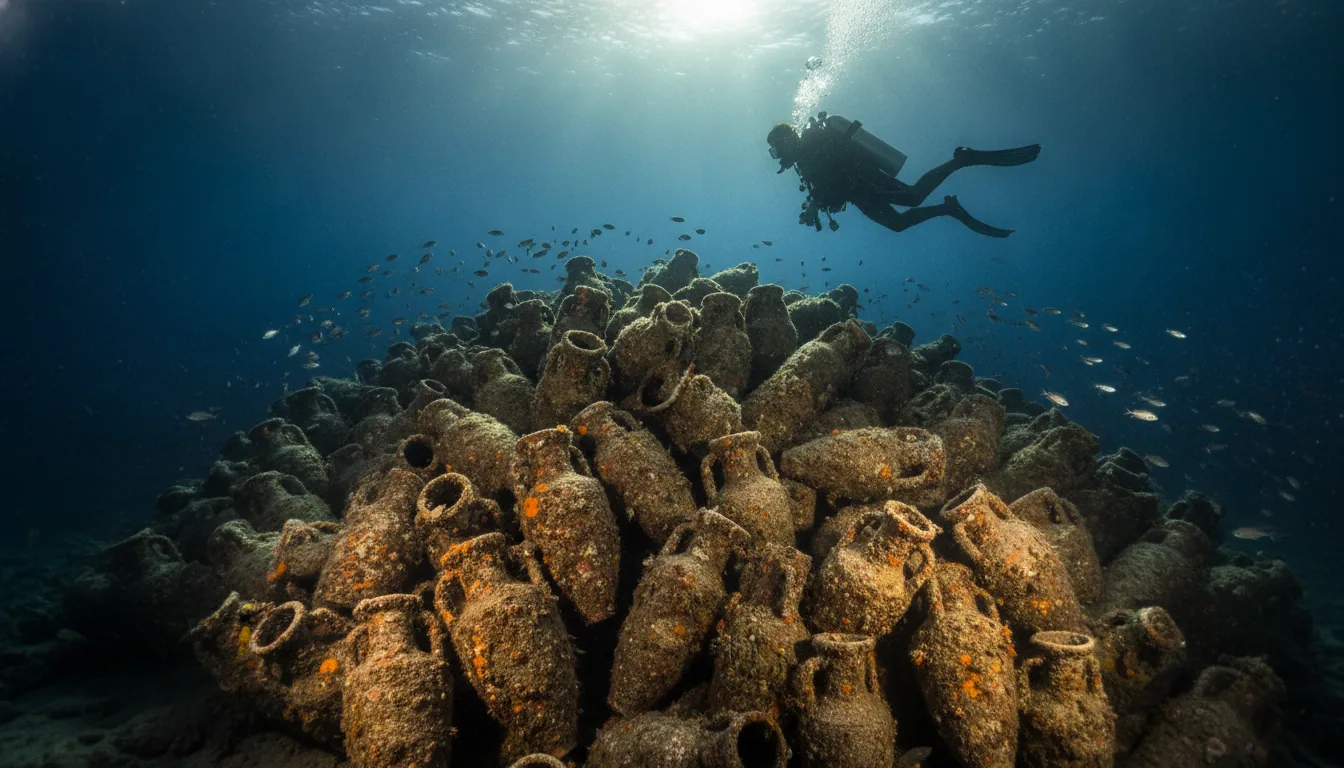
Thirty meters below the surface of the Mediterranean, off the rocky coast of Kekova Island in southern Turkey, there is a pile of clay jars that nobody has touched for roughly 4,700 years. The wooden ship that carried them is gone, eaten away by the sea. The jars remain, along with three stone anchors, patient and silent on the seafloor.
Hakan Oniz of Akdeniz University and his team found this wreck during underwater survey work near Antalya, and the dating stopped them cold. Between 4,400 and 4,700 years old, the vessel was sailing these waters during the Early Bronze Age - the same centuries in which Egyptian workers were hauling limestone blocks into position on the Giza plateau. The pyramids were not yet finished when this ship went down.
More than thirty ceramic amphorae survived the millennia. These two-handled jars - the standard shipping container of the ancient Mediterranean world - are thought to have originated from the Jordan Valley, likely carrying olive oil or wine on what was clearly a commercial run. Three stone anchors tell us this was not a rowboat or a casual crossing. Someone was moving cargo at scale.
That phrase matters: industrial-scale maritime trade, in an era we tend to picture as barely past the age of dugout canoes. The Kekova find pushes back our evidence for organised, long-distance sea commerce by several centuries, well beyond the previous record holder, the Uluburun wreck off the Turkish coast at roughly 1300 BC. Those extra centuries change the shape of the story. The sea was a highway far earlier than we thought.
How the World's Oldest Known Shipwreck Beats the Previous Record by Four Centuries
For a long time, one wreck owned the story of Bronze Age seafaring. Excavated from the seabed near Kaş, Turkey, beginning in 1982, the Uluburun shipwreck dates to roughly 1300 BC. Scholars George Bass and Sheldon Wachsmann were unambiguous about its importance: Bass called it among the most significant Bronze Age excavations of the past fifty years, and Wachsmann declared it "without doubt the single most significant key to understanding Bronze Age seafaring." High praise, and earned.
Here is what makes the Kekova find so striking. Uluburun sits at roughly 3,300 years old. The Kekova wreck pushes past it by four centuries or more, landing somewhere between 4,400 and 4,700 years ago. That gap is not a rounding error — it is the entire span from Julius Caesar to us, moved forward in a single discovery.
The difference matters because Uluburun was already thought to document an early, sophisticated phase of organised maritime trade in the eastern Mediterranean. Kekova now shows that organised trade by sea was not a Late Bronze Age invention. It was already old by the time those Uluburun sailors set out. The ladder of evidence just grew a new bottom rung.
The excavation sits under the oversight of Turkey's Ministry of Culture and Tourism, which places this squarely within a broader national effort to document what lies beneath the Anatolian coastline. Hakan Oniz and his team at Akdeniz University have not worked in isolation. Archaeology of this kind runs on permits, on institutional patience, on the slow authority of evidence built season by season. That patience is what separates a headline from a discovery.
What Was in the Hold: Oil, Wine, and the Jordan Valley
Thirty-plus amphorae sitting on the seafloor tell a story before anyone cracks them open. Ceramic style is, for an archaeologist, a kind of passport: the shape of a handle, the temper mixed into the clay, the curvature of the neck. The amphorae from Kekova point, with reasonable confidence, to the Jordan Valley - meaning this ship was not a local coastal ferry but part of a supply line threading across the eastern Mediterranean.
What did those jars carry? The leading candidates are olive oil and wine, which were the crude oil and grain of the Bronze Age world. Neither is exotic. This was not a luxury haul; it was bulk commodity transport, the kind of cargo you load when trade is regular enough to be worth the investment of a vessel, a crew, and the very real risk of the open sea.
The honest answer, though, is that we don't yet have proof of the contents - residue analysis of the amphorae is still ongoing. What survives inside a sealed ceramic jar after 4,700 years of submersion is not nothing. Organic molecules cling stubbornly to porous clay walls, and archaeologists have extracted readable chemical signatures from containers far older. Results pending is not the same as results absent.
Three stone anchors rounded out the ship's equipment. Stone, not metal - because in 2700 BC, casting a bronze anchor heavy enough to hold a laden cargo vessel was an extravagance no one had reached yet. Stone was the practical solution. It worked. The anchors are still there to prove it.
Together, the amphorae and the anchors sketch a picture not of occasional, adventurous voyaging, but of something more routine and more remarkable: a commercial network already operating at scale, moving staple goods across hundreds of kilometres of open water, while the pyramids were under construction on the other side of the horizon.
The Preservation Paradox: Why Older Doesn't Mean More Intact
Here is a rule of thumb that sounds wrong until you think about it: a wreck that has been sitting on the seafloor for 2,400 years can be in far better condition than one that has been there for 4,700. The Kekova ship proves this without meaning to. At thirty meters depth in the Mediterranean, the water is warm, oxygenated, and busy with life, including a small, relentless organism called the shipworm that tunnels through timber the way time tunnels through memory. Wood disappears. Stone and ceramic survive. That is why Hakan Oniz and his team found amphorae and anchors but almost no hull.
Now picture a different sea, and a different set of rules.
In 2017, Professor Jon Adams and the Black Sea Maritime Archaeology Project sent a remotely operated vehicle down to a depth of more than 2,000 meters, where the Black Sea keeps a secret it has held for millennia: no oxygen. The anoxic layer - a vast, lightless zone where dissolved oxygen simply runs out - means no shipworms. No shipworms means no destruction. The team found a Greek merchant ship from around 400 BC, roughly 2,400 years old, sitting on the bottom as though someone had just set it down. The mast was still standing. The rudders were in place. The rowing benches had not moved.
The same vessel moored in the shallows off Kekova would have been reduced to a scatter of pottery within a few centuries. Depth and oxygen did the opposite of what you might expect: the younger sea preserved the older-looking ship.
This gives archaeologists two different definitions of 'oldest shipwreck.' The Kekova find wins by age - four and a half millennia of history compressed into amphora clay. The Black Sea wreck wins by survival - a complete wooden ghost of the ancient world, form intact where function has long since departed. Both answers are correct. They are simply the answer to different questions.
The Ship on the Vase: How We Know What the Ancient Vessel Looked Like
When Professor Jon Adams and the Black Sea Maritime Archaeology Project lowered their remotely operated vehicles to more than 2,000 meters below the surface, they found something that no diver could ever reach: a complete Greek merchant ship, roughly 2,400 years old, sitting upright as if it had simply decided to stop. The masts were still in place. The rudder, the rowing benches, the ropes. Nothing had eaten it.
But here is what made archaeologists double-take. When they looked at the shape of the hull, the arrangement of the deck furniture, the sweep of the prow, it matched something already sitting in a glass case in London. The Siren Vase, an ancient Greek ceramic in the British Museum, depicts Odysseus lashed to a mast on precisely this type of vessel. Art and archaeology, separated by 2,400 years, were cross-checking each other.
That is an unusual kind of confirmation: a painting on fired clay authenticated a ship at the bottom of the sea, and the ship authenticated the painting. Two sources that could not have colluded, agreeing on the details. The remote robotics made the comparison possible at all - no human has ever seen the Black Sea wreck in person, and no human likely ever will. The discovery belongs entirely to machines and the careful eyes watching their camera feeds from the surface.
The sea was a highway far earlier than we thought.
What We Still Don't Know — and Why That's the Best Part
We know the cargo. We know the approximate age of this ancient sunken vessel, give or take three centuries between 4,400 and 4,700 years. We know the depth, the location, the stone anchors. What we do not know is nearly everything about the people.
Who sailed this ship? Nobody can say. The crew's identity, their home port, their intended destination: all of it is gone with the wood and the flesh and whatever records a Bronze Age sailor might have kept. The cause of sinking is equally blank, whether storm, structural failure, or collision remains unanswered. There may even be hull remnants still buried under the seabed sediment at Kekova, waiting for a future excavation season to find them.
Ongoing residue analysis and dendrochronology work may yet rewrite the timeline. Every answer about Bronze Age trade opens a wider question: just how connected was the ancient world, really? The world's oldest shipwreck has given us the cargo and the coordinates — the crew remain a mystery that 4,700 years of silence has so far refused to break.