A Tooth From Sulawesi, and a Record That Shouldn't Exist
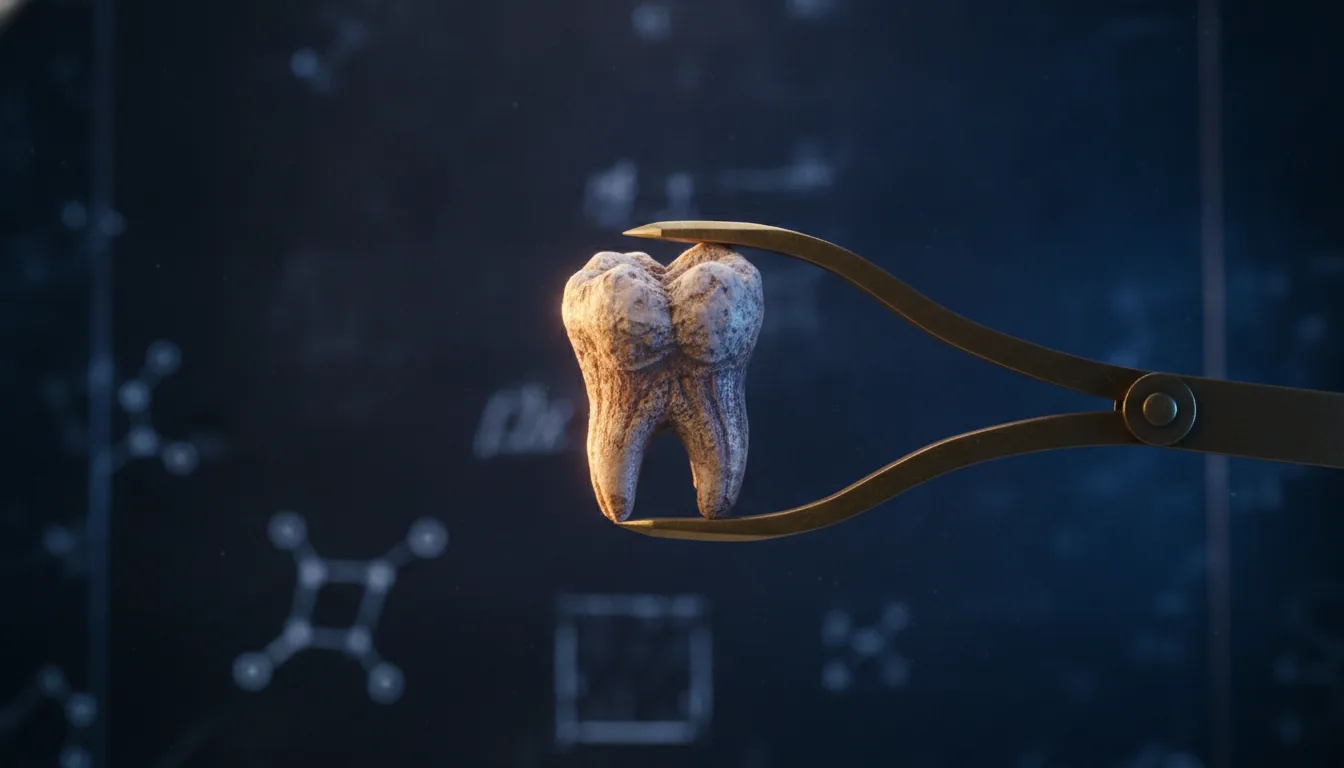
The object is easy to underestimate. One tooth, several thousand years in the ground, pulled from a burial site on the Indonesian island of Sulawesi. Nothing obviously remarkable. And yet locked inside its hardened plaque — dental calculus, the calcified film that your dentist scrapes away and that time, it turns out, preserves Pipeline astonishingly well — was a chemical record that rewrites the earliest chapter of ancient pharmacology.
In September 2026, a team led by archaeologist Adam Brumm of Griffith University published findings in Science Advances identifying betel nut residues in those ancient teeth. The remains date to approximately 25,000 years ago. That makes this the oldest known evidence of habitual psychoactive substance use anywhere on Earth.
Here is the strange part. Betel nut (Areca catechu) is not some obscure botanical curiosity. Hundreds of millions of people chew it today across South and Southeast Asia, prizing its stimulant kick and mild euphoric warmth.
It is as culturally embedded in parts of the world as coffee or tobacco. The fact that someone in Ice Age Sulawesi was already habitually sucking on these nuts — probably, researchers suggest, to dull tooth pain and release its active compounds — means this habit has deep roots. Very deep ones.
The find works on two levels at once. It is a record of a specific behavior: one person, one chemical, one repeated act encoded in the mineral memory of a tooth. But it is also a timestamp on something larger — the ancient, restless human instinct to reach into the natural world and ask what it can do for a body that hurts.
Ancient Pharmacology: The Chemical Diary Sealed in Your Plaque
Dental plaque is, in most contexts, a problem to be scraped away. But leave it long enough, and something remarkable happens: it mineralizes. It turns to stone, locking inside whatever was passing through the mouth at the time, like a very small and very intimate version of amber.
Food particles, bacteria, proteins, DNA fragments, chemical residues from plants and medicines — all of it sealed in a calcified matrix that can survive for tens of thousands of years. Geologists call this hardened plaque dental calculus. Archaeologists are starting to call it the richest archive of prehistoric life we have.
The reason is preservation. Bone degrades. Organic residues on cave walls fade, contaminate, disappear.
Dental calculus does neither. The mineral structure acts as a sarcophagus for molecules that would otherwise break down within centuries. Ancient DNA survives inside it in fragments good enough to sequence. So do molecular signatures of specific plants, including plants that have no business being in someone's diet.
This is precisely what Laura Weyrich and her team at the University of Adelaide demonstrated in their landmark 2017 study published in Nature. By extracting and analyzing the calcified plaque from Neanderthal teeth, they showed that ancient dental calculus could be read like a chemical diary — one that records not just what someone ate, but what they chose to consume deliberately.
The field that grew from that work, paleopharmacology, now asks a question that would have sounded absurd a decade ago: can we reconstruct prehistoric medicine, compound by compound, from the teeth of people dead for fifty thousand years? The answer, uncomfortably and wonderfully, appears to be yes.
The Betel Nut: Ice Age Stimulant, Modern Habit
Areca catechu is not subtle. Chew the nut and your heart rate lifts, a mild euphoria rises, and the mouth fills with red saliva that generations of public health officials have found deeply alarming. It is stimulating, mildly analgesic, and genuinely addictive — and, if the Sulawesi evidence is read at face value, a habit that some of our ancestors had locked in 25,000 years ago.
That much the teeth can tell us. What they cannot tell us is why.
Was the Sulawesi hunter-gatherer chewing betel for tooth pain, as the researchers suggest? Or for the lift — the focused warmth that follows a dose? The honest answer is that we have no way to distinguish medicinal relief from deliberate intoxication through chemistry alone, and the question may be less meaningful than it sounds.
The category of "medicine" as something separate from "recreation" is largely a modern invention — a legal and cultural line we drew recently and sometimes arbitrarily. For most of human history, a plant that numbed pain and brightened the afternoon was simply useful.
What makes the Sulawesi find striking is not just its age but its continuity. Betel nut did not become ancient history. Roughly 600 million people use it today across South and Southeast Asia, making it one of the most widely consumed psychoactive substances on Earth.
The thread runs unbroken from a tooth in a cave to a market stall in Jakarta. That is less a curiosity and more a prompt: the human appetite for chemical companionship — for substances that sharpen, soothe, or shift the edges of experience — is not a product of modernity. It is something much older, and much harder to explain away.
The human appetite for chemical companionship — for substances that sharpen, soothe, or shift the edges of experience — is not a product of modernity.
The Neanderthal Medicine Cabinet
Imagine being in agony. Your jaw throbs with an abscess that has nowhere to drain. Your gut is riddled with a parasite, Enterocytozoon bieneusi, that leaves you cramped and exhausted.
You are living in a cave in what will one day be called northern Spain, and it is roughly 50,000 years ago. What do you reach for?
The Neanderthal individual found at El Sidrón had reached for poplar bark. We know this because their dental calculus, that same faithful chemical diary, held the molecular signature. Poplar bark contains salicylic acid, the active molecule in modern aspirin, and the same compound that relieves pain and reduces fever today was already being consumed by a being who shared perhaps 99.7% of our DNA, long before anyone had a word for "medicine."
Hold that thought, because the story gets stranger. The same teeth from El Sidrón carried traces of Penicillium mold, the genus from which Alexander Fleming would, roughly 50,000 years later, isolate penicillin. Aspirin and a crude antibiotic, in the same mouth, at the same time. That is not a coincidence easily waved away.
The methodological key is this: neither poplar bark nor Penicillium mold was a standard dietary item for these Neanderthals. Other individuals at the site ate pine nuts, moss, and mushrooms, but not this. Researchers infer intentional self-medication precisely because the items were exceptional, not routine.
The test for "medicine" versus "food" is, brutally simply, whether anyone else was eating it.
What this revises is enormous. The old image of Neanderthals as blunt-force carnivores, cognitively incurious about the world around them, does not survive El Sidrón. These were people who could look at a landscape, identify which plant addressed which symptom, and act on that knowledge when in pain.
That is botanical sophistication. That is, by any reasonable definition, pharmacology.
One Species, Many Menus
Travel about 1,500 kilometers north from El Sidrón to Spy Cave in Belgium, and the Neanderthal you meet there is almost unrecognizable as a dietary relative. Where the Spanish population was largely vegetarian, subsisting on pine nuts, moss, and mushrooms, the Belgian Neanderthals were eating woolly rhinoceros and wild sheep. Same species. Radically different table.
This contrast matters more than it might first appear. For most of the twentieth century, the cartoon of the Neanderthal was a meat-obsessed brute, and that cartoon was not invented from nothing. It was drawn from whichever caves happened to be excavated earliest, which were often sites in northern Europe where large game dominated. The menu looked universal because the sample was narrow.
Wider sampling changed the picture entirely. Regional diet was not an anomaly; it was the rule. Neanderthals read their local landscape and ate accordingly, which means every claim beginning with "Neanderthals did X" has to carry a quiet asterisk: which Neanderthals, in which valley, in which season?
The vegetarians of El Sidrón were not exceptions to the species. They were the species, in one of its many local expressions.
This is also why the medicinal evidence is so striking. Self-medication with poplar bark and Penicillium mold showed up in a population that barely ate meat. Their pharmacology grew from a plant-rich world they knew intimately.
A Kiss Across 50,000 Years: The Shared Microbiome
The oldest reconstructed microbial genome ever recovered does not come from a hospital archive or a laboratory freezer. It comes from the calcified plaque on a Neanderthal's teeth, dead for roughly 48,000 years. The microbe is called Methanobrevibacter oralis, and its reconstruction by researchers at the Max Planck Institute is remarkable for one reason in particular: we have it too.
Modern humans carry Methanobrevibacter oralis in their mouths right now. The Neanderthal strain and our own are close enough that the simplest explanation is direct transfer, not parallel evolution. Two lineages, sharing a microbe, implies two mouths close enough to exchange it.
The scientific inference is careful but vivid: food sharing or kissing. Those are not metaphors for something vaguer. They are the actual mechanisms researchers propose, because saliva is the vehicle and proximity is the requirement.
Neanderthals and early modern humans were not simply occupying the same continent at the same time; they were, at least occasionally, close enough to trade microbiomes. That has consequences beyond the charming image it conjures. Where microbes travel, so does everything they carry, including pathogens.
Health and disease would have flowed between populations tens of thousands of years before anyone possessed the concept of contagion. The oral cavity, already our archive of ancient diet and medicine, turns out to be an archive of ancient social life as well. One tooth can hold the record of a meeting between species.
That is a sentence worth sitting with.
What the Teeth Cannot Tell Us
A tooth can tell you what someone ate. It cannot tell you why. That gap between evidence and intention is where paleopharmacology lives now, and the field is honest enough to admit it.
Take the Sulawesi betel nut user: 25,000 years old, a habit written clearly in calculus, a substance we know delivers both euphoria and pain relief. Was it medicine? Ritual? Simple pleasure on a hard afternoon?
All three answers are defensible. None is provable. The ambiguity is not a failure of the science; it is the science being accurate about what can and cannot be known from the inside of a tooth.
The same wall appears with the El Sidrón Neanderthal and Penicillium mold. Accident, repeated observation, or something between the two that we have no precise word for yet: we genuinely do not know how an individual 50,000 years ago came to place mold on an infected jaw. That question is not unanswered because researchers stopped looking. It is unanswered because the evidence has a horizon.
And then the largest unknown: whether habitual pharmacology was a universal human trait across Ice Age populations, or a local, contingent discovery — a single clever person in a single cave, a habit that bloomed and vanished. The diet evidence from Spain and Belgium suggests Ice Age knowledge was regional, not broadcast.
Ancient pharmacology is still in its first chapter. Every new tooth is a new page, and the book is nowhere near finished.