
On August 18, 2026, Ukraine launched over 600 drones toward the Moscow region in a single operation — the largest drone strike campaign of the war to date. Russia's Ministry of Defense claimed 1,671 interceptions across the country within twenty-four hours. Moscow city authorities reported at least 180 destroyed over the capital alone. Somewhere a spreadsheet was quietly updated.
From Symbol to Campaign: Why May 3, 2023 Is the Wrong Precedent
Ukraine's drone strikes on Moscow are not a new idea — but August 18, 2026 is a structurally different operation from anything that came before. On May 3, 2023, two drones struck the Kremlin dome and burned brightly enough to travel across every wire service on earth. The footage was dramatic. The strategic weight was closer to a communiqué than a campaign — a signal sent, a box checked, a photograph taken. I have heard this promise before: 2023, Moscow. It failed then for the reason it will fail now — one strike does not constitute pressure; only repetition does.
August 18, 2026 is a different structure entirely. Over 600 drones were launched toward the Moscow region in a single operation. Russia's own Ministry of Defense claimed 1,671 interceptions across the country within twenty-four hours — a figure that, if taken seriously, describes not a symbolic gesture but an industrial problem. The Moscow city authorities reported at least 180 destroyed over the capital alone. Somewhere a spreadsheet was quietly updated.
The 2023 comparison is reach-for-able, and therefore worth interrogating before it hardens. The structural cause of the 2023 attack's limited effect was simple: volume. A handful of drones can be absorbed, explained away, and met with a press conference. Six hundred cannot be absorbed quietly, and the air-defense arithmetic required to stop them — interceptors, radar bandwidth, the redeployment of Pantsir-S1 batteries that were elsewhere needed — is not a political problem but a physical one. Ask the small question first: who is the borderland here, and who is being made to feel strategic depth for the first time? The answer is not the same as it was three years ago. What changed was not the intent — that was always there — but the scale, and scale is the load-bearing wall.
The Ledger Both Sides Are Filing Simultaneously
Ten civilians died in a Ukrainian village in the Kharkiv region on August 18 — Russian missiles, the same morning. That fact sits at the top of the second column in the ledger neither side has paused to close. The symmetry is not coincidence; it is the structural logic of the war at this depth.
Ask the small question first: who is the borderland in this exchange, and who holds the deeper rear? Kharkiv answers it plainly. The village near Kharkiv absorbs the cost while the argument about Moscow's comprehension is conducted at the level of arithmetic. Zelenskyy put the arithmetic plainly in July: "If not a hundred, but a thousand drones fly towards Moscow, he will begin to understand." Six hundred toward Moscow on Tuesday is a point on that curve, not the terminus.
Neither side has paused its strike calendar to mourn. That is the structural logic the ledger exposes — attrition does not take bereavement leave, and the dual columns accumulate on the same day, filed by the same war. What changes at this volume is not the principle but the saturation rate: 600 outbound drones on one axis, 10 bodies on the other, and somewhere a spreadsheet was quietly updated. The rear is no longer deep enough to be safe; the front is no longer close enough to be the only story. The ledger is now symmetrical in geography if not in power, and that alone shifts the load-bearing calculation for both capitals.
How Jet-Powered Drones Change the Arithmetic of Interception
Propeller drones are slow enough that a trained spotter with a rifle can theoretically engage one. That era is closing. Approximately one in five Ukrainian drones arriving in 2026 strike packages now carries a jet engine, moving at four times the speed of the propeller models that Russian air-defence crews spent three years learning to kill. The intercept window collapses from seconds to fractions of a second.
The Liut, the Bober, and the UJ-22 have confirmed ranges exceeding 1,000 kilometres. Strikes on Yekaterinburg and Chelyabinsk this year pushed the verified reach to 1,700 kilometres — beyond most Western threat assessments from two years ago, when analysts were still measuring Ukrainian ambition by the range of donated Western missiles. Somewhere a spreadsheet was quietly updated.
The design logic here is not simply to defeat individual intercepts. Volume plus speed differential is built to exhaust the system itself. A Pantsir-S1 battery carries a finite magazine; each jet-powered drone that forces a launch burns one interceptor missile worth orders of magnitude more than the drone it kills. The arithmetic runs in Ukraine's favour at scale.
This is where the low-cost anti-drone industry faces its reckoning. Electronic-jamming nets, radio-frequency suppressors, and light-kinetic solutions were engineered for slow propeller targets flying predictable corridors. A jet-powered drone at four times the speed renders most of that inventory marginal. What remains is expensive: radar-guided missiles, laser systems, and dedicated interceptor rounds that cost the defender far more per kill than the attacker spends per sortie. The ledger does not need to be dramatic to be decisive — it needs only to run consistently in one direction.
Pantsir-S1 rounds are finite. Ukrainian drone factories are not.
Load-Bearing Walls: The Kapotnja Refinery, Wildberries, and Three Airport Closures
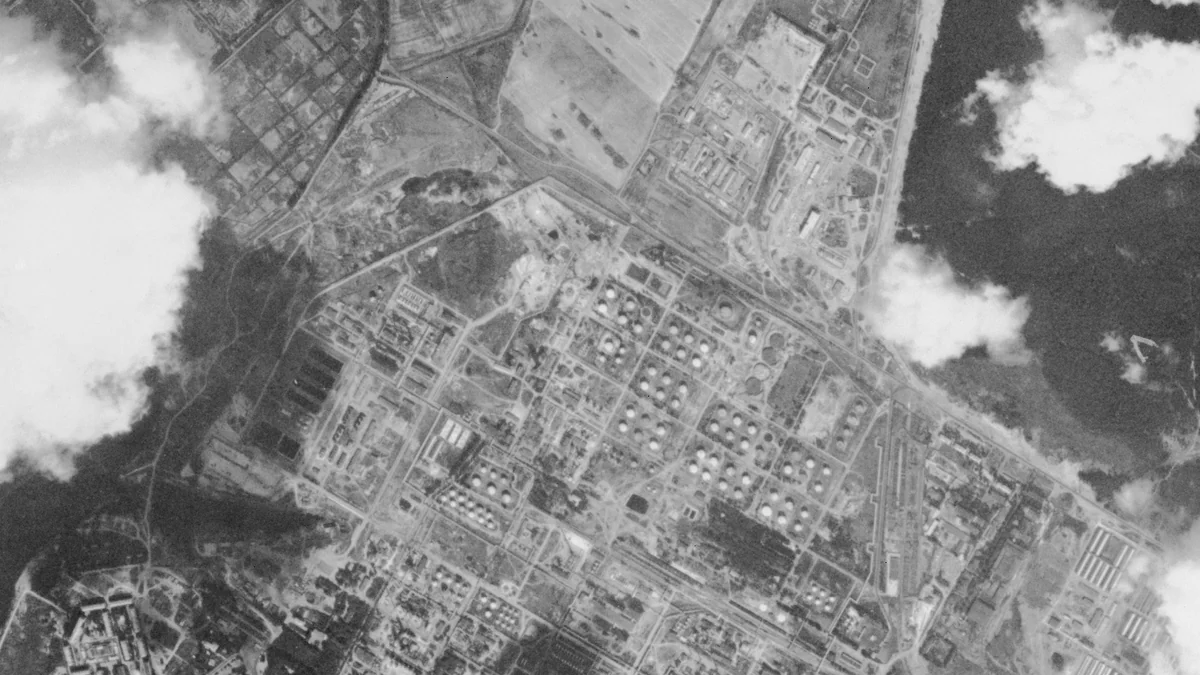
The Kapotnja refinery sits in Moscow's south-eastern fringe, unremarkable to look at, indispensable in function. It is the capital's primary fuel supplier. Each strike that finds it is not a headline; it is a repair invoice that compounds the last one, and the one before that. That is the load-bearing wall. Everything else is moulding — pull it and nothing falls.
The Wildberries warehouses in Podolsk and Bogorodsk are moulding that turned structural. Ukraine's General Staff maintains that Wildberries warehouse space is on the Russian army's logistics inventory. Whether that claim holds in every case is not yet verifiable. What is verifiable: the warehouses were targeted, they burned, and somewhere a spreadsheet was quietly updated.
Then the airports closed. Vnukovo, Domodedovo, Žukovski — suspended, one after the other, on the morning of August 18. These are not front-line airstrips. They are where Moscow's middle class boards planes for Dubai, where the business elite schedules cargo connections, where the war has, until recently, remained reassuringly abstract. The closures lasted hours, not days. That is almost beside the point.
The distinction between civilian and military infrastructure collapses the moment the civilian warehouse appears on the General Staff's inventory. Ukraine did not invent this collapse; it inherited it from a war in which Russian logistics have always run through commercial cover. The refinery, the warehouse, the airport gate — each is a node. The question the targeting logic asks is simple: which nodes, if stressed repeatedly, raise the cost of the campaign faster than they can be replaced?
The Pantsir Dilemma: What Moscow's Protection Costs the Front Line
A defence system moved to protect a capital is no longer defending anything else. Russia's redeployment of Pantsir-S1 batteries from front-line positions to shield Moscow's infrastructure is not a secret; CSIS analysts, Samuel Bendett among them, have tracked the pattern across 2026. Kyiv planned for exactly this trade.
The saturation logic is not complicated. Mayor Sobyanin's office reported at least 180 drones destroyed in the Moscow region on Tuesday morning — a number the Kremlin's spokesmen offered as a victory. A defence that absorbs 180 drones while stripping anti-aircraft cover from troops in contact with Ukrainian forces is not a victory. It is a managed deficit, and deficits compound.
The dry aside the communiqués omit: at least one fire reported near Moscow that morning was attributed not to a Ukrainian warhead but to a falling Russian interceptor missile. The original incident reports do not omit this detail the way the ministerial summaries do. Somewhere the distinction matters, though the crater is identical.
Compare the 2023 Kremlin drone strike — two quadcopters at symbolic altitude — and what followed: a ratchet, not a reset. The precedent the Russian general staff should be studying is not May 3, 2023. It is the logic of attrition air defence, in which each interception cycle consumes expensive missiles against cheap airframes, and the exchange ratio tilts steadily toward the attacker. Pantsir-S1 rounds are finite. Ukrainian drone factories are not.
One Marker to Watch Before the Next Wave of Ukrainian Drone Strikes
The load-bearing question is not how many drones cleared the ring road. It is whether Kapotnja's output curves downward in Russian fuel pricing data within the next thirty days. Refinery damage is slow to show in a headline and fast to show in a spreadsheet. If Moscow's primary fuel supplier begins throttling production, the cost of this single night travels into every Russian fuel price, every logistics contract, every ministry budget line. Somewhere a spreadsheet was quietly updated.
Watch the Pantsir-S1 redeployment. If Russia pulls those units back toward the Zaporizhzhia axis, Moscow's political class has decided the front matters more than the commute. If the systems stay ringing the capital, the real priority is named without a press conference. That decision, traceable through satellite imagery and open-source tracking, tells you more about Russian strategic calculus than any communiqué.
The technological threshold is equally precise. Jet-powered drones currently constitute roughly 20% of Ukrainian strike packages. At 30%, the interception-cost model breaks: the expensive missile required to kill a fast drone no longer makes economic sense at scale. Ask the small question first: who is the borderland here? Ukraine cannot force a Russian political collapse from the air alone. But it can make the Moscow commute expensive enough that someone, somewhere, opens a different ledger — and these drone strikes on Moscow are what that pressure looks like in practice. Watch that 20% figure. If it moves, the arithmetic changes, and this will be back on your screen before winter.