A Gloucestershire Airfield and the Long Chain of Agreements That Made It a Target
In 1986, when American F-111s lifted from RAF Lakenheath to bomb Tripoli, U.S. air base security in Britain operated on a single governing template: London authorising, London not advertising. That template is older than most of the current cabinet. It has governed the U.S. presence on British soil since the bilateral basing arrangements of the early 1950s first converted wartime habit into peacetime infrastructure.
RAF Fairford, sitting roughly a hundred miles west of London in the Cotswold fringe, was built into that infrastructure from the beginning. It became a primary staging post for U.S. strategic bombers in the European theater, a function it has held across administrations on both sides of the Atlantic with a consistency that outlasted every strategic review conducted in either capital. What changed in March 2026 was not the base's role but its declared one: then-Prime Minister Keir Starmer authorised U.S. aircraft to launch operations against Iranian missile sites from British soil, a permission the public record now confirms has been acted upon, with Fairford serving as the operational hub for strikes on Iranian missile positions in the Strait of Hormuz.
Fairford is not the only node. RAF Mildenhall in Suffolk functions as a second significant U.S. Air Force hub in Britain, with Suffolk Police carrying jurisdiction over its security perimeter — a division of responsibility that maps the reach of American operations onto the ordinary territorial boundaries of English county policing. Britain did not merely lease tarmac; it embedded American strike capacity into its own sovereign geography, and every target those aircraft are assigned creates a corresponding address for retaliation — one that carries a Gloucestershire postcode.
Before Dawn on September 27: What Gloucestershire Police Found
Three white vans were moving toward RAF Fairford in the early hours of Sunday. That is the core operational fact: not one vehicle, not a single agitated man at a perimeter fence, but three vans in coordinated movement toward a base the United States Air Force is currently using to strike Iranian missile sites. By the time Gloucestershire Police arrested five men on suspicion of explosives offences and preparing a terrorist act, the machinery of a major incident was already in motion.
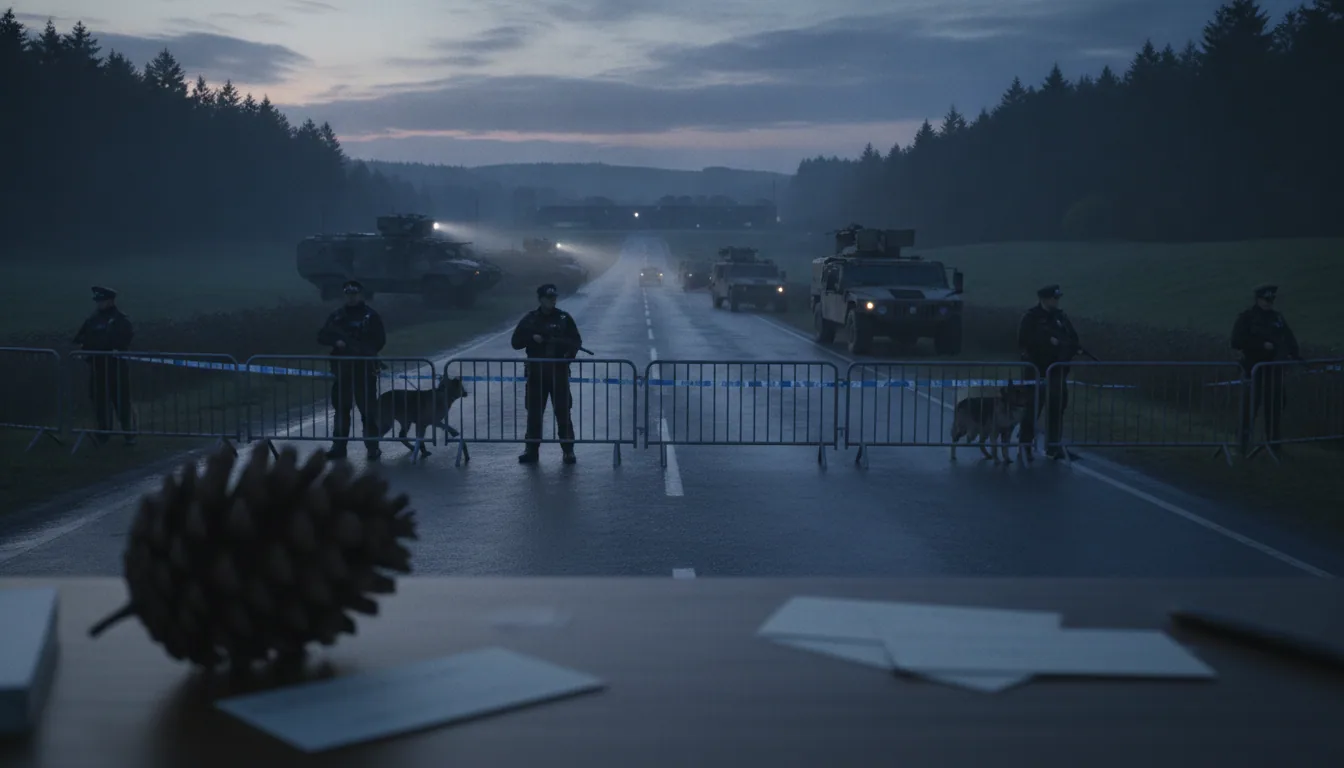
The 440-yard cordon went up around the site. Eighty-five homes in Whelford were evacuated, residents directed to a local leisure centre while Army explosive ordnance disposal teams deployed a robot to search the vehicles.
Armed police blocked the main gate; specialised equipment sealed the approach. Approximately thirty emergency vehicles — police, ambulances, fire engines — were positioned in and around the village of Fairford by the time daylight arrived.
The legal sequencing is worth noting precisely. The five men were held first under the Explosives Act, then further arrested on suspicion of preparing a terrorist act. That is a charge escalation, and charge escalations of that kind do not happen on instinct — they happen when investigators decide that capability and intent are both present in the evidence.
By Sunday afternoon, police described the incident as contained. Assistant Chief Constable Richard Ocone was careful with his language: work to establish the full nature of the incident was ongoing.
Contained and understood are not the same word, and the gap between them is where the investigation now lives. What those vans were carrying, and precisely where each was headed, remains the open question the charge sheet has not yet closed.
The Warning Was Already Filed: Iran, July 2026, and the Logic of Proxy Targeting
The Islamic Revolutionary Guard Corps issued its statement in Farsi, via Tasnim, in July 2026: any base used to strike Iranian territory is a legitimate target. The Western wire eventually carried a version of it. The original was somewhat colder in its phrasing — the verb closer to "designated" than "considered," a bureaucratic precision that matters when you are reading intent.
The operational logic behind such a declaration is not difficult to trace. An aircraft engaged over Iranian airspace requires an Iranian response over Iranian airspace. An attack on the forward base, before departure, removes that complication entirely.
RAF Fairford, sitting a hundred miles west of London and hosting the bombers flying strikes against Iranian missile sites in the Strait of Hormuz, fits that target logic precisely. The IRGC was not speaking in abstractions.
President Trump stated Sunday that the five men were "looking to do big damage" to the installation. A presidential statement of that kind is useful and limiting in equal measure — it signals investigative confidence while simultaneously foreclosing what can be said publicly about the evidence behind it.
The affiliations of the five men have not been confirmed. Their nationalities have not been disclosed. What was in the three vans remains a matter for the bomb disposal teams rather than the press office.
The charge escalation — from the Explosives Act to suspicion of preparing a terrorist act — suggests investigators found something that pointed toward intent, not just capability. Those are different legal and political categories.
Permitting strikes against Iranian territory from a base 100 miles west of London is a sovereign act with a return address.
From the Explosives Act to the Terrorism Act: What the Charge Escalation Signals
The five men were first held under the Explosives Act. That is the opening instrument — provisional, capability-focused, the charge you reach for when you have physical evidence but not yet a demonstrated chain of intent. Then came the second arrest, for suspicion of preparing a terrorist act — a step that requires investigators to have something in hand that speaks to purpose, not merely possession.
The procedural sequence tells its own story. A Terrorism Act arrest unlocks longer detention periods and broader investigative powers. It also signals that Counter Terrorism Policing had moved from support role to primary driver — Deputy Assistant Commissioner Vicki Evans's unit sitting behind Gloucestershire's lead, the way a structural beam sits behind a plasterboard wall.
The U.S. Air Force statement arrived in the flat register of institutional habit. The 501st Combat Support Wing confirmed it was taking "appropriate actions to ensure the safety and security of our US service members." Institutional language doing institutional work — which does not make it false, only opaque.
What the public record does not yet contain: the contents of the three vans, which Army explosive ordnance disposal teams were still searching with a robot as of Sunday afternoon. Whether any cordon-breach had occurred before the arrests, nobody had confirmed.
Richard Ocone, Gloucestershire's assistant chief constable, said only that "work to establish the full nature of this incident is ongoing." Ninety words of careful official English, surrounding a space where the most consequential facts still live.
The Russian Register: Sabotage Briefings and the Blurred Threat Environment
British ministers briefed infrastructure providers on Russian sabotage and hybrid-warfare threats in the weeks before Sunday's arrests. That briefing stream and the IRGC threat stream are separate. Keeping them analytically separate is the first discipline, and the first discipline is also the hardest one to maintain.
The difficulty is structural. A threat environment in which Russian state actors, Iranian proxy networks, and unaffiliated actors are all simultaneously active against British targets does not yield clean attribution from three white vans on a Gloucestershire road at three in the morning.
The public visibility of bomber deployments from a civilian-adjacent airfield makes the tactical geometry worse, not better: when a B-52 roll is visible on commercial flight-tracking software and covered on the evening news, the base's operational signature becomes a targeting document available to any adversary willing to read it.
This is where the resource problem bites hardest. Gloucestershire Police and Suffolk Police — the territorial forces responsible for RAF base protection at Fairford and Mildenhall respectively — were not designed for sustained high-tempo counter-terrorism work at active military installations running combat operations in a live theatre.
County constabularies carry the outer perimeter; the resourcing arithmetic does not improve by wishing it did. The comparison that matters is not 2001 or 2005, when the threat environment was broadly unified around a single adversarial network — it is the Cold War's divided threat landscape, when two separate hostile intelligence services required two separate counter-intelligence cultures to track.
Britain is now navigating something closer to that — with county police forces as one of the load-bearing walls.
The Basing Bargain: U.S. Air Base Security in Britain and the One Marker to Watch
In March 2026, Keir Starmer's government granted specific authorization for U.S. aircraft to launch operations against Iranian missile sites from British soil. The decision was strategic, bilateral, and, in the immediate term, classified enough to keep from the front pages. What it was not was local: Whelford did not vote on it.
That asymmetry is what September 27 makes unavoidable. The strategic logic of the basing arrangement runs from Washington through Whitehall. The costs are borne by 85 households evacuated to a leisure centre before dawn, by the 30 emergency vehicles blocking country roads, by the 440-yard cordon drawn through farmland. Decisions at one altitude, consequences at another.
Andy Burnham's statement was careful: "the safety and security of the public is our first priority." It is the correct thing to say, and it sits in genuine tension with the authorization his predecessor signed. Permitting strikes against Iranian territory from a base 100 miles west of London is a sovereign act with a return address. The IRGC filed that address in July 2026, in Farsi, via Tasnim. On Sunday morning, someone apparently consulted it.
The structural question does not resolve on the evidence available now. Whether the five men represent an Iranian-directed operation, an inspired franchise, or something the current attribution frame does not yet fit, the charge sheet cannot yet answer.
That is the marker to watch: the disclosure of the suspects' nationality and organisational affiliation. If the trail runs to the IRGC, the July warning has moved from rhetoric to operation, and the sovereignty arithmetic of American military basing on British soil will require a public accounting that Whitehall has so far managed to defer. If it does not, the attribution question reopens, and the threat environment around these bases becomes harder, not easier, to read.