What the 1951 Defence Agreement Could Not Settle — and Why the US-Greenland Security Pivot Replaced It
The US-Greenland security pivot did not begin on September 18, 2026: its roots run to the 1951 Defence Agreement between the United States and the Kingdom of Denmark, a Cold War instrument that gave Washington basing rights in exchange for a Danish signature and, implicitly, a Danish silence about what those bases were actually for. Its 2004 update modernised the legal plumbing without altering the architecture. What it never resolved was the question every such agreement buries in its footnotes: what happens when the strategic stakes rise faster than the treaty language can accommodate?
On September 18, 2026, the answer arrived at the United Nations General Assembly. The venue was chosen with care - UNGA is where you sign things you want witnesses to, where the photograph matters as much as the text. The trilateral "Infinite Life" pact between the United States, Denmark, and the Government of Greenland, the Naalakkersuisut, does not amend the 1951 framework. It replaces it, structurally, with a permanent arrangement carrying no expiration date.
The lineage is worth tracing. In 2019, the purchase proposal was floated and dismissed as a bad joke by the people who lived on the island being discussed. It was not a joke; it was a first offer.
Diplomatic urgency has a way of concentrating minds, and the soft fact of early 2026 - that military force was reportedly among the options considered before the diplomatic track prevailed - belongs in this ledger. Acquisition by purchase failed. Acquisition by permanent security framework succeeded.
The geography did not change. Only the instrument did, and this time it comes with all three signatures.
The Architecture of Permanent: Bases, Bans, and the Distributed Footprint
The operative word in the new agreement is not "security." It is "permanent." No expiration date, no review clause, no sunset provision - the United States receives guaranteed basing, access, and overflight rights in perpetuity.
The 1951 framework was a treaty between sovereign parties that could, in principle, be renegotiated. This one is designed to outlast any government in Copenhagen or Nuuk, including a future independent one.
The exclusion mechanism is equally architectural. Russia and China are barred from establishing military bases or making sensitive investments in Greenland without written American approval. Rubio's formulation at the signing carries its own logic: Greenland will "forever be part of the strategic defense area of North America."
Forever is a long word in diplomacy. It is usually the word that tells you someone won.
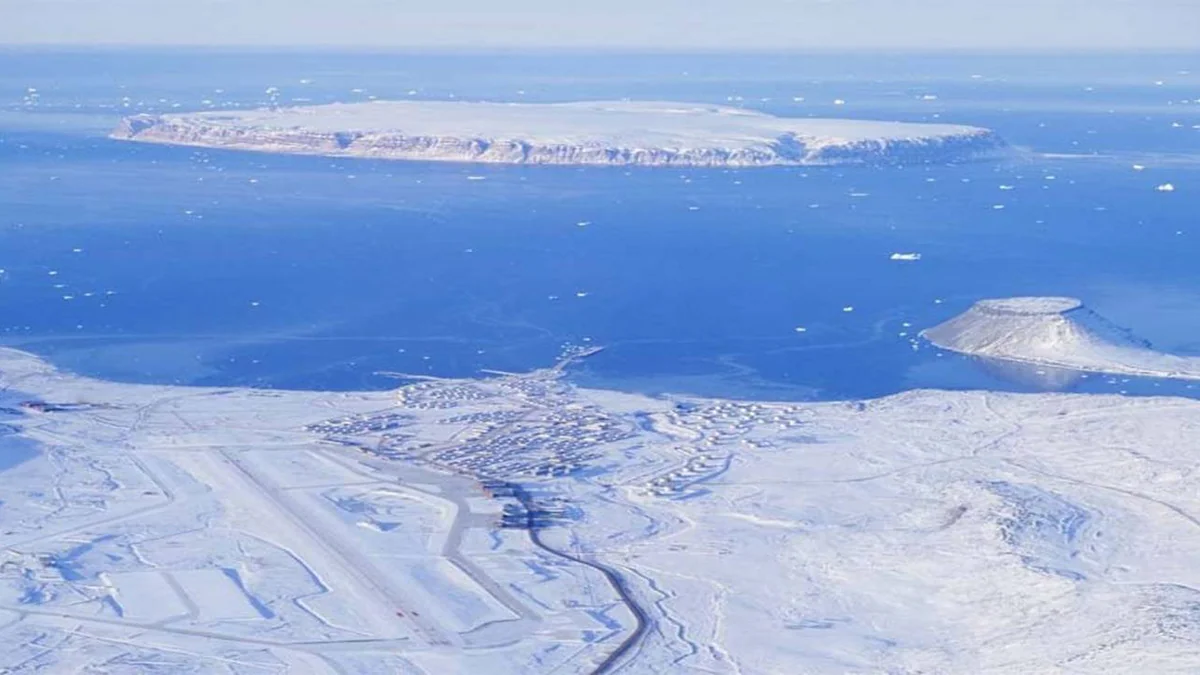
The physical footprint reflects the ambition. The old arrangement concentrated American presence at Pituffik Space Base - formerly Thule, the single northern anchor. The new one distributes it.
A $25 million modernization of Pituffik's runway and navigation systems is already underway, while plans advance for three new installations in southern Greenland, among them the reactivation of Narsarsuaq airfield. From one base at the top of the island to a regional lattice covering its full length - that is not modernization. That is a different strategic doctrine written in concrete and tarmac.
Denmark's €2 billion Arctic defense commitment, announced in January 2025 and covering new naval vessels and long-range drones, functions as the allied funding layer underneath this American architecture. Washington gets the rights; Copenhagen pays for the surrounding infrastructure.
Ask the small question first: who is the borderland here, and who is the empire? The €2 billion answers it more plainly than any communiqué.
Sovereignty in the Communiqué: What Frederiksen and Nielsen Said, and What They Did Not
Mette Frederiksen called the agreement good for NATO. Jens-Frederik Nielsen called it joyous. Both reached, in the same breath, for the sovereignty clause - the line in the text affirming the Kingdom of Denmark's territorial integrity and the Greenlandic people's right to self-determination.
That the two leaders needed that clause at all tells you something the communiqué prefers not to say plainly.
Read what they chose. Frederiksen's formulation was careful: the agreement "recognizes the sovereignty and territorial integrity of the Kingdom and the Greenlandic people's right to self-determination." Nielsen's was warmer, noting security strengthened for Greenland, Denmark, the United States, and the Western Alliance, in that order - a sequencing worth a second look.
Neither leader mentioned the independence clause by name: the provision that binds U.S. military rights to Greenland regardless of any future sovereign status. Welcoming an agreement while not quite naming its most durable term is a recognizable genre of official statement.
The physical record had already been written. On May 21, 2026, Washington inaugurated a new 3,000-square-meter consulate in Nuuk - a concrete footprint established four months before the agreement was signed.
Approximately 1,000 residents gathered outside to protest annexation rhetoric. Their presence is part of the official record too, even if it appeared below the fold.
What remains open is mechanical. Parliamentary ratification is required in both Copenhagen and Nuuk before any provision enters force.
The gap between a signature at the United Nations General Assembly and a binding instrument is not decorative. It is the only remaining distance between what the leaders said and what the text will actually do.
The Independence Clause: A Right That Survives Itself
Picture the ledger entry someone drafted and then left to stand. Article by article, the "Infinite Life" agreement acknowledges the Greenlandic people's right to self-determination - Frederiksen named it, Nielsen welcomed it, the text carries it.
Then, in the same instrument, the drafters wrote the clause that will outlast the acknowledgement: U.S. military rights remain in force even if Greenland achieves full independence. The right to leave and the garrison that stays are bound in the same document.
The right to leave and the garrison that stays are bound in the same document.
The paradox is not accidental. Self-determination is explicitly recognized and simultaneously narrowed by the recognizing text itself. A future independent Greenland would inherit, along with its flag and its seat at whichever table admits it, a permanent American military footprint it did not negotiate and cannot revoke.
That is not sovereignty in the ordinary sense. It is sovereignty with a load-bearing wall already poured by someone else.
The Puerto Rico comparison is the one that comes to mind first, and it is the one to put down carefully. Puerto Rico was never offered the independence clause at all.
The closer model is the post-1947 Philippines - formal independence, retained American bases, a Status of Forces Agreement that outlived the independence ceremony by decades. The analogy holds on the structural point and breaks on the consent record: Manila had less leverage than Nuuk does today, and the mineral ledger here is a different kind of bargaining chip entirely.
For 57,000 people on an island the size of Western Europe, the question is not philosophical. What the text calls self-determination, the garrison clause calls conditional.
One word does not cancel the other. Both remain in the document, waiting for the parliament to ratify them.
The Mineral Ledger: What the GIUK Gap and the Sarfartoq Project Share
Greenland's accession to the Minerals Security Partnership in November 2024 was the economic draft before the security fair copy. Thirty nations, Washington as the gravitational centre, agreed that Greenlandic rare-earth chains were a supply-security matter, not a commercial one. The security agreement signed ten months later did not change the architecture; it completed it.
The Sarfartoq Project carries a single number worth sitting with: 34 percent of global neodymium-praseodymium oxide production refined outside China, projected from one site on one island with a population smaller than a mid-sized Estonian county town. Neodymium and praseodymium are the materials inside the permanent magnets that drive electric motors and precision-guided systems alike. Supply-chain denial runs both ways - whoever controls that 34 percent can withhold it, and whoever controls the island controls that question.
Compare this with Brussels. The European Commission announced a €200 million investment package for Greenlandic minerals and renewables in September 2026, timed with a precision that is either coincidental or instructive.
The figure is not trivial; it is also roughly one-twelfth the Danish Arctic defence commitment of January 2025. The EU counter-move - or parallel move, the distinction matters and is not yet resolved - arrives after Washington has already set the strategic frame.
The GIUK Gap is the maritime sentence of which all of this is the subordinate clause. Bases, rare earths, investment packages: each is a separate argument, and each argument points back to the same chokepoint between Greenland, Iceland, and the United Kingdom. The ledger and the gap are one connected position.
The One Vote to Watch
The deal was announced at the United Nations General Assembly on September 18, 2026. It has not yet been ratified. That gap - between the signature table and the statute book - is where the entire architecture either holds or quietly shifts.
Parliamentary action is required in both Copenhagen and Nuuk before the pact can be enforced. The Folketing's calendar is manageable; the Inatsisartut's is less certain.
A revision in Nuuk - a qualifying clause, a sunset condition, a demand to define "sensitive investments" before the vote proceeds - would crack the "permanent" framing at its foundation. A delay would tell a quieter version of the same story.
57,000 people live on that island. The public record does not show when they were consulted, or whether the sequence of signing before ratifying was a courtesy or a conclusion already drawn.
Watch the Inatsisartut vote. If it passes clean, the moulding held. If it stalls, the load-bearing wall of the US-Greenland security pivot was never where the communiqué said it was.