A Federal Agency Historically in the Business of Stopping Bullets Is Now Stopping Journalism
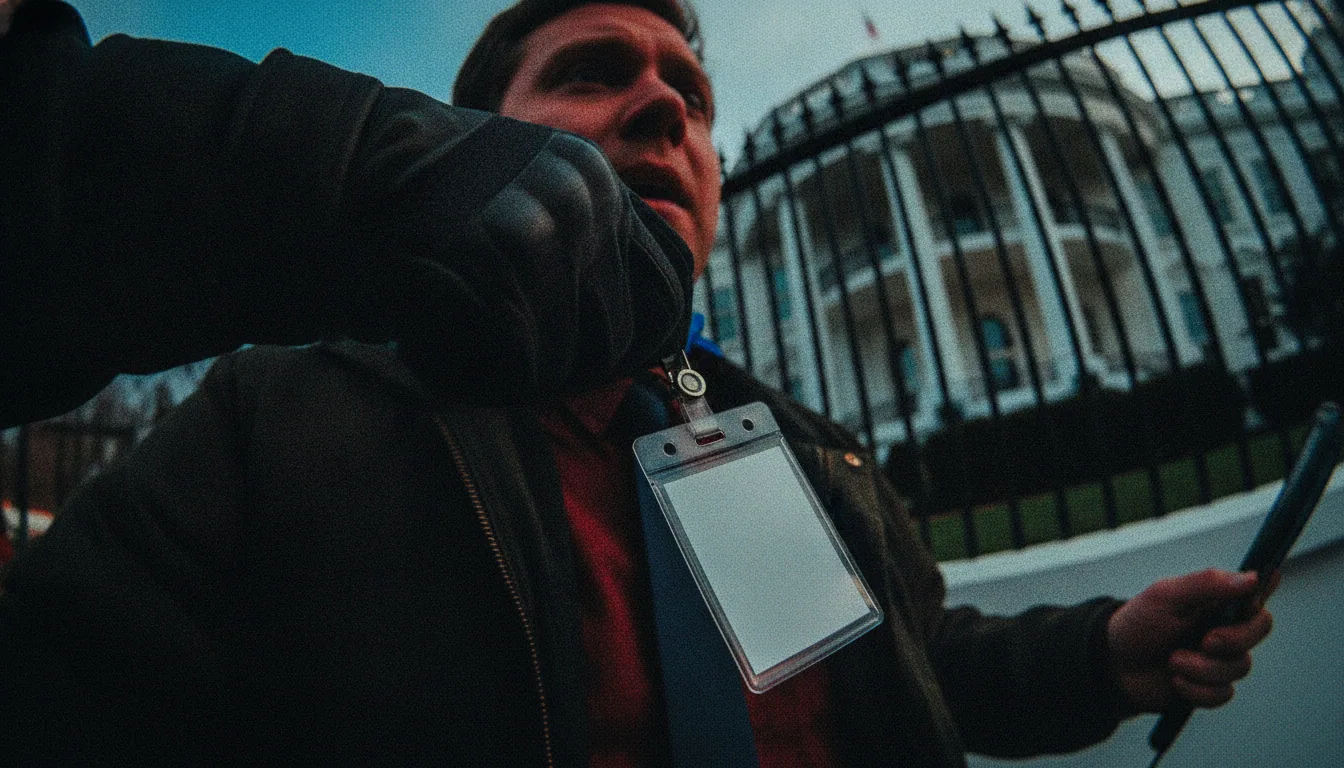
Imagine you show up to work on a Saturday morning, coffee in hand, press badge on your lanyard, ready to do the exact job you were credentialed and cleared and background-checked to do, and a federal agent looks at your badge, looks at you, and says something that translates roughly to: "the boss posted something last night." That is not a hypothetical. That is September 19, 2026, at the White House security checkpoint, where the U.S. Secret Service — an agency historically in the business of stopping bullets, not journalism — began physically confiscating the hard passes of reporters from CNN, MS NOW, and Politico.
The announcement came the day before, on September 18, via Truth Social, which is how we live now. Not a memo. Not a formal directive routed through legal counsel or the press secretary's office. A social media post, on a platform that looks like Twitter if Twitter had a midlife crisis and moved to Florida, declaring that CNN, MS NOW, and Politico were banned from White House access effective immediately. CNN reporter Betsy Klein had her credentials seized. MS NOW's Akayla Gardner found her badge simply disabled, like a forgotten subscription. Politico's Cheyenne Haslett had hers taken at the gate.
The hard pass is the long-term security credential that lets journalists do the physical work of covering the presidency — deactivating or confiscating one is not a strongly-worded email; it is the government using the machinery of security enforcement to decide, outlet by outlet, which press is the right kind of press. That distinction, it turns out, matters a lot more than most people remembered to care about until the badges started disappearing.
Three Reporters Turned Away at the Gate
Here is the part where the abstract becomes concrete and the concrete becomes absurd. On September 19, 2026, three journalists — named, credentialed, employed by major news organizations — walked up to the White House and got turned away like their names were missing from a list at a club whose bouncer has a security clearance and a federal mandate. CNN's Betsy Klein arrived at a checkpoint and had her press pass physically seized. Not declined. Not flagged. Seized. Someone took the badge out of her hand, which is the kind of thing that happens in countries whose names come up in State Department travel advisories.
Akayla Gardner from MS NOW didn't even make it to the part where someone takes your badge. Her access credentials had been remotely disabled before she reached the gate, which means at some point a federal employee opened a system, found her name, and clicked a button. That's it. That's the whole process. A journalist's access to the White House — a constitutional question with fifty years of legal precedent behind it — came down to a checkbox in a government database.
Politico's Cheyenne Haslett had her credentials confiscated at the complex. Three reporters, three outlets, three separate enforcement actions, all executed by the U.S. Secret Service, acting on the basis of a post on Truth Social. This isn't a rumor or a procedural footnote. These are named people doing a named job being physically blocked from doing it by a federal security apparatus that received its instructions from a social media platform the president owns. The machinery worked exactly as directed. That's the part worth sitting with.
The Official Explanation, Which Is Somehow Worse Than the Thing It's Explaining
Trump's reasoning, delivered with the confidence of a man who has never read the First Amendment but has definitely skimmed a few angry comments about it, was this: courts shouldn't allow "fake news" or "fiction" to be written, and "somebody has a right to keep them away." That's the whole argument. That's the legal theory. A president who doesn't like what journalists write about him should simply be able to remove them from the building, because feelings. Philosophy departments everywhere are collectively closing their laptops in despair.
Then came Karoline Leavitt, doing what press secretaries do, which is taking a bad situation and explaining it in a way that makes it measurably worse. Access to the White House, she clarified, is a "privileged and limited" gift the administration gets to allocate as it sees fit — not a press function, not a constitutional matter, a gift. Like a birthday invitation that can be rescinded if you say something unkind about the cake.
The administration also quietly moved to take direct control of the presidential press pool rotation, pulling that function away from media organizations entirely. The White House Correspondents' Association condemned this as a First Amendment violation. CNN said it would not be deflected from holding the government accountable. Politico pledged to vigorously defend its rights. What's practical to understand here is simple: when the people deciding who covers power are also the people being covered, the phrase "free press" starts doing a lot of heavy lifting for a very small amount of actual freedom.
When the people deciding who covers power are also the people being covered, the phrase "free press" starts doing a lot of heavy lifting for a very small amount of actual freedom.
This White House Press Ban Has Happened Before — Just Quieter
Picture February 2025. The Associated Press, the wire service so old and institutional it might actually predate electricity, gets barred from the presidential press pool. Not for fabricating quotes, not for running a spy ring out of their Washington bureau. For refusing to call the Gulf of Mexico the "Gulf of America." That's it. A cartographic preference dispute resolved through credential revocation, which is government slang for "we don't like your map, so you don't get to work anymore."
Before that, there was Jim Acosta in 2018 — a federal court had to literally order the White House to give his hard pass back. Then Brian Karem in 2020, same story, different byline, same lesson apparently not learned by anyone with the authority to learn it. Courts drew a line. The line got stepped over. Courts redrew the line. Rinse, repeat, accelerate.
And then there's the quiet one: the Biden administration trimmed active hard passes from 1,417 to 975 in 2023 — no press conference, no Truth Social post, just a procedural update that made access to the White House a smaller, more managed, more contingent thing than it was before. The 2026 ban didn't materialize from nowhere. It dropped into a groove that someone had already spent years carefully carving, and the machine slid right in.
What the Law Actually Says, for Anyone Who Still Believes That's a Relevant Consideration
Here's the thing about Sherrill v. Knight that nobody wants you to understand: the courts already solved this. In 1977, the D.C. Circuit Court ruled that the White House cannot simply revoke a journalist's credentials because someone upstairs is having a bad week. The government must provide a reason. It must provide a chance to respond. Due process, they called it, which is legal slang for "you don't get to just do whatever you want because you're in a big house and you're angry."
Banning outlets based on what they write is not a gray area. It's a content-based restriction — the specific flavor of First Amendment violation that courts treat like a housefire rather than a parking ticket. The whole architecture of press freedom jurisprudence exists precisely to stop this exact scenario from being normal.
WHCA president Jacqui Heinrich put it without ceremony: the First Amendment does not depend on whether a president likes the coverage. That sentence shouldn't need saying. It's the kind of thing that gets carved into courthouse walls, not tweeted as a defense mechanism. Jim Acosta got his pass back in 2018. Brian Karem got his back in 2020. Both times, courts looked at the administration's reasoning and found it roughly as persuasive as a permission slip written in crayon. The precedent is there. The question is how long "before" takes to become "again."
And Where Was Everybody When This Was Being Decided
Susie Wiles, the White House Chief of Staff, was reportedly out of town when Trump posted the ban on Truth Social. That's worth sitting with for a moment. The person whose entire job is to coordinate and staff exactly this kind of executive decision was, apparently, not in the building. The announcement skipped the standard communications infrastructure entirely and landed directly on a social media platform — the press access ban decided by app while the Chief of Staff was elsewhere.
Nobody cleared this through the normal channels. Or if they did, nobody is saying so publicly, which is a different kind of answer. The internal legal review, if one existed, remains undisclosed.
What's also undisclosed: how long this lasts. The White House press ban has no stated end date. Nobody has confirmed whether CNN, MS NOW, and Politico are temporarily inconvenienced or permanently restructured out of existence in the White House press rotation. Whether additional outlets end up on the list is unknown. When the lawsuits formally land in federal court is unknown. The only thing known, with complete certainty, is that a consequential press freedom decision was announced via app while the Chief of Staff was elsewhere — and the institution responsible for oversight looked up briefly, shrugged, and got back to its lunch. The decision-making process wasn't broken. It was just nobody's problem until it became everybody's.