
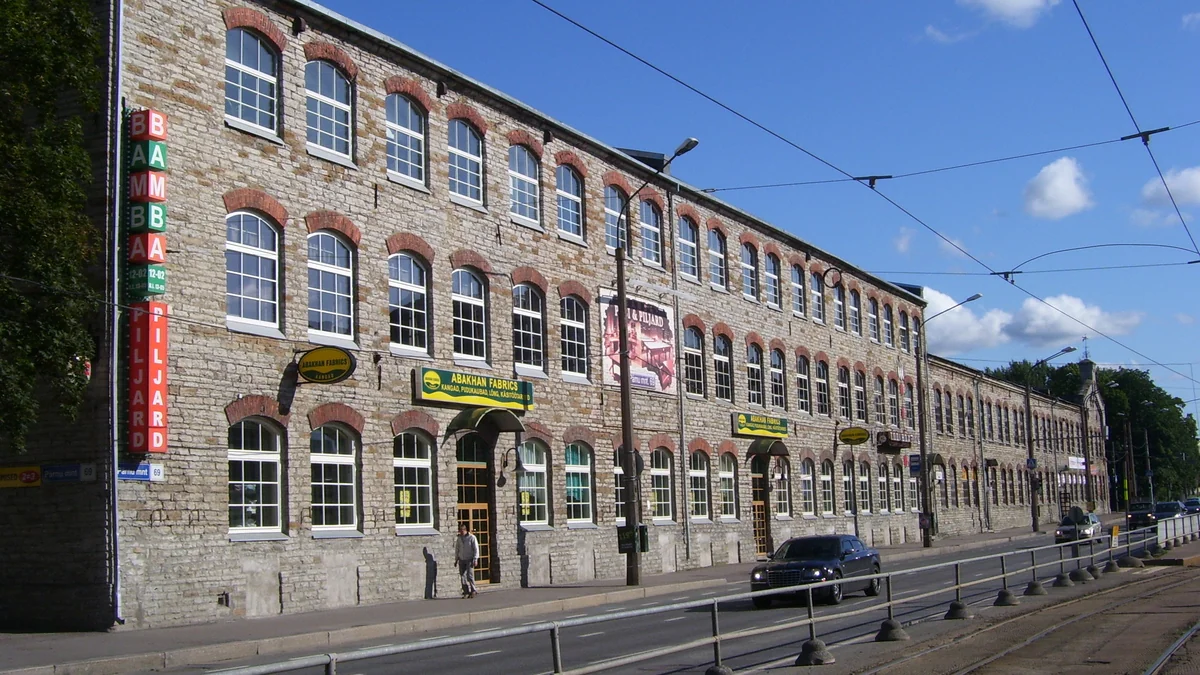
The Luther furniture factory, founded in Tallinn in 1877, became a global pioneer in plywood technology. By inventing waterproof casein glue in 1896, the factory enabled the creation of modernist icons like Marcel Breuer's furniture, bridging the gap between Estonian industrial innovation and international design history.
Here is a question that sounds simple but contains the history of modern design: What do a minimalist London apartment and a 19th-century workshop on the edge of Tallinn's harbor have in common? The answer is a material we usually take for granted—plywood. But in the late 1800s, this wasn't just cheap board for the back of a cabinet. It was the cutting edge of material science.
When Alexander Martin Luther began producing plywood in 1877, no one could have predicted that his workshop would become the backbone for the most famous designers in Europe. The Luther family had been merchants in Tallinn since 1742, trading in flax and managing the flow of goods through the Baltic. Their move into timber wasn't a creative whim; it was a strategic pivot. To a merchant in 1877, Tallinn was a port city on the Western fringe of the Russian Empire, a place where industry was still clumsily finding its feet. From that small start, a factory grew that would eventually employ 2,000 people and export a vision of the future that far outpaced any map of the city at the time.
The Logic of the Grain
To understand why this mattered, you have to look at how wood behaves. A standard wooden plank is predictable: it splits along the grain. Wood is strong in one direction and remarkably weak in another. In 1885, the Luther factory began the first production of cross-layered plywood in the Russian Empire. This is the first rung on our ladder of understanding. By stacking thin veneers and rotating each one ninety degrees, they created a material where the weakness of one layer was braced by the strength of the next.
Now hold that thought, because even the best-engineered wood has a nemesis: humidity. Early glues were temperamental; they dissolved in the damp. In 1896, a chemist named Oscar Paulsen stepped into the story and developed a waterproof casein glue. This "Luther Glue" was the moment the material changed its nature. It transformed wood from a decorative surface into a technological component.
Suddenly, this plywood could survive the vibrations of a railway carriage or the harsh conditions of early aviation. By 1896, a small factory in Tallinn was competing in industries where wood had previously been too fragile to go. To someone standing in a workshop in 1610, a piece of wood that wouldn't warp or split in the rain would have been indistinguishable from magic.
From the Baltic to the World Stage
By 1897, the company was thinking globally. They registered a firm in London called Venesta—a portmanteau of "Veneer" and "Estonia." It was a deliberate, sophisticated move into the British Empire's market. A year later, they launched the Luterma brand, a name that would soon become more famous than the city it came from.
In 1900, the factory took home the Grand Prix from the Paris World Fair. In the context of the era, this wasn't just a trophy; it was the industrial equivalent of a Nobel Prize. It signaled to the world that the highest standard of plywood engineering was coming out of Tallinn. The material had become the invisible skeleton of London's modernist lifestyle.
Because the casein glue allowed the plywood to be bent and molded without losing its integrity, it became the perfect medium for a new generation of architects. In the 1930s, the London-based design firm Isokon came knocking. The legendary Marcel Breuer had designed his famous "Long Chair," and the orders for its production went straight to the Luther factory floor in Tallinn. Breuer chose Luther because their plywood behaved exactly as his geometry demanded. The Estonian forest and the skills of Tallinn's craftsmen were literally woven into the philosophy of the Bauhaus.
A Silent Transition
By 1914, the factory was a city within a city, its reinforced concrete machine halls representing the peak of industrial architecture. But the story took a sharp turn in 1940. Following nationalization, the factory was renamed the Tallinn Plywood and Furniture Factory (TVMK).
This was the beginning of the brand's silence. While the technical expertise remained, the international voice was muffled by bureaucracy. Luterma disappeared from the global stage, though unlike many European firms of the era, the factory actually managed to keep its machines running. This chapter of the factory's life, the TVMK era, remains one of those things we still don't fully know—a period of industrial history waiting for its own discovery.
The Architecture of Memory
In 1997, the historical limestone walls and concrete structures of the Luther quarter were placed under national heritage protection. Today, they are being reimagined. The current development projects, led by Arco Vara, involve hundreds of new apartments and commercial spaces.
Here is the poetic part: the shapes of the new towers are inspired by the very thing that made the site famous—the gentle curve of bent plywood. It is a rare moment where modern urban planning pays a direct, geometric tribute to the material that built its foundation. With 615 underground parking spaces designed to keep the street level for pedestrians, the project tries to balance modern utility with historical weight.
The Luther legacy still lives in those lines. It reminds us that sometimes, the most complex shifts in human history—how we sit, how we travel, how we build—start with something as simple as a better way to glue two pieces of wood together. We are still figuring out how to live with our industrial past, and in Tallinn, that conversation is written in stone and steam-bent birch.