
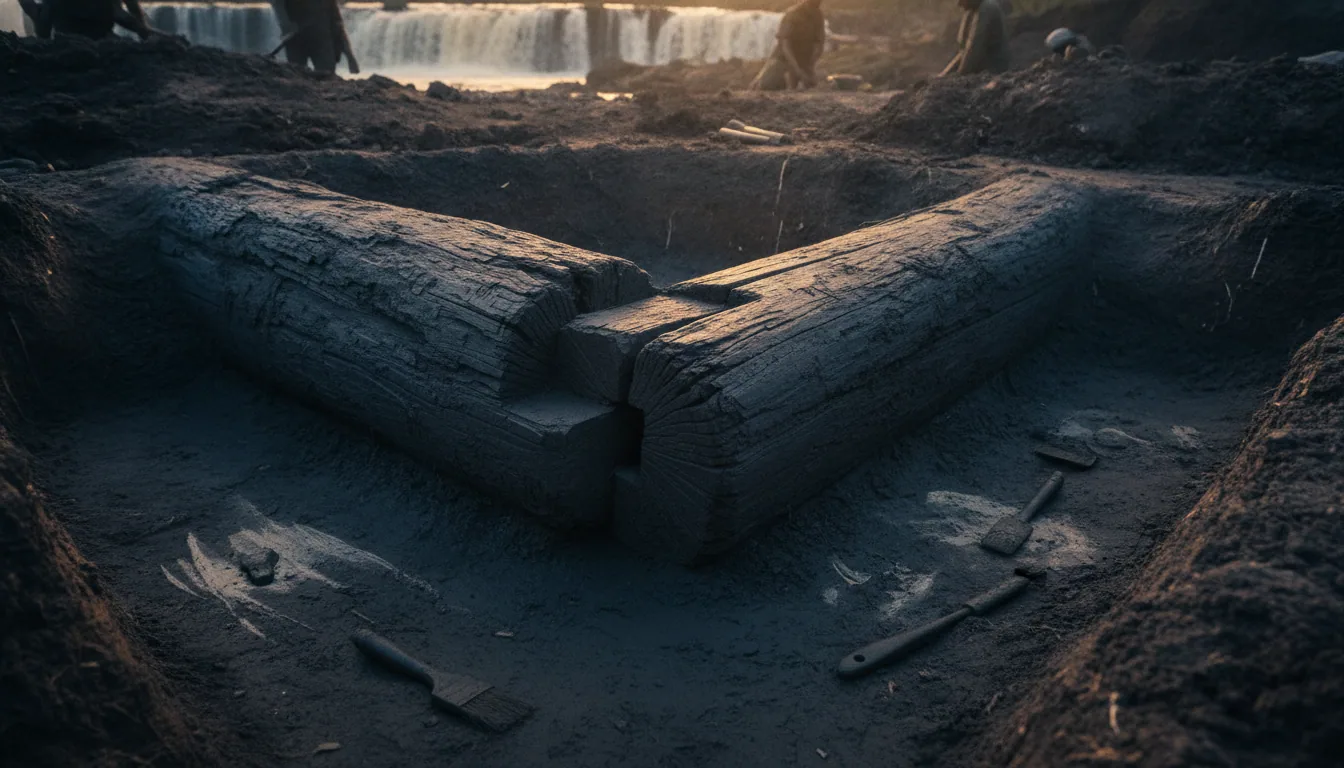
Two logs joined by a deliberate notch, found at Kalambo Falls in Zambia, are dated to 476,000 years old — predating Homo sapiens by more than 170,000 years. Analyzed as part of the "Deep Roots of Humanity" project, they represent the world's oldest known structural timber joint and push the origins of architectural thinking deep into a past we thought we understood.
Two logs. One notch. Four hundred and seventy-six thousand years old.
The carpenter at your left elbow would recognize the joint immediately — it's the same principle as a half-lap connection, the kind where you cut a recess into one piece of wood so another piece seats inside it and the two together become something neither was alone. It is a technical choice. It assumes the person making it could picture the finished structure before the first cut.
Here is the strange part. The person who made this cut was not us. Homo sapiens did not yet exist.
A number that shouldn't be possible for wood
Four hundred and seventy-six thousand years is a number that does not belong in the same sentence as timber construction. This wood does not come from the age of writing, or bread-baking, or even our species. It comes from a period so remote that the most our kind had managed was to not yet exist. And yet the notch is there, cut square, cut deliberately, cut to fit.
We are accustomed to thinking of the Stone Age as a time when wood was firewood or a pointed stick — raw material, not worked material. The logs from Kalambo Falls knock that assumption cleanly off its shelf. Larry Barham, an archaeology professor at the University of Liverpool who led the analysis, asks us to stop thinking in the category of "Stone Age" altogether, because these ancient humans were doing something new with wood — something that required technical precision and, more importantly, a plan.
A single worked plank is a tool. Two pieces fitted together with a cut notch is something else. Between a sharpened stick and two notched logs, there is a conceptual gap as large as the one between a knife and a cabinet.
Why anything survived at all
Before asking who built this, we need to understand why it still exists.
Wood does not keep. It is consumed by fungi, bacteria, insects, oxygen. The oldest wooden structures most archaeologists handle are measured in centuries, not hundreds of millennia. Kalambo Falls is 235 meters high, and at its base the river slows into a quieter reach where sediment has been accumulating for immense stretches of time. That sediment is oxygen-poor. The bacteria that decompose wood need oxygen to do their work, and in the anaerobic mud of the riverbed, they simply cannot. The logs sat there like specimens in a sealed jar — not preserved by luck, but by the steady, quiet physics of a waterlogged, airless environment that has been running the same experiment for half a million years.
Think of it as the Arctic effect, achieved with mud instead of ice. The same dig also produced a wooden wedge and a digging stick — objects that together suggest a toolkit with an internal logic. Not random debris. A set of things that belong together.
How you date wood that is too old for carbon
Now hold that thought, because the dating method is worth a moment — not because it's complicated, but because it's genuinely satisfying.
Radiocarbon dating works by measuring the decay of a radioactive isotope in once-living material. It is extraordinarily useful, and it reaches back about 50,000 years. These logs are ten times older than that limit. Radiocarbon is simply the wrong instrument.
Instead, researchers used a technique called pIR-IRSL luminescence — post-infrared infrared stimulated luminescence, if you want the full name. The concept underneath the acronym is this: mineral grains in sediment absorb radiation from surrounding rock and soil over time, accumulating energy the way a battery charges in the dark. When those grains were last exposed to sunlight — in this case, the moment the logs were buried and sealed under sediment — the clock started. In the laboratory, you stimulate the grains with light and measure how much energy they release. More energy means a longer burial. Geoff Duller's laboratory read the number: at least 476,000 years.
For comparison, a site in Israel has yielded a worked wooden plank dated to around 780,000 years ago — genuinely remarkable, and older still. But it was a single object. Kalambo provides two components designed to work as one. That difference is the whole point.
The mind behind the notch
A structural joint requires you to hold a plan in your mind before the first cut. You have to imagine something that does not yet exist, then execute a sequence of actions aimed at producing it. Archaeologists call this forward planning — the cognitive signature of minds that model the future, not just react to the present. A tool is a response. A structure is a projection.
The notch is, in miniature, the same mental operation behind every building ever raised.
So who made it? The logs predate Homo sapiens by roughly 176,000 years — our species appears in the fossil record around 300,000 years ago, and the arithmetic is clear. The most likely candidate is Homo heidelbergensis, an archaic human whose skull has been found in the same Zambian region. We know frustratingly little about them: they were widespread across Africa and Europe, they made stone hand-axes with genuine skill, and some researchers believe they used fire. Now, apparently, they also cut housing joints.
What was the construction for? The most plausible answer is a platform above wet, marshy ground — Kalambo's riverbank would have been seasonally waterlogged, and raised wooden surfaces appear in various ancient cultures for exactly that reason. Perhaps it was the beginning of a shelter. We don't know. The logs themselves don't say.
What that single notch says — cut into wood by hands that no longer exist, for a purpose we can only approximately reconstruct — is that the impulse to reshape the environment according to a plan, rather than simply responding to it, is older than our species. Older than our art. Older than the first Homo sapiens looking up at an African sky.
What opens now
The luminescence dating method that gave us this date can be applied to excavation sites worldwide, reopening questions about wooden artifacts that were previously undatable. There may be more notches waiting in the mud of other river valleys, misdated or undated or not yet dug.
We still don't know whether the Kalambo construction was the singular invention of one unusually thoughtful community, or evidence of something ordinary — a way of living with wood that was commonplace half a million years ago and simply failed to survive anywhere else. That uncertainty is not a gap in the finding. It is the finding. It is the horizon opening in front of a species — our species — that is, it turns out, younger than its own building traditions.
We still don't know. That, honestly, is the best part.