On September 12, 2026, the Virgo Transport 8 ferry tilted and disappeared 150 kilometers south of Banjarmasin. Carrying 243 passengers, the vessel encountered 3-meter waves in the Java Sea. Search operations have rescued 103 survivors, while approximately 140 individuals remain missing in this major maritime incident.
The Indonesian ferry disaster involving the Virgo Transport 8 highlights a fatal intersection of severe tropical weather and systemic regulatory gaps in archipelago transit. A nation that aspires to be a global maritime fulcrum still relies on a fleet where the cost of a ticket often dictates the margin of survival. This tension between high-level geopolitical ambition and the gritty reality of inter-island transit defines the modern Indonesian experience.
Indonesia’s geography is its greatest economic asset and its most persistent logistical nightmare. With an archipelago spanning 17,000 islands, ferries are not merely a choice but the essential lifeblood of national connectivity. For the hundreds bound for Banjarmasin, these vessels represent the only affordable bridge across the treacherous Java Sea.
If a state prioritizes rapid economic mobility over technical oversight, the maritime corridor becomes a high-stakes gamble for its citizens. The Surabaya-Banjarmasin route serves as a critical artery for trade, yet it remains susceptible to the volatile intersections of tropical weather and institutional gaps. We see here a failure to reconcile mass transport demand with modern safety protocols.
The disappearance of this vessel is more than a localized tragedy; it is a symptom of systemic friction within the Indonesian socio-economic blueprint. While search and rescue teams scramble, the event exposes the fragility of a network that millions depend on daily. The modern state cannot simply build ports; it must also build the regulatory trust that keeps those ports functioning.
Anatomy of a Critical System Failure: The Indonesian Ferry Disaster
The modern maritime promise of constant connectivity often creates a false sense of security that vanishes when structural physics takes over. This disconnect became a fatal reality at approximately 2:00 AM on Sunday, marking the moment digital signals were severed by a mechanical crisis. The vessel was tilting.
If a vessel's center of gravity shifts beyond its design limits due to shifting cargo or water ingress, the window for survival closes within minutes. Environmental variables at the disaster site were unforgiving, with waves reaching 3 meters in height. These conditions exceed the safe operational threshold for many older ferries, turning the ocean into a kinetic barrier.
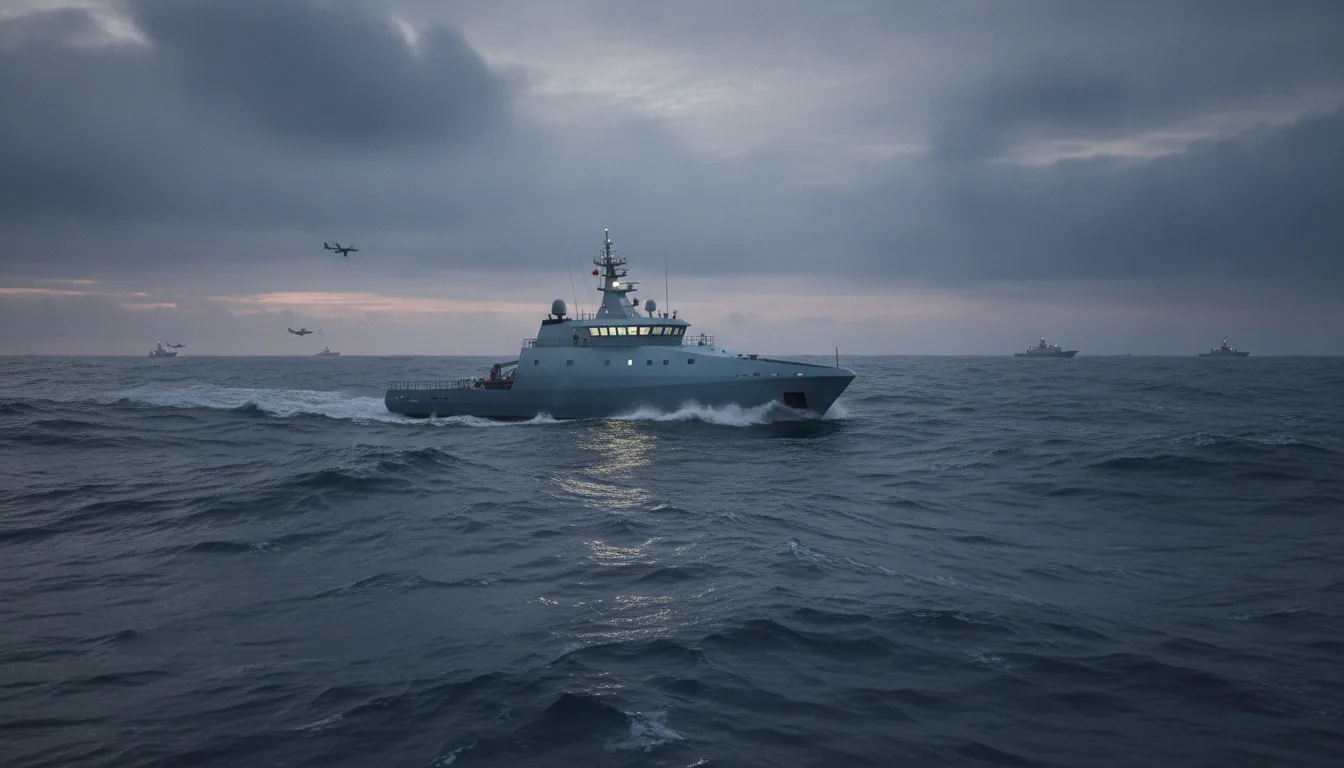
Basarnas, the national search agency, initiated a deployment by sending the KN SAR Laksmana 241 and a helicopter to the search perimeter. This zone is located 150 kilometers south of Banjarmasin, a remote stretch of water that tests the endurance of specialized 40-meter rescue ships. The logistical challenge is exacerbated by the scale of the Java Sea, forcing a reliance on limited aerial assets.
The modern state cannot simply build ports; it must also build the regulatory trust that keeps those ports functioning.
The correlation between vessel stability and severe weather suggests a systemic failure in the enforcement of safety standards. If the maritime authority allows a ship to depart into known storm systems, then structural failure becomes a predictable event rather than an accident. We are observing a pattern where economic necessity forces operators to test the absolute physical limits of buoyancy.
How many more tilting vessels must we lose before the state prioritizes vessel integrity over the political convenience of cheap transport? Beyond immediate recovery, this maritime catastrophe exposes a critical need for real-time stability monitoring integrated into the national grid.
The Manifest Integrity Gap: Why Maritime Catastrophes Repeat
A maritime nation with 17,000 islands maintains sophisticated port authorities while simultaneously tolerating a shadow economy of unlisted passengers. The official manifest becomes fiction. In 2018, the KM Sinar Bangun disaster at Lake Toba exposed the lethal nature of this gap when a vessel capsized while carrying four times its rated capacity.
The integrity of a shipping lane relies on the predictability of its actors, yet Indonesian waters frequently demonstrate a decoupled relationship between law and practice. In August 2026, a fire aboard the KMP Putri Yasmin signaled that systemic vulnerabilities remain unaddressed. If the regulatory environment fails to penalize overloading, every departure becomes a calculated gamble.
The current crisis in the Java Sea quantifies the human cost of safety violations, where search teams have recovered 103 survivors against one confirmed death. With 140 people still missing, the search area highlights the difficulty of locating individuals who were never logged. The gap between the manifest and reality is both lethal and persistent.
Historical data proves that when institutional behavior ignores weight limits, technology cannot compensate for the resulting instability. The Virgo Transport 8 captain's final report of tilting suggests a familiar mechanical struggle against an imbalanced load. The state abdicates its duty if it continues to view these disasters as unavoidable weather events.
Socio-Economic Aftershocks: The Latent Crisis of Recovery
An elderly survivor stands on the Banjarmasin pier, his salt-crusted skin a contrast to the high-tech sensors of the 40-meter KN SAR Laksmana 241 nearby. Research from the CSIS Maritime Safety Report indicates that administrative overlap between agencies frequently complicates the transition to social care. If the mandate of Basarnas ends at the shoreline, the survivor enters a legal and logistical vacuum.
In local hospitals, the scent of antiseptic masks a deep-seated institutional deficit in emergency readiness. Findings in PubMed indicate that many Indonesian nurses feel underprepared for the specialized demands of large-scale maritime disaster recovery. The success of a rescue is hollow if the healthcare system cannot absorb the shock of its aftermath.
The long-term impact is most visible among the aged, whose economic stability is tied to the very transit routes that failed them. Data from Crossref highlights that elderly survivors exhibit disproportionately high rates of PTSD yet lack access to psychiatric frameworks. They are left to grapple with the memory of a tilting deck in near-total isolation.
The Virgo Transport 8 disappearance signals a need for a data-driven rewriting of regional connectivity. We must shift toward a predictive framework where safety is an integrated economic pillar rather than an administrative afterthought. Can a nation so dependent on its waterways ever truly bridge the chasm between the necessity of affordable transit and the fundamental right to survival to prevent another Indonesian ferry disaster?