
A Number That Does Not Fit the Old Story
For decades, the accepted story of Mercury's shrinkage went roughly like this: a small planet, mostly iron, that cooled off fast and stopped doing anything interesting billions of years ago. Geologically inert. A fossil world. Scientists had even put a number on how much it had shrunk since formation: a radius reduction somewhere between 1 and 7 kilometers.
Now that number is wrong.
A study published this week in Geophysical Research Letters, led by planetary scientist Gaku Nishiyama at the German Aerospace Center (DLR), puts Mercury's total diameter shrinkage at 19 to 23 kilometers since the planet formed 4.5 billion years ago. That is a contraction 10 to 30 percent greater than any previous model had suggested. And it forces an uncomfortable question: what exactly did we miss, and why?
Here is the strange part. The older data were not bad. Scientists were looking at the right planet with real instruments. But, as often happens in science, the picture was being read with the wrong assumptions baked in, and some of the most important evidence had been quietly buried under billions of years of cosmic debris before anyone thought to look for it.
That gap between 7 kilometers and 23 kilometers is not a rounding error. It is the difference between a planet that finished its geological story long ago and one that, in some meaningful sense, is still telling it.
Why a Planet Shrinks: The Raisin Buried at the Heart of the Solar System
Take a grape and leave it on the counter for a week. The skin, unable to shrink with the drying flesh beneath it, buckles into creases. You have a raisin. Now scale that process up to a planet, run it over four and a half billion years, and you have Mercury.
The engine of this process is Mercury's iron core. As the planet radiates heat into space, the core cools and solidifies, and solid iron occupies less volume than molten iron. The interior contracts. The rigid outer crust, however, cannot follow it inward — it has nowhere to go, so it folds and cracks and heaves upward instead.
Mercury's core is disproportionately enormous compared to Earth's. Where Earth's core accounts for roughly 17 percent of the planet's volume, Mercury's takes up close to 85 percent. More core means more volume lost to cooling, which means a stronger raisin effect.
Now consider what 19 to 23 kilometers of diameter reduction actually means. Mercury's total diameter is about 4,880 kilometers. Losing up to 23 kilometers of diameter sounds modest until you translate it: that is roughly equivalent to crumpling a sphere the size of a small continent inward by the height of a large mountain range, uniformly, across the entire planet.
The crust does not absorb that compression quietly. It leaves marks — enormous, readable ones.
Written in Cliffs: Reading Mercury's Skin
A planet cannot shrink quietly. When the interior contracts and the outer crust has nowhere to go, the rock buckles, breaks, and rides up over itself — leaving a scar on the surface that can persist for billions of years. Mercury's skin is covered in exactly these scars, and learning to read them is how planetary geologists turned a photograph into a force diagram.
The most legible signatures are lobate scarps: curved, cliff-like ridges that stretch for hundreds of kilometers across the surface. They are not cliffs in the ordinary sense, formed by erosion or collapse.
They are the visible edge of thrust faults, places where one slab of ancient crust was shoved horizontally over another as the planet's circumference shrank beneath it. Picture a too-tight jacket whose back seam has split and ridden up: the overlapping fabric is the scarp.
Wrinkle ridges provide a second, independent confirmation. Lower and subtler than lobate scarps, they form by the same compressional logic, and finding both structures in the same region is geologists' version of corroborating witnesses. Neither feature would exist on a world that had always been at rest.
The third line of evidence is the most practical one to grasp: small thrust faults scattered across the surface at finer scales, too modest to dominate the landscape but too numerous to ignore.
Together, the three tectonic signatures tell one consistent story. The crust was squeezed. The interior shrank. The planet left a receipt. The only remaining question is how large the bill actually was.
What the Craters Were Hiding
Imagine trying to count the rings on a tree stump, but someone has scattered a thick layer of sawdust across the wood. You can still count rings — just not all of them. That is roughly the problem Gaku Nishiyama and his colleagues at the German Aerospace Center (DLR) discovered when they looked closely at Mercury's surface record.
The planet's geological history had been obscured, systematically and silently, by meteorite impacts. Every time a rock from space slammed into Mercury, it scattered debris outward in a wide apron of ejecta. Those aprons buried the older lobate scarps — the cliff-like wrinkles that mark where the crust has buckled inward as the planet contracted.
An earlier scientist counting scarps would miss the ones sleeping under layers of ancient rubble. The inventory of contraction looked smaller than it actually was — not because the telescopes were wrong, but because the counting method was blind to what the craters were hiding.
Nishiyama's team found a way around the sawdust. They cross-referenced detailed tectonic fault maps against surface roughness data — a methodological step that, in retrospect, seems obvious, and is never obvious until someone does it first.
Roughness is a fingerprint: buried scarps leave a subtly different texture on the surface than flat, impact-smoothed plains. By reading that texture across the decade-old MESSENGER dataset with fresh analytical tools, the team extracted the signal that previous surveys had missed.
The number of hidden scarps was not trivial — it was enough to push the total contraction estimate up by 10 to 30 percent. The bias was never in the instruments. It was in what the question assumed about the ground.
The Grabens That Say Mercury Is Not Done
Perched on top of some of Mercury's largest lobate scarps sits something smaller and easily missed: narrow rift valleys called grabens, sunken strips of crust dropped between parallel faults like the floor of a slow-motion trapdoor. On Mars or the Moon, you might find similar features frozen in time, geological relics of an ancient active past. On Mercury, they are something more unsettling.
Their location directly atop the compression ridges means two opposing stresses — one squeezing the crust inward as the planet contracts, one pulling it apart in a shallower surface layer — were operating nearly simultaneously. That only happens when the crust is still actively moving.
The implication is blunt: these grabens indicate Mercury remained geologically active within the last 300 million years. That sounds old — in human terms, it is incomprehensible. In planetary terms, it is nearly yesterday, roughly the same fraction of Mercury's life as the last hour is to yours.
Compare that to the old consensus: Mercury was thought to be a long-frozen world, its interior cooling completed billions of years ago, its geology a closed book. The grabens rewrite that.
The question now is not whether Mercury was recently active, but whether it is active today, in the very year you are reading this. Nobody knows. That gap between "nearly yesterday" and "right now" is exactly where the next mission is aimed.
A planet barely larger than our Moon is still wrinkling its own skin, still adjusting to a cooling it began four and a half billion years ago.
Twenty Centimetres: What BepiColombo Will See That MESSENGER Could Not
MESSENGER measured Mercury's surface with roughly one metre of vertical precision. That sounds impressive until you consider what it misses: the slow, grinding creep of an active thrust fault, which moves in increments far smaller than that. One metre of resolution is like trying to detect a racing pulse by pressing a brick against someone's wrist.
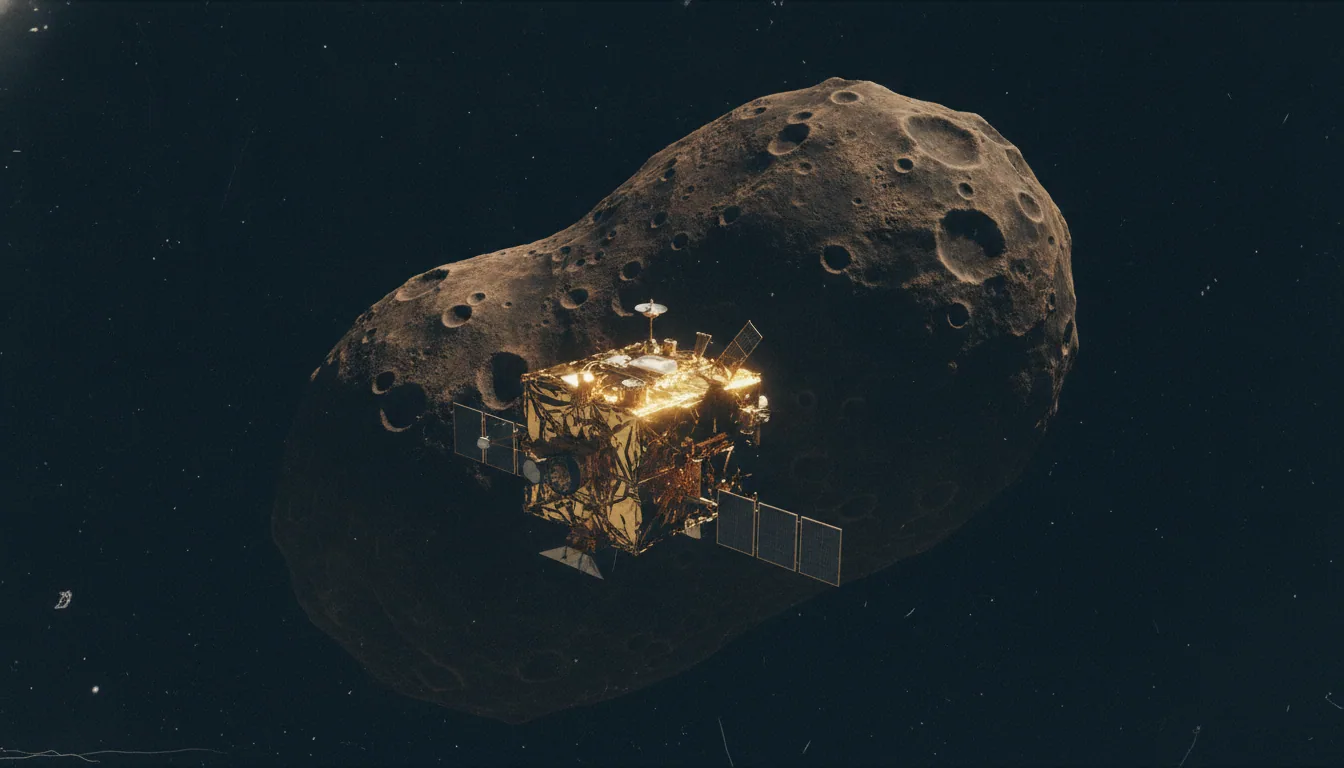
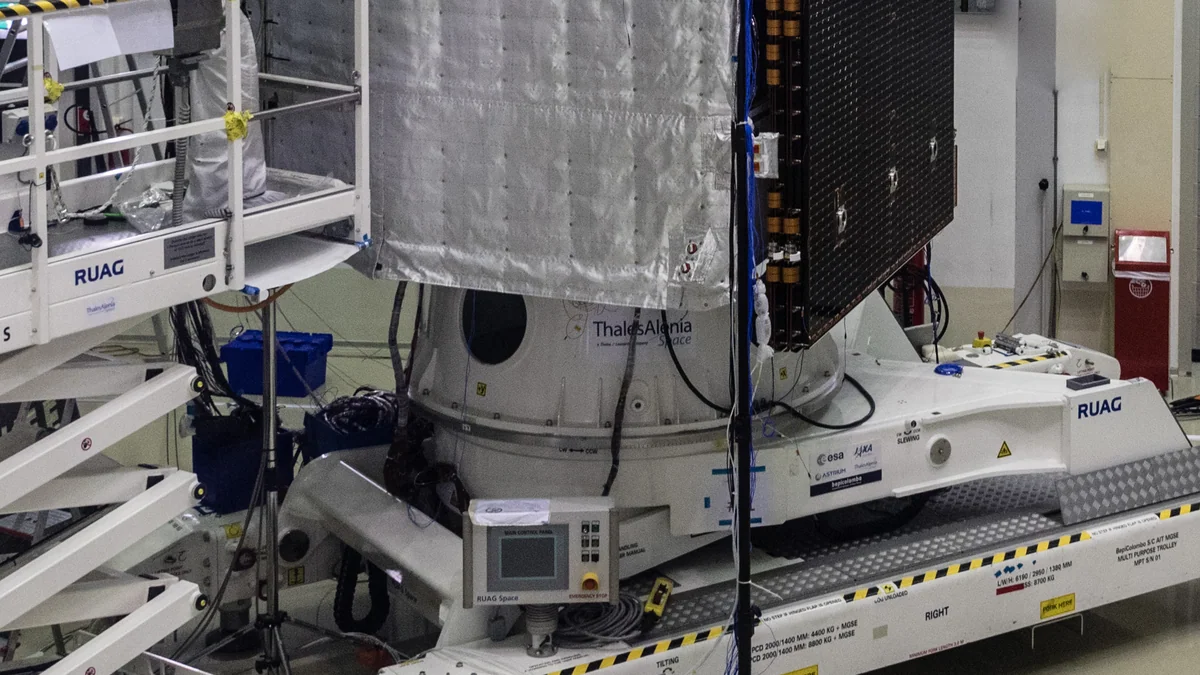
BepiColombo changes the equation. The joint ESA/JAXA spacecraft separated from its transport module in September 2026 and is scheduled to enter Mercury orbit in November 2026, carrying a laser altimeter capable of resolving surface relief to 20 centimetres. That is a fivefold improvement in precision over MESSENGER, the difference between seeing that a scarp exists and watching, measurement by measurement, whether it is still moving.
The timing is not accidental, but it is fortunate. Nishiyama's revised contraction picture, published just weeks before orbital insertion, gives BepiColombo's science team exactly the right targets: the youngest lobate scarps, the grabens sitting atop them, the places where geology is most likely still happening. At 20 centimetres of precision, the instrument can, in principle, detect fault displacement that would have been invisible noise in the MESSENGER dataset.
The numbers frame the opportunity precisely. Where MESSENGER could tell us the height of a scarp, BepiColombo can track whether that height changes.
A planet that shrank 19 to 23 kilometers over 4.5 billion years is still shrinking now, slowly, quietly. Twenty centimetres of precision might be just enough to catch it in the act.
What Mercury's Shrinkage Teaches Us About the Lives of Small Worlds
Every era of planetary science has believed it knew how planets age, and every era has been partly, gloriously wrong. For decades, the working assumption was simple: small rocky worlds cool fast, go quiet, and become geological museums. Mercury, we thought, had closed its doors billions of years ago.
It had not. A planet barely larger than our Moon is still wrinkling its own skin, still adjusting to a cooling it began four and a half billion years ago. That should make us uncomfortable about every other small rocky world we have filed away as "dead."
We still do not know Mercury's current shrinkage rate, the true state of its core, or how much the Sun's tidal pull stirs its interior. Those blanks are not failures — they are forwarding addresses, left for BepiColombo.
Beyond Mercury, there are billions of small rocky worlds orbiting other stars that we will never visit. Mercury is the one we can read. It tells us those worlds may be far quieter than we expect, or far less quiet than we assumed — and we do not yet know which. That is exactly where the next adventure begins.