A Signal Arrives from 200 Million Kilometres Away
BepiColombo's Mercury arrival crossed its first threshold at 11:45 UTC on September 3, 2026, when a small piece of spacecraft hardware let go. The Mercury Transfer Module, which had been BepiColombo's engine for eight years, released its grip on the rest of the stack. Four hundred seconds later, a signal carrying that news crossed 200 million kilometres of empty space and arrived at an antenna dish in Cebreros, Spain.
Mission control at the European Space Operations Centre in Darmstadt heard it confirmed by a second Estrack station in Malargue, Argentina, on the opposite side of the Earth. Then came the words from the flight operations team: "Roll call completed, GO for separation." Eight years of navigation, of thermal management, of trajectory revisions and gravity assists around three different worlds, compressed into one procedural sentence.
Here is the strange part. The engineers said it calmly.
That calmness is its own kind of wonder. The transfer module had done its job: it pushed the spacecraft on a path no direct rocket could have managed, looping past Earth, Venus, and Mercury six times to bleed off enough energy to make capture possible. Now it was gone, its role complete.
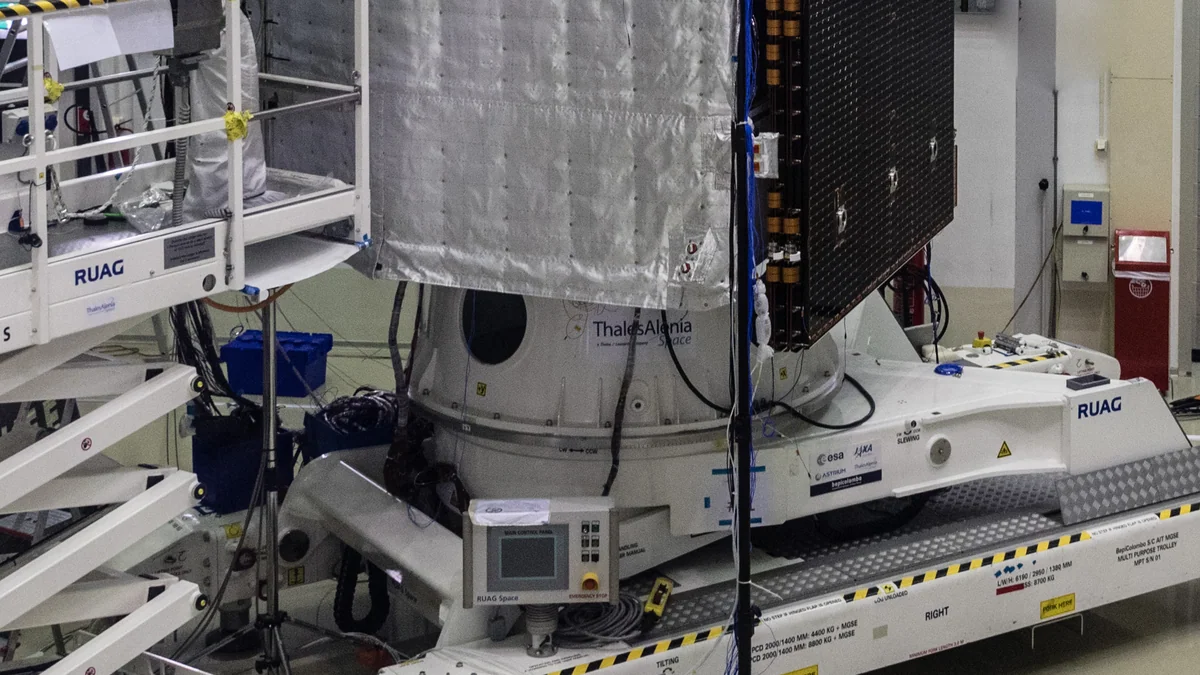
What remains is the paired science package: the Mercury Planetary Orbiter and its Japanese companion Mio, still locked together but falling toward a planet that has resisted close study for half a century. Mercury Orbit Insertion is locked in for November 21, 2026. Between now and then, the science teams wait. The planet does not.
The Planet That Breaks the Models
Only two spacecraft have ever orbited Mercury. Mariner 10 flew past three times in the 1970s and mapped roughly half the surface. MESSENGER arrived in 2011, gave us a complete map, and then crashed deliberately into the planet when its fuel ran out. Two visitors in the entire history of spaceflight, for a world that has been circling the Sun since the solar system was young. By any honest measure, Mercury is the least understood planet in our inner neighbourhood.
What little we do know keeps breaking things. Mercury's iron core takes up roughly 85 percent of the planet's radius, a proportion so large it has no good parallel among the rocky worlds. Earth's core is large by volume, but Mercury is mostly core, with only a thin rocky shell wrapped around it.
Every leading model of how planets form from the early solar disk struggles to produce this configuration naturally, and the leading explanations — a giant impact that stripped the outer layers, intense solar radiation that boiled them off — each carries problems their authors openly admit.
Then there is the magnetic field. Small rocky planets are not supposed to have one. Mars does not. Venus does not. The Moon does not.
To sustain a global magnetic field, a planet generally needs a large, rapidly spinning, electrically conducting liquid core, and Mercury rotates so slowly that the textbook says it should not qualify. Yet it does. The field is weak — about one percent of Earth's — but it is real, structured, and still unexplained in its details.
And in the permanently shadowed craters near Mercury's poles, the closest planet to the Sun, radar observations have confirmed water ice. That image is worth holding for a moment before moving on.
How BepiColombo Reached Mercury: Nine Slingshots and One Very Inconvenient Engine Failure
On October 20, 2018, an Ariane 5 rocket climbed out of French Guiana and deposited BepiColombo into space. The clock started. Eight years to Mercury.
Getting there is not a straight shot. Mercury sits deep in the Sun's gravity well, which means any spacecraft arriving from the outside has too much energy — it overshoots into solar orbit rather than being captured. The only practical solution is to bleed that energy away over years, using planets as brakes.
BepiColombo made nine of these gravity assists in total, swinging around Earth once, Venus twice, and Mercury itself six times. Each flyby bent the trajectory a little tighter, a little slower, like winding a spring in reverse.
The real workhorse of the cruise phase was the Mercury Transfer Module, which drove the spacecraft using solar-electric ion propulsion. The principle is straightforward: solar panels generate electricity, that electricity ionises xenon gas, and the resulting stream of charged particles exits the engine at high speed. The force it generates is roughly equivalent to the weight of a postcard resting on your palm. Applied continuously across hundreds of millions of kilometres, it is enough.
Then, in May 2024, a power system malfunction took the ion engines partially offline. Mission teams rewrote the trajectory. The price: one additional year of travel. It is a testament to the design margins built into the mission that the science goals survived largely intact — though the exact cause of the failure has never been publicly confirmed.
The final Mercury flyby, on January 8, 2025, passed just 295 kilometres above the surface. Close enough that the instruments caught genuine science data. A rehearsal, and a promise of what comes next.
Two Eyes on One World: What the Spacecraft Actually Are
Think of it as a single mission carrying two entirely different minds. Stacked together for the eight-year journey, the Mercury Planetary Orbiter and the Mercury Magnetospheric Orbiter are built for different questions, different orbits, different ways of listening. One is European, one is Japanese. Both are extraordinary.
The MPO, built by ESA, is a nadir-pointing platform, meaning its instruments are aimed constantly downward, locked onto the surface below. It carries 11 instruments, among them BELA, the BepiColombo Laser Altimeter, which will fire pulses of light at the ground and time the echoes to build a three-dimensional map of every ridge and hollow. A spectrometer suite will decode the chemical fingerprints of the crust, reading what Mercury is made of the way a flame test reads a metal's colour.
Mio, the JAXA orbiter whose name means "waterway" in Japanese, does something different. It spins. That rotation is not a flaw but a feature: it stabilises the craft while its five instrument suites sweep through Mercury's magnetosphere like a net dragged slowly through a river, sampling the invisible architecture of the planet's magnetic field from every angle.
The two will travel together until December 9-10, 2026, when they finally separate — each settling into its own distinct orbit. The MPO will eventually reach a path that ranges between 480 and 1,500 kilometres above the surface, close enough to feel the planet's gravity pulling at its instruments. For the first time, something will be watching Mercury with two pairs of eyes, simultaneously, from two perspectives. The planet has never been so observed.
The Questions BepiColombo Is Actually Going to Ask
Main science operations begin on April 6, 2027, eighteen months from now. What does that clock buy? Mostly patience — the time to separate the two orbiters, lower them into their final orbits, and calibrate instruments that have been sleeping through eight years of interplanetary transit. When the work starts, it will be unlike anything Mercury has seen before.
Every previous Mercury mission asked one set of questions at a time. Mariner 10 had no magnetometer in orbit; MESSENGER had no dedicated magnetospheric craft alongside it. BepiColombo changes the equation entirely: the Mercury Planetary Orbiter maps the surface and interior while Mio watches the magnetosphere simultaneously, in the same moment, during the same solar event.
It is the difference between photographing a storm from space while someone inside it reads the barometer.
The science agenda carries two questions that dwarf the rest. The first is ice. Mercury's poles host permanently shadowed craters — places the Sun has never touched — and radar data from MESSENGER suggests water ice fills them. How it arrived, whether as cometary debris or outgassed from the interior, remains genuinely open.
The second question is Einstein. The Mercury Orbiter Radio science Experiment will use precise radio tracking of the MPO to measure how the Sun's gravity bends space near its surface. Mercury's orbit is the most sensitive natural laboratory we have for testing general relativity — better than any we can build. MESSENGER tried this. BepiColombo does it with a dedicated instrument, from a tighter orbit, for longer.
What the data will actually say, nobody knows yet. That is the point.
What We Cannot Know Yet — and Why That Is the Whole Point
Science journalism has an occupational hazard: the temptation to tidy discovery into a clean ending. BepiColombo refuses that comfort.
Three open questions sit at the center of this mission, each one earning its uncertainty honestly. The physical state of Mercury's core, whether it is fully solid, partially molten, or layered like a cooling caramel, cannot be resolved until the Mercury Planetary Orbiter begins returning orbital data in April 2027. Models disagree. The data will arbitrate. That is the deal.
The revised trajectory, forced by the May 2024 ion engine failure, preserved the primary science phase. Whether it leaves enough margin for an extended mission beyond that initial window is genuinely unresolved. Engineers and scientists will run those numbers once the spacecraft settles into its 480-by-1,500-kilometre mapping orbit. The answer is not yet known because the inputs do not yet exist.
And the engine failure itself: its exact technical cause has not been publicly resolved. The spacecraft is a machine, not a metaphor, and machines fail for specific reasons that matter to the next spacecraft builder.
Every previous generation of planetary scientists believed they were nearly finished with the solar system's inner map. Mariner 10 changed that. MESSENGER changed it again. Mercury, the smallest, oldest, strangest terrestrial world, keeps moving the horizon — and BepiColombo's arrival at Mercury is the next attempt to pin it down. That, more than any single measurement BepiColombo will make, is the point.