
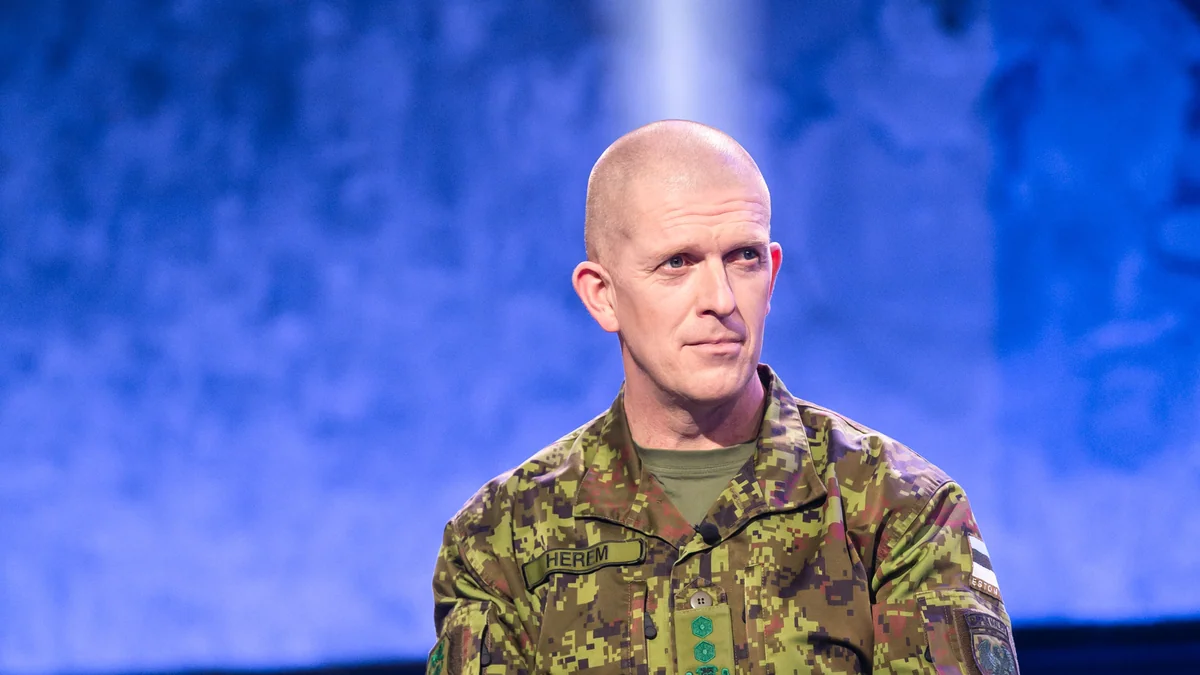
Monday, September 9, 2026. It started with a confirmation to ERR. Martin Herem is moving from the front lines of defense to the head of the Ministry of Defense. It took just one sentence to reshape the entire landscape of Estonian security policy.
This was not a decision made in a smoke-filled room by party bureaucrats. It did not emerge from weeks of coalition horse-trading. Prime Minister Kristen Michal made the offer personally. "I named him myself," Michal told Postimehe. While the Reform Party board discussed the name, the choice belonged to one person.
The formal signature will come on September 15, when the Reform Party leadership officially confirms the candidacy. Until that moment, we have a handshake and a pact, but not yet a signed contract. In the world of high-stakes politics, the gap between a promise and a signature is where the real work happens.
Anyone who has watched Estonian security over the last decade knows the name Martin Herem. He led the Estonian Defense Forces from 2018 to 2024. After that, he moved into the private sector as a strategic advisor. He is a man who understands weapons, procurement, and the cold reality of defending a border.
But this is not just a career change for a retired general. This is a move made against a backdrop of empty chairs, broken procurement deals, and a deep-seated rot of mistrust within the ministry walls. To understand why it is Herem, and why it is happening now, we have to look back at the events of September 3.
The Cost of Mistrust: 70 Million Euros and a Resignation
Hanno Pevkur stepped down as Defense Minister on September 3, 2026. The reason was a specific number: 70 million euros. That was the price tag on an ammunition procurement deal that raised too many questions about how things were done and who was responsible.
In politics, 70 million euros does not just disappear quietly. That is money meant for the ammunition the Estonian Defense Forces need to stay ready. But it is also taxpayer money. Every person who pays into the system, every coalition partner, and every international ally needs to know that those funds are handled with absolute clarity.
When that clarity vanishes, the minister follows. Pevkur's departure left a void in the ministry that officials call a "trust crisis." In plain language, it meant the staff in the office weren't sure who they were answering to, and the political leaders weren't sure what they were actually leading.
In the defense sector, this is more than an office problem. It is a dangerous situation where decisions must be fast and mistakes are always expensive. Herem's first job is to fix this. He has already stated publicly that he plans to reform internal management to make the line between the political level and the administrative level clear again.
We do not know the exact details of those reforms yet. But we know the first casualty. Herem made it a condition of his employment that the Secretary General, Kaimo Kuusk, must go. Kuusk is the man who was at the helm while this crisis of trust deepened. His last day will be September 15, 2026.
The Terms of the Deal: 5% and a Departure
Martin Herem did not come to the table empty-handed. Before he accepted the job, he laid out two non-negotiable requirements. These are the conditions the government had to meet just to get him in the door.
The first requirement is a number: 5%. Estonia's defense budget must stay at 5% of the Gross Domestic Product (GDP). This is not a target for the distant future or a goal to reach if the economy is good. For Herem, this is the floor. He will not work with anyone who allows defense spending to drop below that mark.
The second requirement was personal and immediate. He refused to work with the current Secretary General of the Ministry of Defense, Kaimo Kuusk. Herem made this demand public. The government gave in. Kuusk will leave his post on September 15, 2026, the same day Herem is formally confirmed.
What does this mean for the person sitting at their kitchen table? A 5% GDP commitment means defense is the undisputed priority in the national budget. It means that even when times are tight, this is the one area that will not be cut. It is a political promise that defense costs won't have to compete for funds against hospitals, schools, and pensions—unless someone starts asking very loud questions.
Herem's demand reduces the risk of those cuts, but it doesn't eliminate them. Do the arithmetic. That money has to come from somewhere. When we commit to 5%, we are making a choice about every other euro in the treasury.
The firing of a Secretary General before even taking office is a different kind of move. In a ministry, the Secretary General is the civil servant who manages the daily operations and holds the "long-term memory" of the institution. Replacing them is an internal shock to the system that costs time and resources. The choice was Herem's, but the price is paid by the whole system.
Setting conditions like this in public is a new custom in Estonian politics. Usually, these deals are made behind closed doors before anything is announced. Here, the conditions became public at the exact same time as the appointment. On September 15, 2026, when the Reform Party board meets, the Secretary General will already be gone.
The Path of the General
Martin Herem led the Estonian Defense Forces for six years, from 2018 to 2024. Those were the years when the defense budget grew, military planning was overhauled, and the security map of Europe was torn up and redrawn. Most Estonians don't know him from political rallies; they know him from press conferences where he spoke seriously about serious threats.
There is a detail in his biography that matters: Herem is the first Commander of the Defense Forces who was educated entirely in an independent Estonia. He is not a product of the Soviet officer training system. His entire worldview was formed in a country that had to build its own military culture from nothing.
After he left the military in 2024, he didn't disappear. He went to work for Milrem Robotics and Frankenburg Technologies—private companies in the defense industry where his expertise was in high demand. At the same time, he was named the "Professor of Future Thought" at the University of Tartu for the 2026/2027 academic year.
A general who becomes an academic and a corporate advisor is a path we usually see in Western Europe, not here. The Reform Party clearly sees him as a prize. An editorial in Delfi called Herem a "true political jackpot." You don't often hear those words used for a compromise candidate. The party wanted someone whose authority comes from years of service and a solid reputation, not a party card.
There are two ways to read his background. The first is that he is the person who knows exactly what the defense machine needs because he has lived inside it. The second is that he has spent the last few years working for the very companies that sell equipment to the Ministry of Defense. Both of these things are true. Both are important.
An Expert in a Political Seat
Herem was quick to point out that joining the Reform Party was not a prerequisite for the job. That sounds like a simple statement, but it is a calculated one. The party gets an expert with the authority of a man in uniform, but they don't have to answer for his personal political views.
Compare this to a typical party appointment. Hanno Pevkur was a Reform Party man through and through. When the scandal hit, it hit the party directly. Herem is built differently. His reputation is military, not political. This gives the party a buffer.
However, there is another side to this coin. A general moving directly into a top political role is a new phenomenon in our democracy. In NATO countries, the principle of civilian control over the military is considered sacred. When people start crossing that line from both sides, the line itself starts to blur.
Then there is the question of Milrem Robotics. Herem worked as a strategic advisor for companies that sell defense technology—potentially to the Estonian state. No one has yet explained publicly how this conflict of interest will be handled legally. The Delfi editorial was right; he is a jackpot for the party's image, but for the taxpayer, the question of transparency remains open.
The Questions That Remain
As we move toward September 15, four major questions are still sitting on the table. They are not small details.
First: Who will be the new Secretary General? Kaimo Kuusk leaves on September 15. If the replacement comes from inside the ministry, they bring continuity. If they come from the outside, they bring independence. We don't know which way the government will lean.
Second: What happens to Herem's role at the University of Tartu? He is supposed to be the "Professor of Future Thought" for the upcoming year. You cannot run a ministry and a professorship at the same time. No one has explained how that contract will be managed.
Third: The money. Herem demanded a defense budget of 5% of GDP. That is a massive political commitment that requires real cash. At the current size of the Estonian economy, 5% of GDP translates into billions of euros. The government has not said where that money will come from or which other budget lines will have to shrink to make room for it. The taxpayer has a right to know.
Fourth: The internal reform. Herem says he will restore trust between the politicians and the administrators. That is a fine phrase, but without a specific plan, it is just a promise.
These things matter. The Secretary General runs the daily life of the ministry. The professorship is a legal obligation. And five percent of GDP is a choice that affects every school and every clinic in the country. These questions won't go away. They will come back during budget debates, in Riigikogu committees, and in the procurement protocols of the coming year.
It is the public's job to keep asking them until Martin Herem, the minister, provides the answers.