Before Anyone Got Hurt: The Response That Worked
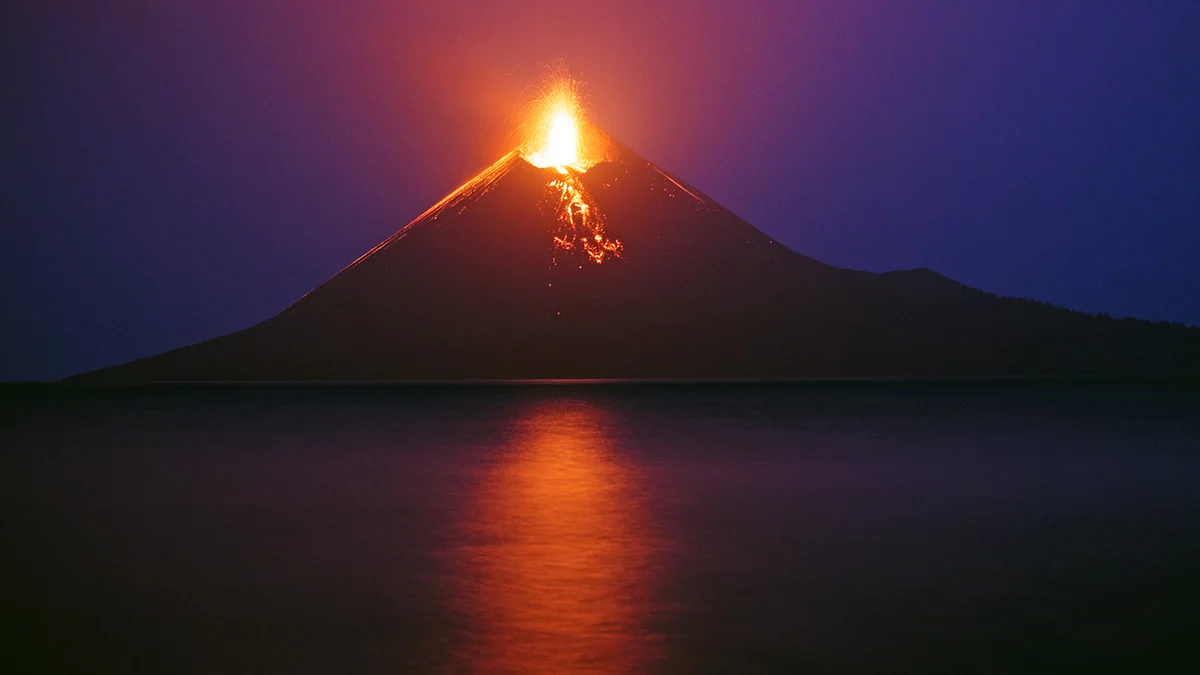
At 23:07 on September 4, 2026, Anak Krakatau began its most intense eruption in years. Within hours, airports across western Java were shutting down.
Not because a plane had been damaged. Not because an engine had swallowed ash and died mid-air. Because the system that exists precisely for this moment had worked.
PVMBG, Indonesia's volcanology agency, held the volcano at Level III (Siaga), the second-highest alert tier, from the eruption's opening hours. VAAC Darwin, the regional Volcanic Ash Advisory Centre, issued advisories that fed directly into NOTAMs, the official notices that close airspace. The logic is not bureaucratic caution.
Volcanic ash is silica glass. Inside a jet engine at operating temperature, it melts, re-solidifies, and kills thrust. The only safe response is grounding, and that is what happened.
A 3-kilometre exclusion zone was established around the crater. Six airports closed. More than 500 flights were cancelled across the region.
Japan's Meteorological Agency, monitoring seismic signals reaching across the Pacific, confirmed no significant sea-level changes at coastal stations. No tsunami threat. The two worst outcomes — a flameout over the Sunda Strait, a wave hitting a crowded Java coastline — were both ruled out inside the first day.
The number worth holding onto is from 2018. The last major Anak Krakatau event, a flank collapse and surprise tsunami, killed over 400 people. In 2026, with more sensors, faster protocols, and agencies that had learned from that catastrophe, the aviation and tsunami fatality count stood at zero.
Twenty-two thousand passengers were stranded and frustrated. That is a real cost. It is not the same cost.
What Anak Krakatau Actually Did
The eruption sent ash to two separate altitudes: a lower column topped at 20,000 feet and a second, far taller plume that reached 50,000 feet. That upper figure is not incidental. Transcontinental jet routes cruise between 35,000 and 42,000 feet.
A plume at 50,000 feet does not threaten to clip those corridors — it fills them.
The scale of the event registered far beyond the Sunda Strait. Booming sounds from the explosive degassing were audible up to 700 kilometres away. Volcanic tremors were strong enough that the Japan Meteorological Agency tracked them from its monitoring stations — roughly 5,500 kilometres north.
The JMA also confirmed no significant sea-level changes at Japanese stations, ruling out a distant tsunami risk. The fact that its instruments registered the eruption at all tells you something about the energy released.
Context matters here. Anak Krakatau is not simply another Indonesian volcano. It grew inside the caldera carved by the 1883 Krakatoa eruption, one of the most destructive volcanic events in recorded history — an event whose pressure wave circled the Earth four times.
The child inherits the same plumbing, the same geological tension between Java and Sumatra along one of the most seismically active corridors on the Pacific Ring of Fire. Indonesia monitors dozens of active volcanoes precisely because this stretch of crust is never truly quiet.
The PVMBG held the alert at Level III (Siaga), the second-highest tier in Indonesia's four-level warning system. That designation carries legal weight: it triggers the exclusion zones, the aviation notices, the shutdown sequence. The science drove the decision.
Why Volcanic Ash Grounds Flights: The Silica Problem
Volcanic ash looks like smoke. It behaves like ground glass. The distinction matters enormously at 35,000 feet.
The particles ejected by Anak Krakatau are not soft soot. They are pulverised rock and silica, sharp-edged and abrasive, formed when magma shatters violently on contact with air or water. Inside a jet engine, temperatures exceed 1,400 degrees Celsius.
Volcanic glass melts at around 1,100. The ash liquefies, coats the turbine blades, and re-solidifies as it moves toward the cooler rear of the engine. The result is a blocked, unbalanced turbine — and, at the extreme, a flameout.
The 1989 KLM Flight 867 incident near Alaska's Redoubt volcano, where all four engines failed before pilots managed a restart, wrote this risk permanently into aviation protocol.
The system that responded here is standardised and automatic. VAAC Darwin, the Volcanic Ash Advisory Centre responsible for this region, issues Volcanic Ash Advisories when a plume is detected. Those advisories automatically trigger NOTAMs — Notices to Air Missions — which have legal force: airspace closes, and aircraft stay on the ground.
Anak Krakatau gave the system two problems at once. The lower ash column reached 20,000 feet, directly within the cruise altitudes used by short-haul domestic routes. The higher plume hit 50,000 feet, cutting through the flight levels used by widebody international jets crossing between continents.
Both bands had to be treated as contaminated. Six airports closed.
That is not a precaution. That is the protocol working exactly as it was designed to after incidents that proved the alternative is unacceptable.
22,800 Passengers, 516 Flights, Six Airports: The Aviation Standstill in Numbers
By Sunday afternoon, six airports had gone quiet. Soekarno-Hatta (CGK), Halim Perdanakusuma (HLP), Radin Inten II, Husein Sastranegara, Pondok Cabe, and Budiarto — all closed, one after another, as the ash advisory from VAAC Darwin tracked the plume northwest across Java. The closures were not precautionary in the vague, bureaucratic sense.
They were the direct consequence of a silica cloud that could have turned turbines into slag.
At Soekarno-Hatta alone, 301 flights were cancelled or delayed. Break that figure down and the shape of the disruption becomes clear: 233 domestic routes, 58 international, 10 cargo. Those numbers mean a family stranded mid-connection, a freight consignment sitting on a tarmac, a business traveller rerouting through Kuala Lumpur and adding nine hours to a one-hour journey.
Multiply it across the region and the total reaches 516 flights and approximately 22,800 passengers. That is roughly the population of a small Estonian town — Haapsalu, give or take — suddenly holding worthless boarding passes.
International carriers felt it immediately. Singapore Airlines cancelled 19 Singapore-Jakarta flights in a single day. Malaysia Airlines cut 12; Thai Airways, four.
Those are not marginal routes. The Singapore-Jakarta corridor is one of the world's busiest international flight paths, a commercial artery carrying business traffic, migrant workers, and tourists at a volume that most European hub-to-hub pairs cannot match. When it closes, the pressure does not disappear — it redistributes, jamming alternative routes and overwhelming airport lounges from Changi to Kuala Lumpur International.
The headline number, 22,800, is real but probably conservative. It counts confirmed disruptions, not the knock-on delays that ripple through connecting schedules for days. The geography made it worse: the Sunda Strait sits at the intersection of Java and Sumatra, meaning ash drift in almost any direction reaches an airport.
Life Under the Ash: Schools, Fishing Boats, and Yards Swept Every Five Minutes
Airports get the headlines. The slower story plays out on the ground.
In Lampung and West Java, residents described a different kind of emergency: fine grey ash settling on every surface, thickening with each hour. Aldi Candra Prayogi, a local resident, told the BBC it felt like small grains of sand had gotten into his eyes.
The dust fell so heavily that sweeping a yard every five minutes was not hyperbole. It was a maintenance schedule.
Compare that to the 2018 eruption. Then, the immediate danger was a tsunami. The threat arrived in minutes, killed over 400 people, and was over.
This time, the hazard is slower and more diffuse: silica particles suspended in air, settling into lungs, onto fishing boats, across school courtyards.
Authorities advised residents to wear masks and stay indoors. Both are reasonable instructions. Neither is simple to follow in a tropical climate, in crowded housing, for people whose work is outdoors.
Schools in the affected areas cancelled activities. Fishing trips in the Sunda Strait were halted entirely: surface ash and reduced visibility made navigation dangerous, not dramatic. Local fishermen lost working days to a hazard they could not see clearly and could not outrun.
In 2026, with more sensors, faster protocols, and agencies that had learned from that catastrophe, the aviation and tsunami fatality count stood at zero.
The shift from acute physical danger to prolonged public health management is the less-told story of a slow-settling eruption. A tsunami is a crisis with a clear end.
Ash is a chronic condition until the wind changes. The residents of Lampung already know the difference.
The Honest Scorecard: What Worked, What It Cost, and What Nobody Knows Yet
The coordination held. PVMBG had Anak Krakatau on Level III alert before the ash column reached 50,000 feet. VAAC Darwin issued advisories.
BMKG and JMA tracked both the tremors and the sea-level readings. The 3-kilometre exclusion zone went up. Crucially, no aircraft flew into the plume and no jet engine ingested silica glass.
After the 2018 collapse that killed more than 400 people with almost no warning, the institutions appear to have learned. That is worth stating precisely: the system worked the way it was supposed to.
What is harder to state precisely is the cost. The 48-hour closure of six airports cancelled 516 flights and stranded 22,800 passengers. Airlines including Singapore Airlines, Malaysia Airlines, and Garuda Indonesia absorbed the operational losses.
The exact figure — what carriers paid in rebooking, compensation, and repositioning, what airport operators lost in fees, what Lampung's tourism businesses lost in a weekend — has not been published. It should be. Knowing the price of a volcanic event is not morbid accounting; it is the only way to make the case for investing in the monitoring that prevents a worse one.
The unknowns are structural. Nobody can say with confidence how much magma remains in the system, whether the cone faces further collapse risk, or when smaller airports like Radin Inten II will reopen. Those are not failures; they are the honest limits of volcanology.
The proportionate response to an Anak Krakatau eruption is not to reroute aviation corridors away from the Sunda Strait permanently. It is to make the monitoring network — PVMBG, BMKG, VAAC Darwin, JMA — permanently funded, regionally shared, and immune to budget cycles.
That is not a gesture. That is a lever.