286 Days: The Number That Ends the Argument
In the autumn of 1974, the USS Midway left San Diego for Yokosuka and did not return for five years - not a deployment but a permanent forward basing, a different logic entirely. The USS Abraham Lincoln's maintenance crisis is different in the way that matters: it was never supposed to stay. The Navy's own doctrine sets seven months as the outer limit before the compounding costs, mechanical and human, begin to exceed the operational return.
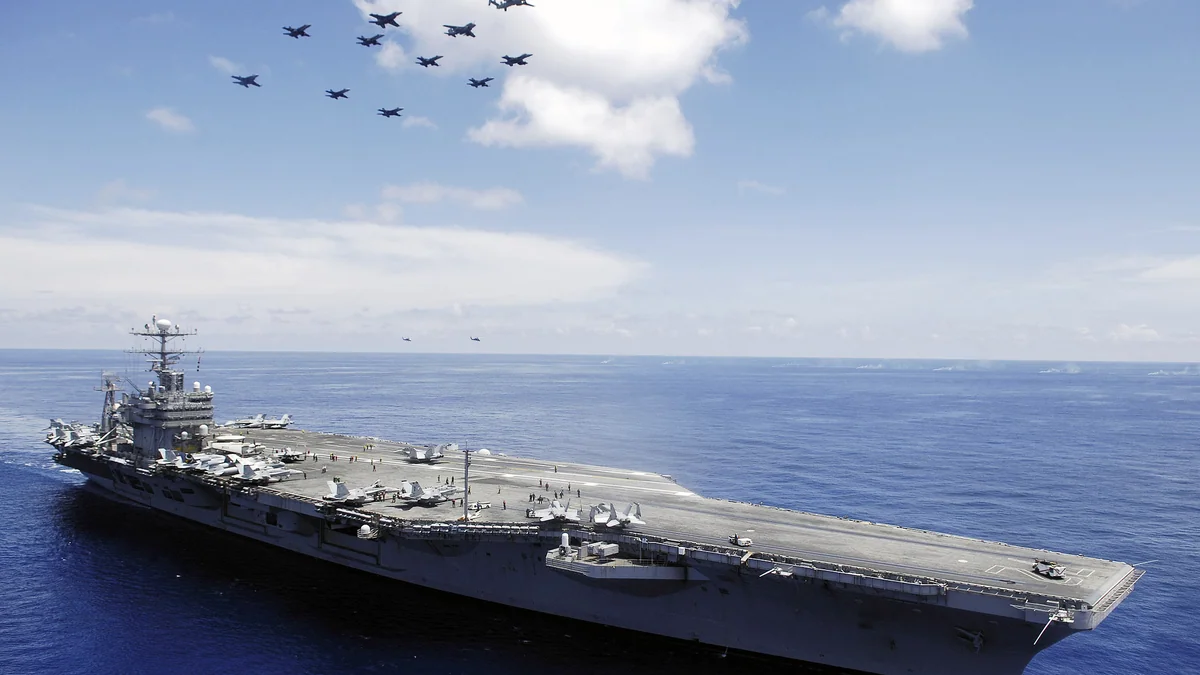
The Lincoln left on November 21, 2025. As of September 2, 2026, it has been at sea for 286 days. That number does not require interpretation.
Buried inside the 286 is a harder figure: 207 consecutive days without a port call, a modern record that the Navy's own planning frameworks implicitly condemn. Port calls are not amenities. They are the structural interval at which a ship's systems are reset and its crew's psychology is allowed to decompress below the threshold of crisis.
The operational alibi is real and should be stated plainly. Operation Epic Fury - the strike campaign against Iran launched February 28, 2026 - generated over 10,000 sorties and the delivery of 1.5 million pounds of ordnance. That is a serious wartime pace, and it explains the tempo. It does not explain the absence of the infrastructure required to sustain it.
Scale of campaign and adequacy of logistics are separate questions. The Lincoln answers both. The argument about whether the Navy was prepared for what it committed a carrier strike group to do - that argument, 286 days later, is settled.
When the Hub Falls: Bahrain, Diego Garcia, and the Elasticity of Nothing
In February 2026, Iranian missiles and drones destroyed the Navy's primary logistics base in Bahrain. The event was precise in a way that strategic planners prefer not to think about: one hub, one strike, one cascade.
What Bahrain provided was not merely fuel and ammunition. It was the repair capacity, the medical infrastructure, the resupply rhythm that a crew of 5,000 people requires to remain functional across months at sea. Remove it and you do not slow the deployment. You hollow it out from the inside.
The Navy rerouted through Diego Garcia. That island sits in the middle of the Indian Ocean, a British colonial remnant leased to Washington - ask who paid the original price for that arrangement, and you find the Chagossians, expelled between 1968 and 1973 so the base could exist. The geography is a useful fact and also a structural one: Diego Garcia extended the supply line by thousands of miles, across an ocean, into a chain with no redundancy. Elasticity, in logistics, means the capacity to absorb a shock without breaking. The reroute did not demonstrate elasticity. It demonstrated that there was none.
Ask the small question first: who is the borderland here, and who is the empire? The Lincoln's sailors were not the borderland. They were the load-bearing wall. Diego Garcia held, barely. Everything carried through it - food, parts, medical supplies - arrived slower, in smaller quantities, in a vessel already past the point where the original assumptions about duration made any operational sense.
Two Tortillas and a Service Dog: The Human Cost of the Navy's Carrier Deployment Crisis
The food ration recorded aboard the USS Abraham Lincoln during the 207-day stretch was two tortillas and a half-cup of rice per meal. That sentence requires no adjective.
The ship's store ran out of soap, toothpaste, and basic toiletries sometime during the same stretch, collapsing the distinction between combat deprivation and ordinary institutional neglect. A sailor rationing the last bar of soap is not in a war story. He is in a logistics failure. The difference matters, because one of those can be planned against.
Multiple sailors reportedly attempted to jump overboard. That is the extreme psychological endpoint of an unbroken 207 days without port - not an anomaly to be explained away, but a datum that belongs in any honest accounting of what sustained operational tempo costs in human units. The mental health infrastructure available to a crew of five thousand: five chaplains, one psychologist, one service dog.
Acting Navy Secretary Hung Cao told lawmakers the ship would return home soon, and denied reports of deployment-related deaths. "Nobody died," he said. Fifty House Democrats, unconvinced, signed a letter demanding a formal investigation into living conditions aboard the Lincoln. Whether that letter opens a real inquiry or becomes a filing exercise is the question worth watching.
The political surface of a human crisis rarely matches the depth of the crisis itself. What the record shows - the ration, the empty shelves, the overboard attempts, the five-to-five-thousand support ratio - is a system that consumed the people inside it and then asked its appointed spokesman to say otherwise. Washington can paper over numbers. The numbers stay.
The Hull as Evidence: Oxidation, Rust, and Holes in the Flight Deck
The flight deck of the USS Abraham Lincoln did not arrive in Thailand bearing battle damage. It arrived bearing something quieter and, in its way, more damning: oxidation spreading across the steel, heavy rust where protective coatings had long since surrendered, and holes worn through the deck plating by operational attrition alone. Over 10,000 sorties and 1.5 million pounds of ordnance had been cycled through that deck without the maintenance intervals the hull required. The evidence was not dramatic. It was structural.
Brynn Tannehill's observation - that "the ships are breaking almost as fast as the people" - is not a metaphor. It is a diagnosis. The catapult systems and flight deck surfaces degrade on the same curve as the crew operating them: incrementally, invisibly, and then all at once. Standard maintenance intervals exist precisely because metal and human beings share one property that no operational tempo order can repeal: both fail when run past their tolerances.
The ships are breaking almost as fast as the people.
What restoration will cost has not been named publicly. That silence is itself a data point. The Navy that lost 15,000 operational days over the last decade to maintenance delays now holds a Nimitz-class carrier whose repair bill remains unquoted. The hull arrived as evidence. The question is whether anyone in Washington intends to read it.
The Ledger the GAO Brought: A Decade of Deferred Maintenance
The GAO audit released in August 2026 did not describe an aberration. It described a system. Over the preceding decade, the Navy lost 15,000 operational days to maintenance delays - time when ships sat pier-side, neither deployable nor in dry dock, simply waiting. The Lincoln's crisis is the culmination of that ledger, not a footnote to it.
The cost of that decade runs to $3.4 billion in additional expenses incurred by deferring what should have been routine. Compare this to any allied navy's maintenance scheduling and the divergence is not subtle: the Royal Navy, under sustained fiscal pressure, still manages to cycle its surface fleet through planned maintenance windows with tolerable predictability. The U.S. Navy, commanding the largest defence budget on earth, does not. CBO data shows destroyer maintenance now runs between 20 and 100 percent longer than original estimates - a range so wide it is less a planning variance than an admission that planning has effectively ceased.
The ghost fleet paradox sharpens the absurdity. The USS Pasadena has sat in inactive idle status since January 2025, consuming $300 million while awaiting decommissioning - money spent maintaining a ship that provides zero operational value, while active hulls deteriorate at sea for want of the same resources. The GAO projects fifteen attack submarines will enter that same limbo by 2030. A navy that cannot repair its working ships is simultaneously spending heavily to store its broken ones. That is not a budget problem. That is a structural failure in which the decorative line item - the headline fleet number - is preserved while the load-bearing capacity quietly collapses beneath it.
What the Investigation Will Have to Name
Adm. Daryl Caudle did not dress the failure in operational language. Seven-month deployment targets, he said, represent "an earnest attempt that is currently failing." That is a load-bearing wall named by the man who holds it up - and it is the only honest sentence in the official record of this deployment.
Pete Hegseth called the condition reports "fake news." The documented record disagrees: 15,000 operational days lost, $3.4 billion in additional costs over a decade, holes worn through a flight deck, and a crew rationed to tortillas while Acting Navy Secretary Hung Cao assured lawmakers the ship would come home soon. The gap between the communiqué and the primary source is, at this point, measurable in rust.
Fifty House Democrats have signed a letter demanding an investigation. Read the mandate language carefully when it arrives. If the final report names dry dock capacity and operational tempo doctrine as co-causes, the Navy's maintenance crisis has a structural reckoning ahead of it. If it names only supply chain execution, this will be back on your screen before the Lincoln is operational again - and Caudle's admission will have meant nothing at all.