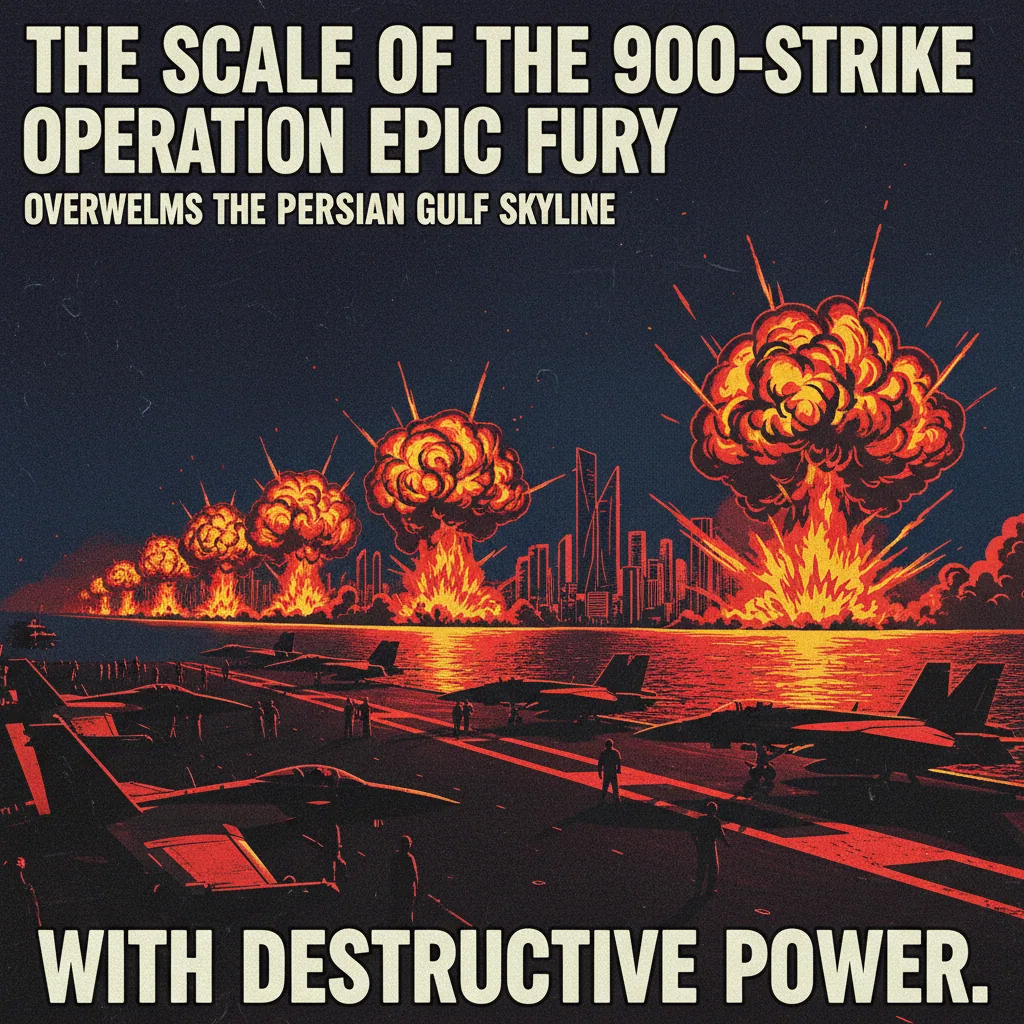
On February 28, 2026, the US-Israeli Operation Epic Fury killed Supreme Leader Ali Khamenei, collapsing Iran's four-decade proxy architecture. The Iran-US direct confrontation that followed involved sixteen American bases struck, $37.5 billion in Pentagon expenditure, and ballistic exchanges over the Strait of Hormuz by September 1, 2026.
The Hinge: How the Iran-US Shadow War Stepped Into Daylight
The 1980 Iraqi assault on Khuzestan province opened with a premise that Tehran would fold quickly, that the blow would be decisive, that the map would settle. It did not settle. The precedent is useful only if you immediately name where it breaks: that war ran eight years on attrition between two regional powers, with the great ones supplying both sides from a careful distance. What happened on February 28, 2026 was something structurally different — not a proxy handed a weapon, but the principal itself arriving on the target list.
Operation Epic Fury, the coordinated US-Israeli air campaign launched that date, killed Ali Khamenei. That sentence deserves to sit alone for a moment. The deterrence architecture of four decades — the calculated ambiguity, the use of Hezbollah and the Houthis and the Popular Mobilization Forces as the pointing hand that left the fist deniable — dissolved with the man who had been its central load-bearing weight. What replaced him was not a successor with equivalent legitimacy but a committee, the Higher National Security Council alongside an IRGC command that now held the guns and the grievance simultaneously.
The path back to open hostilities ran through a wedding party. A US strike killed five people at the event; Iranian retaliation struck US bases in Bahrain, Jordan, and Iraq. A 60-day ceasefire, signed in Switzerland in June 2026, briefly interrupted the exchange. It did not hold, because a ceasefire that addresses the symptom and not the structural cause is not a ceasefire — it is a calendar.
September 1: The Strikes, Larak Island, and the Day Before
The sequence has a logic, if you read it in order. A US strike killed five people at a wedding party. Iran responded by hitting American bases in Bahrain, Jordan, and Iraq. Washington did not back down. The machinery of symmetrical escalation had found its rhythm, and each move was now generating the next.
On August 30, CENTCOM struck Larak Island, targeting missile launchers that Iranian forces had positioned there for mine-laying operations in the Strait. The island is small, the mission was specific, and the strategic signal was not: the US was willing to go inside Iranian territory, not merely intercept at the perimeter. One day later, on August 31, Iran fired ballistic missiles at two American airbases in Jordan. That exchange closed the question of whether this was still a war of proxies and plausible deniability. It was not.
September 1 brought the larger answer. CENTCOM struck IRGC radar installations, air defense networks, and naval assets across the Strait of Hormuz — a set of targets chosen to degrade Iran's capacity to surveil and close the waterway. The targeting list was, in the language of doctrine, about restoring freedom of navigation. The operational reality was something colder: the US was systematically dismantling the sensor architecture that allowed Iran to threaten 20 percent of global oil transit on any given morning. Ask the small question first: who is the borderland here, and who is the empire? In the Strait on September 1, there was no borderland. There were two states exchanging direct fire, and the water between them carried the world's energy.
Sixteen Bases and the Limits of the Patriot
Sixteen US bases across the Middle East were struck. Radar networks degraded, troop rotations disrupted, positions abandoned. The number is not metaphor; it is the operational ledger of a fixed-base posture that was designed for a different threat.
The Patriot system's limits are not new knowledge in defence circles, but the IRGC forced the question into the open. Iranian ballistic missiles with mid-flight course-change capability threaded past intercept envelopes that were calibrated for trajectories that hold their line. A missile that turns is not the missile the battery was briefed on. The practical meaning: the architecture the United States has spent forty years and considerable money building into the Gulf did not perform as advertised, at a moment when performing as advertised was the entire argument for staying.
The human ledger is blunt. At least 18 US military personnel were killed and over 600 wounded. Iranian casualties are estimated between 3,500 and 6,900, with over 1,500 of those civilians. Those two sets of numbers sit beside each other in the record, and neither cancels the other.
What the base damage reveals is structural, not incidental. If the forward-deployment model requires permanent, fixed, large-footprint installations within missile range of an adversary willing to use them, then the model has a load-bearing problem — not a maintenance one. The Pentagon can relocate troops. It cannot easily relocate the doctrine that concentrated them in the first place.
The practical question for any planner reading the September exchange is not whether Patriot can be upgraded. It is whether the geography of US power projection in the Gulf has become a liability that the hardware cannot remedy.
A ceasefire that addresses the symptom and not the structural cause is not a ceasefire — it is a calendar.
The Uninhabitable Base: When a Fitness App Becomes a Target List
In early 2018, a global heatmap published by the fitness tracking company Strava illuminated the running routes of US personnel at classified installations across Syria, Niger, and Afghanistan. The bases glowed like cities. Nothing had been hacked; the soldiers had simply logged their workouts.
The lesson was not learned. By the time Iranian targeting cells were working through the problem of fixed US infrastructure in 2026, more than 1,300 Strava users at American bases across the Middle East had inadvertently contributed their location data to what amounted to a free, continuously updated survey of perimeter layouts, shift patterns, and high-traffic corridors. No signals officer required. No embassy cut-out, no asset to burn. The aggregation of open-source consumer data had replaced a classical collection cycle — one that would have taken months and cost money Iran did not have to spare.
The institutional failure this exposes is older than the app. US forward-basing doctrine in the Gulf was built for a threat environment in which an adversary had to work for its targeting intelligence. The smartphone dissolved that assumption quietly, years before the first missile left its launcher. Doctrine designed for one world does not automatically update when that world changes — and the gap between what the architecture assumed and what Iran actually needed to strike is, at this point, structural, not incidental. Sixteen bases struck. The list was not a secret.
The Strait as Verb: Hormuz, the $37.5 Billion Ledger, and a Wounded Presidency
The Strait of Hormuz is eleven miles wide at its narrowest point. Twenty percent of global oil transits it. Those two numbers, held together, explain why Iran has treated the strait not as geography but as syntax — a verb it conjugates whenever Washington turns the pressure dial.
The comparison that matters here is not 1973 Suez or even the 1987 Tanker War, though both get reached for reflexively. Those crises involved a chokepoint threatened. This one involves a chokepoint contested by a state that has already absorbed the loss of its supreme leader and is still mining the approaches. The threat calculus is different when the party holding the lever has nothing obvious left to lose from using it.
By July 2026, US Secretary of Defense Pete Hegseth acknowledged direct military expenditure exceeding $37.5 billion. That figure does not price the rerouting costs absorbed by Asian importers, or the insurance surcharges already baked into every cargo manifest east of Aden. It prices only what the Pentagon spent — which is a floor, not a ceiling.
Then there is the governance question, which no ledger captures. Iranian President Masoud Pezeshkian was reportedly wounded during the exchanges. The Higher National Security Council and the IRGC command structure have been making the operational calls since Khamenei's death in February. A wounded presidency atop a headless supreme leadership is not a negotiating partner in any conventional sense — it is a question of who, precisely, would sign a ceasefire, and whether that signature would hold past the next IRGC commander who disagrees.
The Vacancy at the Top: What to Watch Now
Ali Khamenei died in the February strikes. That sentence contains the structural problem: the Islamic Republic was not designed to function without a Supreme Leader, and seven months on, no permanent successor has been named. The IRGC and the Higher National Security Council have filled the vacuum, but filling a vacuum is not the same as resolving it.
Masoud Pezeshkian, wounded and reportedly displaced, remains the formal president. Whether that office retains any load-bearing function or has become decorative is the question no communiqué yet answers. The IRGC now controls the escalation dial; the clerical establishment retains the legitimating theology; neither controls the other cleanly.
This is the marker to watch: not the next missile salvo, not the oil price on a Tuesday morning, but the naming of a Supreme Leader successor and who controls that process. If the IRGC drives the appointment, the Islamic Republic's decision-making architecture has militarised permanently. If the clerical establishment prevails, some negotiating channel remains. A ceasefire in the Iran-US confrontation signed before that question settles is a document in search of a signatory.