A Thousand Volunteers, Two Thousand Pairs of Underwear, and One Clear Finding
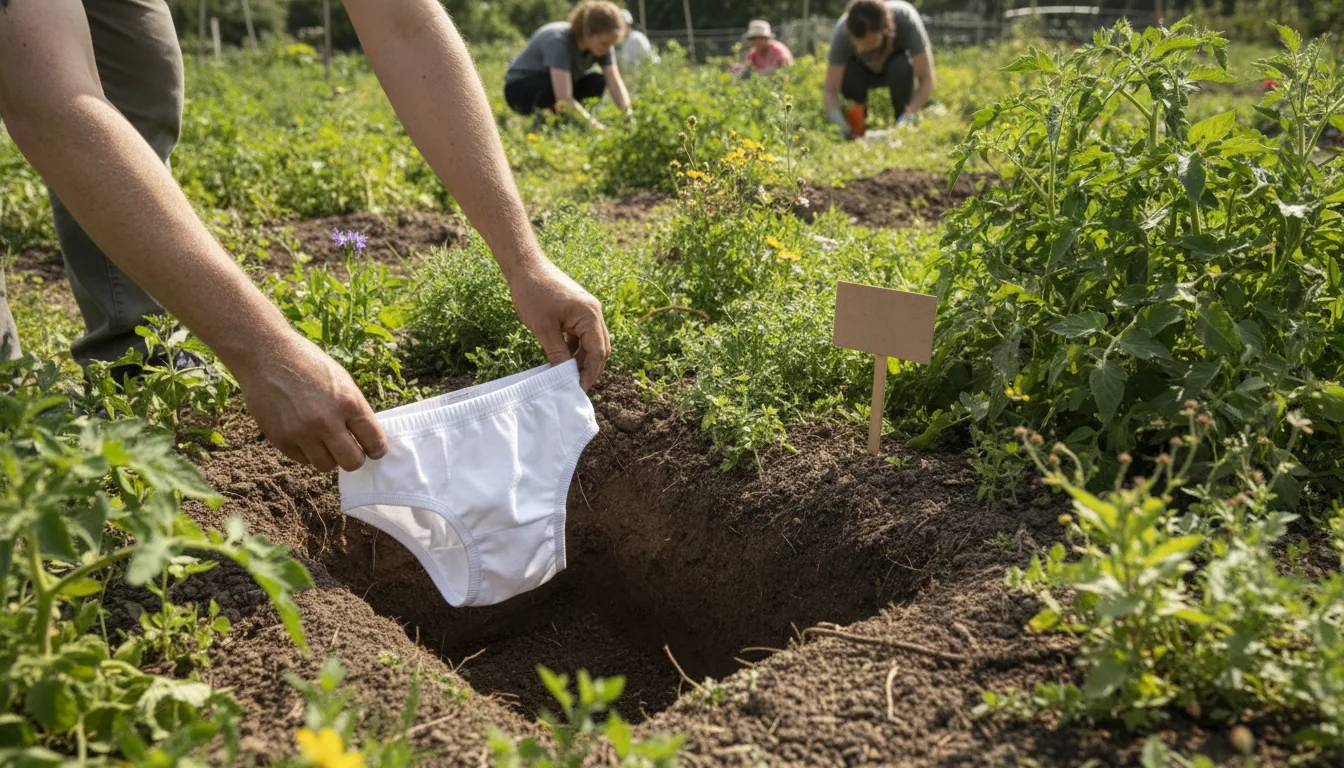
In the spring of 2021, researchers at the University of Zurich and Agroscope, Switzerland's federal agricultural research institute, sent a strange package to a thousand volunteers: cotton underwear and tea bags, with instructions to bury them. Not a prank. A study. By the time participants dug their garments back up sixty days later and mailed photographs and soil samples to the researchers, the project had generated one of the largest citizen-science datasets on soil health ever assembled in Europe.
The logistics alone were remarkable. One thousand citizen scientists. Two thousand pairs of underwear buried at one thousand locations across Switzerland. Twelve thousand tea bags placed alongside them as a cross-validation layer. Each pair had to be buried at a standard depth, left for exactly sixty days, then carefully retrieved, documented, and dispatched to the lab. The sheer coordination required - volunteers photographing decomposed briefs at kitchen tables before posting them to researchers - is either absurd or inspired, depending on how urgently you think soil health needs public attention.
The headline result was sharp and clear. Private gardens produced an average decomposition rate of 58 percent after two months, while manicured lawns managed just 40 percent. That 18-percentage-point gap is not a rounding error. It is a measurable biological difference between two types of land that look, to the naked eye, equally green. The more carefully tended the surface, the less life appeared to be working underneath it. One number, collected by a thousand non-specialists with garden trowels, said something that years of specialist reports had largely failed to communicate: what we do to soil matters, and we can see it.
Why Cotton Underwear Works as a Scientific Instrument
Cotton is almost pure cellulose - the long-chain organic polymer that soil microbes have been dismantling for hundreds of millions of years. Bacteria and fungi secrete enzymes called cellulases that cleave cellulose into simple sugars, which the microbes then consume. The more biologically active the soil, the faster the fabric falls apart.
That chemistry is what makes the test valid. Bury a pair of 100% white cotton briefs and you are placing a calibrated food source directly into the microbial community. The fabric's destruction is a proxy for the community's vitality - not its chemical composition, not its pH, but how alive it is.
The protocol is specific for good reason. Underwear goes in at three inches deep and stays for exactly 60 days. That depth sits in the zone of highest microbial density, and 60 days is long enough to produce measurable differences across soil types without allowing complete decomposition to flatten the data. Standardisation matters here the way it does in any experiment: change the burial depth or the duration and you change what you are measuring.
The fabric must be 100% white cotton. Synthetic fibres such as polyester resist microbial attack entirely - a polyester brief would emerge pristine from any soil, healthy or dead, and tell you nothing. Some dyes also inhibit microbial activity, which is why white is mandatory.
What the underwear format replaced is worth noting. The cotton strip assay has existed since the 1940s, but the original method required tensile-strength machines costing thousands of dollars to measure how much pulling force a degraded strip could withstand before snapping. Dr. Oliver Knox of the University of New England converted that lab procedure into a visual check anyone can perform at home. That's not a gesture. That's a lever.
The Lawn Paradox: What the Underwear Index Says About "Tidy" Green Space
The Swiss data produced one finding that should make every lawn-proud homeowner pause. Manicured lawns averaged just 40% decomposition after sixty days. Private gardens, by contrast, hit 58%. That 18-percentage-point gap has nothing to do with how the soil looks and everything to do with how it is managed.
Land-use type turned out to be a stronger predictor of decomposition than most measured chemical soil properties. That matters because the standard agronomic toolkit - NPK tests, pH strips, conductivity meters - reads the chemistry. The underwear index reads the biology. A lawn can carry perfectly respectable nitrogen levels while hosting a microbial community so suppressed by compaction, mowing regimes, and herbicide use that it barely functions.
The biology is sensitive to things no test kit captures in a single sample. Microbial activity shifts sharply with temperature and moisture, which is why soil from a shaded, water-retaining garden bed behaves differently from sun-baked, drainage-optimized turf. "Tidy" green space tends to optimize for appearance, and appearance turns out to be a poor proxy for life.
Here is the catch that Franz Bender of Agroscope was careful to name: 58% decomposition in gardens is not automatically a clean bill of health. Rapid breakdown can signal nutrient oversupply - too much organic matter added, microbial populations running hot on fertilizer rather than on balanced ecology. Maximum decomposition is not, in his words, desirable in every ecosystem. The goal is a Goldilocks zone: active enough to cycle nutrients and build organic matter, but not so turbocharged that the system is burning through inputs faster than it can bank them. The lawn fails the test. The over-fed garden might be passing it for the wrong reasons.
Land-use type turned out to be a stronger predictor of decomposition than most measured chemical soil properties.
The Underground Majority: Why Soil Biology Is the Ecosystem Everyone Ignores
Reach down and grab a teaspoon of soil from a healthy garden. That small smear contains more microbes than there are humans on Earth. Bacteria, fungi, nematodes, mites - a civilization dense enough to make a rainforest canopy look sparse. Most people never think about it because none of it is visible, and soil science has done a poor job of making it feel real.
The numbers that frame what is at stake are genuinely staggering. More than half of all estimated global biodiversity lives below ground - not in forests, not in coral reefs, but under our feet, in a system we are only beginning to understand and already degrading at scale.
That degradation has a cost measured in food, not just ecology. Declining soil health is already driving food insecurity across multiple continents and accelerating desertification in regions where the margin between arable land and dust is measured in centimetres. Lose the microbial engine, and you lose the fertility cycle. Lose the fertility cycle, and the land stops producing before the rains even stop coming.
The tragedy is practical, not sentimental. Healthy soil grows food, filters water, and locks carbon underground where it belongs. A compacted, chemically exhausted field cannot do any of those things, regardless of how much fertilizer you pour on top.
From a 1940s Lab Test to a Global Citizen-Science Campaign
The cotton strip assay is not new. Soil scientists have been burying strips of fabric and measuring how fast microbes destroy them since the 1940s. The catch was the equipment: reading the result meant running the degraded strip through a tensile strength tester, a machine that lives in a laboratory, not a garden shed.
That changed when Dr. Oliver Knox at the University of New England swapped the strip for a pair of briefs roughly five years ago. Cotton underpants are woven from the same cellulose the test has always relied on. They are cheap, standardised, and the result is legible to anyone: the more your underwear has been eaten, the busier your soil life. A lab instrument became a kitchen-table tool.
The idea spread fast because the barrier to entry was absurdly low. The USDA Natural Resources Conservation Service launched its own version, "Soil Your Undies," in Oregon in December 2018, asking farmers to bury a pair and dig them up two months later. A federal agency reaching farmers through their underwear drawer is not the obvious image of agricultural extension, but the campaign worked precisely because the protocol needed no training to follow.
The Swiss researchers added one further check. They buried 12,000 tea bags alongside the 2,000 pairs of underwear, cross-referencing results against the established Tea Bag Index. The Underwear Index correlated closely with it. That cross-validation matters: a method is only as useful as the evidence that it measures what it claims to. Australia's CottonInfo program adopted the same challenge format, proof that when entry costs are a pair of briefs, a regional test can scale into a global one.
The Honest Scorecard: What This Index Measures, and What It Cannot
The Underwear Index earns its keep on two counts. First, it captures biological soil activity - microbial metabolism, enzymatic output, decomposition rate - that a standard NPK chemical panel simply ignores. Second, it scales: 1,000 volunteers, 2,000 pairs of underwear, 1,000 locations, no laboratory required. That is genuine democratization of soil monitoring, and the correlation with 12,000 validated tea-bag readings confirms the signal is real.
The limits are just as specific. The 60-day burial window was calibrated in Swiss temperate conditions; whether it holds in arid or tropical climates - where temperature and moisture drive microbial activity far outside European norms - remains untested. The 100% cotton requirement is likewise precise: synthetics don't decompose, and some "cotton" garments carry trace chemical treatments that may suppress the microbes you are trying to measure, quietly skewing the result.
Interpretation adds another layer of uncertainty. As Franz Bender of Agroscope noted, rapid decomposition is not unconditionally good - in over-fertilized gardens or nitrogen-saturated forest soils, high activity can signal nutrient oversupply rather than ecological balance. And the index's long-term correlation with crop yields across diverse agricultural systems outside Switzerland remains, for now, untested.
So: bury a pair, read the result, then ask the management question. Not as a gesture toward caring about soil health. As a starting diagnostic - the first number in what should be a longer conversation between you and what lives beneath your feet.