The Day Africa's Only Nuclear Plant Blinked Because of Fish
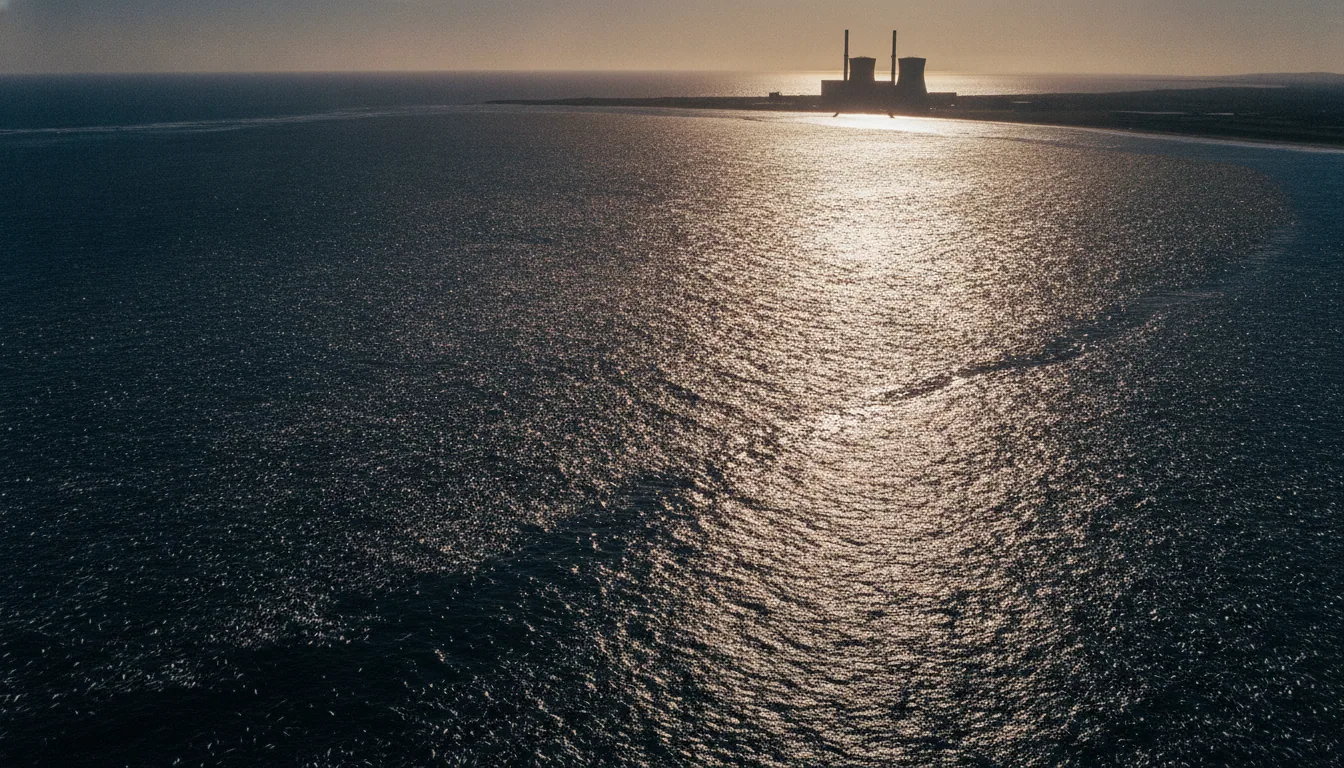
On the morning of August 21, 2026, engineers at Koeberg Nuclear Power Station, sitting on the Atlantic shore north of Cape Town, had a problem that no reactor manual quite prepares you for: the sea was sending them dead sardines. Billions of them. The fish were packed so densely against the station's seawater intake screens that Unit 1 had to cut its output by half. Africa's only nuclear plant, throttled not by a failed valve or a control-room alarm, but by a plague of small, silver fish.
The sardine mass mortality had been building for weeks before it reached Koeberg's filters. The first reports came in early August along South Africa's west and south coasts: Saldanha Bay, Hout Bay, Betty's Bay, Gansbaai, Cape Canyon. Beaches lined with silver.
The acute wave was already easing by August 16, the fish floating slower to shore. But the sheer volume of the kill had already set its consequence in motion, and the consequence arrived at Koeberg five days later.
Laboratory teams at the South African Institute for Aquatic Biodiversity worked quickly to understand what they were looking at. The answer was unambiguous, and also entirely new: this was Pilchard Herpesvirus - PHV - identified in South African sardines for the very first time, a pathogen with a documented history of catastrophe, appearing now in waters it had, as far as anyone knew, never touched before.
The question of how it got here, and what it would do next, was suddenly not just a matter for marine biologists. It was a matter for the power grid, the fishing industry, and everything that eats a sardine for a living.
How a Virus Teaches a Fish to Drown
Here is the strange part. The sardine is surrounded by water, and water carries more than enough oxygen to keep it alive. The ocean is not failing the fish. The fish's gills are.
Pilchard Herpesvirus targets the gill epithelium - the thin, folded tissue lining that a sardine uses to pull dissolved oxygen from passing water. Once the virus takes hold, the tissue responds the way most living tissue responds to invasion: it inflames and proliferates. This is gill hyperplasia, meaning the tissue thickens beyond its normal architecture.
The folds that once presented an enormous surface area to the water become a packed, swollen mass. The surface for gas exchange collapses inward. The fish asphyxiates, not in a bucket, but in the open Atlantic.
It is a precise, localized attack on the one organ a fish cannot compensate for. There is no backup lung, no behavioral workaround. The sardine cannot breathe its way out of the problem because breathing is exactly the system that is broken.
One clarification that matters here: sardines and pilchards are the same animal - Sardinops sagax - at different points in their lives. Smaller, younger individuals get called sardines; older, larger ones are pilchards. PHV does not distinguish between them.
What it does not target, as far as current evidence shows, is anything else. The virus is host-specific to Sardinops sagax, with no documented risk to anchovies, to seabirds, to the dolphins pulling them from the water, or to the humans buying canned fish at a supermarket.
Commercial sardine products and healthy-looking fish carry no known health risk. The virus is lethal inside one very specific set of gills, and silent everywhere else.
A 99.7% Match to a Thirty-Year-Old Stranger
When the genetic sequencing came back from Rhodes University, the number was almost unsettling: the South African strain of Pilchard Herpesvirus was 99.7% identical to the PHV that tore through Australian pilchard populations in 1995 and again in 1998. That is not a family resemblance. That is a near-perfect copy of something last seen causing destruction on the other side of the planet, in fish populations that had never met South African sardines.
Think of it as a mugshot match after thirty years. The virus circulating in Saldanha Bay and Gansbaai in August 2026 was, genetically speaking, almost the same pathogen that spread at 30 kilometres per day along 5,000 kilometres of Australian coastline - sometimes running against the current, baffling researchers watching from the shore.
And it was already moving. Scientists detected PHV not only in dead sardines recovered from the affected bays, but in live specimens too. The virus was spreading through the population before the full mortality wave crested.
Here is what makes that finding practically important. In Australia today, PHV is endemic: the virus circulates, fish are exposed young, and population-level immunity holds the disease in check without catastrophe. The Australian pilchard population learned to live with it, the hard way, over decades.
South African sardines have never encountered this pathogen before. They are, in the language of disease ecology, a naïve population - no immune memory, no inherited resistance, no prior warning.
When a virus meets a naïve population, the result is not an endemic murmur. It is what happened in August 2026.
When a virus meets a naïve population, the result is not an endemic murmur.
How PHV arrived in South African waters is genuinely unknown. Ballast water discharged from cargo ships, shifting ocean currents, long-range fish movement - each hypothesis has some logic, none has proof. The virus left no travel record.
Australia, 1995: The Preview We Didn't Know We Had
Picture the Australian coastline in the southern winter of 1995: kilometre after kilometre of beach fringed with silver. Not sand. Fish. Dead pilchards, piled in drifts, the smell arriving long before the sight.
A disease front was rolling westward along 5,000 kilometres of coastline, and nobody yet knew what it was or how to stop it.
That front moved at roughly 30 kilometres a day. What unnerved the biologists tracking it was not the speed itself but the direction. Prevailing currents ran one way; the die-off ran the other.
A pathogen does not swim against the tide by accident. It was moving through the fish population, host to host, outpacing the water entirely, which told researchers they were dealing with something highly contagious and brutally efficient.
The 1995 epizootic was the largest fish kill in recorded history. Then 1998 arrived and made it worse.
By the end of that second outbreak, Western Australia had lost an estimated 60 percent of its entire pilchard biomass. The fishery's economic damage reached A$15 million, a figure that captures only what could be invoiced, not what disappeared from the food chain beneath.
Seabirds starved. Predator fish shifted range. The coastal ecosystem, built around a single small species, shuddered.
Recovery came, but slowly. More precisely: the survivors passed some partial immunity to their offspring, and the virus, finding fewer naïve bodies to burn through, settled into the background.
Pilchard Herpesvirus did not leave Australia. It simply became endemic, a permanent resident waiting for the next generation of fish with no memory of it.
That is the template South Africa now holds in its hands. The Australian story is not a reassurance. It is a timeline, roughly sketched, for what a population of sardines looks like on the other side of a first encounter with PHV, and how long the other side takes to reach.
The Keystone That Keeps the Sea Standing
Pull one brick from an arch and the whole thing may still stand. Pull the right brick and it falls. In the South African marine food web, sardines are that brick.
They convert zooplankton - the ocean's sunlight-harvested soup - into dense protein that feeds Cape gannets, African penguins, Cape fur seals, dolphins, and sharks. Remove that middle layer and the losses don't stop at the animals that ate sardines directly. They ripple up and down, and they take years to fully surface.
Ecologists call it a trophic cascade. The name sounds technical. The reality is starvation at multiple levels simultaneously.
The most visible measure of sardine abundance is the Sardine Run, the annual migration along the KwaZulu-Natal coast that draws predators from hundreds of kilometres and tourists from across the world. It is one of the ocean's genuinely great spectacles, and it depends entirely on there being enough sardines to migrate.
Australia lost roughly 60% of its pilchard biomass during the 1998-1999 PHV outbreak. A loss of that scale here would not just quiet the waters. It would hollow out an ecosystem that coastal communities and wildlife alike have built their rhythms around.
Scientists are now asking whether PHV arrived into a population already under pressure. The investigation is looking carefully at secondary stressors - cold sea temperatures and harmful algal blooms - that may have weakened the fish before the virus ever reached their gills.
A healthy sardine and a stressed one may respond to the same pathogen very differently. That question matters enormously, because if the answer is that PHV alone caused this, the problem is one thing. If environmental conditions loaded the gun, the next outbreak is closer than we think.
The Questions South Africa's Sardine Die-Off Left Open
Four things we do not know. That is worth sitting with for a moment, because each gap is its own unfinished investigation, and together they outline the shape of what the August 2026 outbreak actually cost us.
Start with the simplest-sounding one: how much did we lose? The total tonnage of sardines killed during the acute phase has not been published. This is not an oversight; counting dead fish dispersed across open ocean, sinking or drifting on currents across a coastline stretching from Saldanha Bay to Cape Canyon, is genuinely hard.
The absence of a number is itself a data point about the limits of marine mortality accounting.
Then there is the route question. The South African PHV strain matched the Australian sequences at 99.7%, but nobody has traced the path between them. Ballast water, migratory fish carrying sub-lethal viral loads, climate-shifted currents opening new corridors: all are plausible, none are confirmed.
It may stay that way. Ocean epidemiology rarely delivers tidy origin stories.
Whether the virus has already seeded itself in other Indian Ocean sardine populations is also unresolved. A 30-km-per-day disease front, as seen in Australia in 1995, crosses a lot of ocean quietly before anyone counts the dead on a beach.
And the Sardine Run? Australia lost 60% of its pilchard biomass in 1998 to 1999. Recovery took years.
Whether the 2027 run arrives at anything like historical scale depends entirely on how much of the breeding population survived August, and that number, too, is not yet published. The sardine mass mortality of August 2026 answered one question by raising four more. That is, in the end, how science actually works.