Kyiv, August 20: The Toll, and What It Measures
London, November 1940: the Luftwaffe's night campaign against the capital worked precisely because British radar and fighter stocks were already stretched thin across the southeast. The comparison is imperfect, as all comparisons are - Britain still had interceptors, and Kyiv does not. But the mechanism is identical: a city struck not because its defences failed in the moment, but because they had been spent in the months before it.
On August 20, 2026, Russian missiles and drones hit Kyiv in a barrage that left at least eleven people dead, according to Radio Free Europe/Radio Liberty. The Guardian counted thirteen. A third report recorded six dead and thirty-three injured. The divergence in the numbers is not unusual for the first hours after a mass strike; what the three tallies share is more instructive than what separates them.
All three point to the same fact about Ukraine's air defense shortage: the missiles arrived. Not all of them were stopped. The dead are not the anomaly - the failure of interception is. In earlier phases of the war, Kyiv's layered defences absorbed barrages of this scale with sharply lower casualty figures. August 20 registers differently because the shield that once absorbed these strikes is no longer intact.
Ask the small question first: who is the borderland here, and who is the empire? The answer has not changed since 2022. What has changed is the arithmetic - the number of interceptors in the magazines, the rate at which Russia produces missiles, and the gap between the two. The death toll is the symptom. The supply ledger is the disease.
From Fifteen Percent to Zero: How the Interception Rate Collapsed
The numbers form a short, brutal sequence. In July 2026, Ukrainian air defenses intercepted 29 of 195 Russian ballistic missiles - a rate of roughly 15 percent. On August 5, the figure reached its logical terminus: zero of 28 ballistic missiles were stopped. Three weeks later, Kyiv counted its dead.
The sequence requires one clarification before it is read as a general collapse. Ukraine's performance against cruise missiles and drones has remained comparatively high; during one documented large-scale attack, 54 of 69 missiles were intercepted overall. The failure is not systemic across all aerial threats. It is specific, and the specificity matters: ballistic trajectories - the Iskander-M's steep terminal arc, the Kinzhal's speed - leave a single viable answer, the PAC-3 kinetic interceptor. Where PAC-3 stocks hold, interceptions occur. Where they run out, the arithmetic above is what follows.
Russia has understood this for longer than the West has acted on it. The combined-attack doctrine - waves of cheap Shahed drones forcing expensive PAC-3 shots before the ballistic salvo arrives - is not improvisation. It is inventory attrition wearing the uniform of tactics. Each drone that draws a Patriot launch is doing precisely the work assigned to it: not to destroy a target, but to empty a magazine. The July-to-August trajectory, from 15 percent to zero, is the visible result of that logic running its course against a defense whose resupply rate cannot match its consumption rate. The floor has been found. Whether it holds there, or drops further, is now a question of logistics, not tactics.
One Percent of the Stock: The Arithmetic Behind Ukraine's Air Defense Shortage
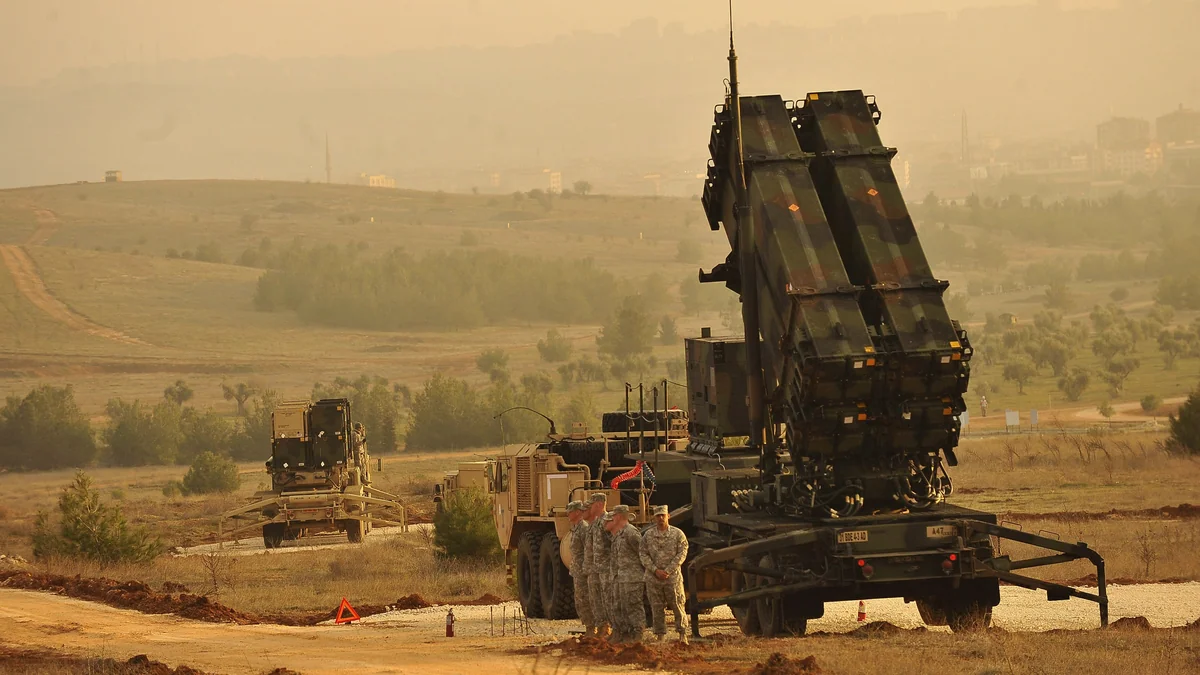
Ukraine currently holds roughly 1 percent of the total United States Patriot interceptor stockpile. Zelenskyy's formal request to allies asks for 5 percent - enough, his staff calculates, to cover the 2026-2027 winter. The gap between those two numbers is not a negotiating position. It is a physical description of where Ukraine stands.
The delivery record makes the arithmetic harder. Ukraine received three times fewer air defense missiles in early 2026 than in the same period of 2025. Lockheed Martin produced approximately 620 Patriot missiles across all of last year - 1.7 per day. A single four-day exchange in the Middle East consumed 225 interceptors. The pipeline that feeds Ukraine is the same pipeline that feeds every other claimant, and the pipeline is narrow.
Germany's position closes one exit from the arithmetic. Berlin has reached the ceiling defined by its own national defense requirements and NATO obligations - a limit that Brigadier General Jürgen Schrödl has stated plainly, without hedging. Germany was the most consistent European supplier of Patriot capacity. That tap is not being turned off out of political reluctance; the stock is genuinely at the boundary its alliance commitments require it to maintain. The ceiling is structural, not decorative.
The Pentagon signed a seven-year contract in January 2026 to raise annual Patriot production to 2,000 units by 2030. That contract matters enormously for 2030. For the winter that begins in three months, it changes nothing. The industrial promise and the immediate interceptor deficit occupy entirely different calendars, and Ukraine sits on the wrong one.
Six Hundred and Twenty Missiles a Year, Against a Four-Day War
Lockheed Martin produced approximately 620 Patriot missiles across the whole of 2025. That is 1.7 missiles per day, which sounds like a production line until you set it beside a single number from the Middle East: 225 interceptors fired in four days during one regional engagement. Four days erased roughly four months of global output. The ledger does not balance, and it was never designed to balance two simultaneous wars at once.
The arithmetic has a name in procurement circles - valley of death - and the Pentagon has now mapped its dimensions in ink. A seven-year contract signed in January 2026 targets 2,000 Patriot missiles annually by 2030. The ambition is real. The gap between the contract date and the delivery date is also real, and Ukraine is burning through stocks on the wrong side of it, in years that the contract has not yet reached.
What the numbers describe is a structural condition, not a policy failure anyone can fix with a phone call. Industrial capacity for high-end interceptors was sized for a world that had not yet seen two ballistic-missile wars running in parallel. Russia grasped this before the West did, or at least before Western procurement offices updated their spreadsheets. The 2030 target is load-bearing; everything between now and then is decorative. Ukraine's winter arrives on schedule either way.
The Drone as Decoy: Russia's Attrition Logic and Its Industrial Arithmetic
The logic is not complicated, which is part of why it works. Russia sends cheap Shahed drones first - waves of them, enough to force Ukraine's air defense operators to engage, burning through interceptors that cost orders of magnitude more than the drones they destroy. Then the ballistic salvo arrives. The Iskander-M follows the decoy; the expensive rounds are already spent.
This is not improvisation. It is a doctrine calibrated to a specific asymmetry: the cost of a Russian ballistic missile is a fraction of the PAC-3 interceptor required to kill it, and Russia can sustain that exchange rate far longer than Ukraine can. The West has not found a convincing answer to this arithmetic, because the arithmetic does not care about intentions.
Each drone that draws a Patriot launch is doing precisely the work assigned to it: not to destroy a target, but to empty a magazine.
What makes the calculation grimmer is that Russia has been closing the production gap on its own side. Ballistic missile output is now estimated at 10 to 20 percent above original plans - supply growing precisely as Ukrainian stocks shrink. The Cold War analogy, where the defender could at least match the attacker on volume, does not hold here. The attacker is accelerating. Ukraine is intercepting less. The gap between those two lines is not a political problem waiting for a summit communiqué. It is a physical one, measured in rounds remaining and missiles launched, and it widens by the week.
The S-300 Resurrection, the Freyja Programme, and the One Number to Watch
The United States and Ukraine are collaborating to reactivate Soviet-era S-300 systems, fitting them with restored or newly compatible missiles. The programme's own arithmetic concedes the gap: hundreds of missiles annually, not thousands. Against a Russian ballistic salvo that burned through 195 launches in July alone at a 15 percent interception rate, "hundreds" is a holding action, not a solution.
Freyja, Ukraine's domestic ballistic missile defence programme developed with Denmark's Fire Point, runs in parallel. Testing results are not yet public, which means the programme remains a promise on a ledger rather than a battery in the field. Two programmes, both unverified at scale, both racing against a winter that does not negotiate.
The human calculus underneath is not abstract. Research on Ukrainian public opinion shows that strategic losses, Azovstal and Severodonetsk specifically, produced measurable collapses in public hope. A capital that cannot protect itself from ballistic missiles through a second consecutive winter is a different political object than one that can.
The one number to watch is the date of the first confirmed S-300 reactivation battery reaching operational deployment. If that date slips past November 2026, Kyiv enters winter without a ballistic backstop. The Freyja programme will still be testing. The Patriot production ramp will still be years short. Ukraine's air defense shortage has one deadline that does not move: the marker either moves, or the city does not defend itself.