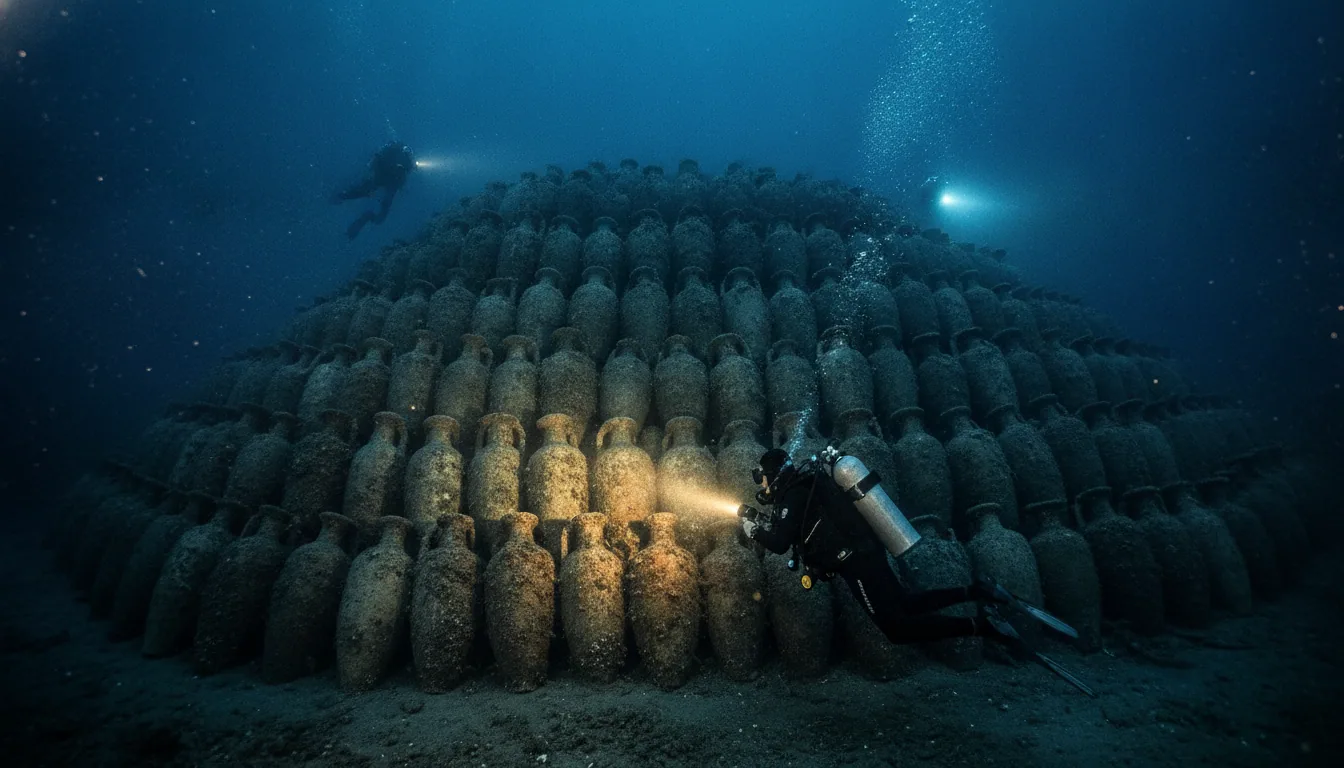
The Roman shipwreck found off the coast of Sicily near Mazara del Vallo is a 2,100-year-old merchant vessel that reveals the sophisticated, industrial-scale trade network of the ancient Republic. Lying forty-six meters below the surface, the ship remains laden with its original cargo, offering researchers a rare look into a lost economic engine.
The Silence at Forty-Six Meters
Imagine standing on the roof of a fifteen-story apartment building and looking straight down at the pavement. Now, replace the air with cold, blue Mediterranean water. At this depth, forty-six meters below the surface, the sun is no longer a warm friend but a dim, ghost-like glow.
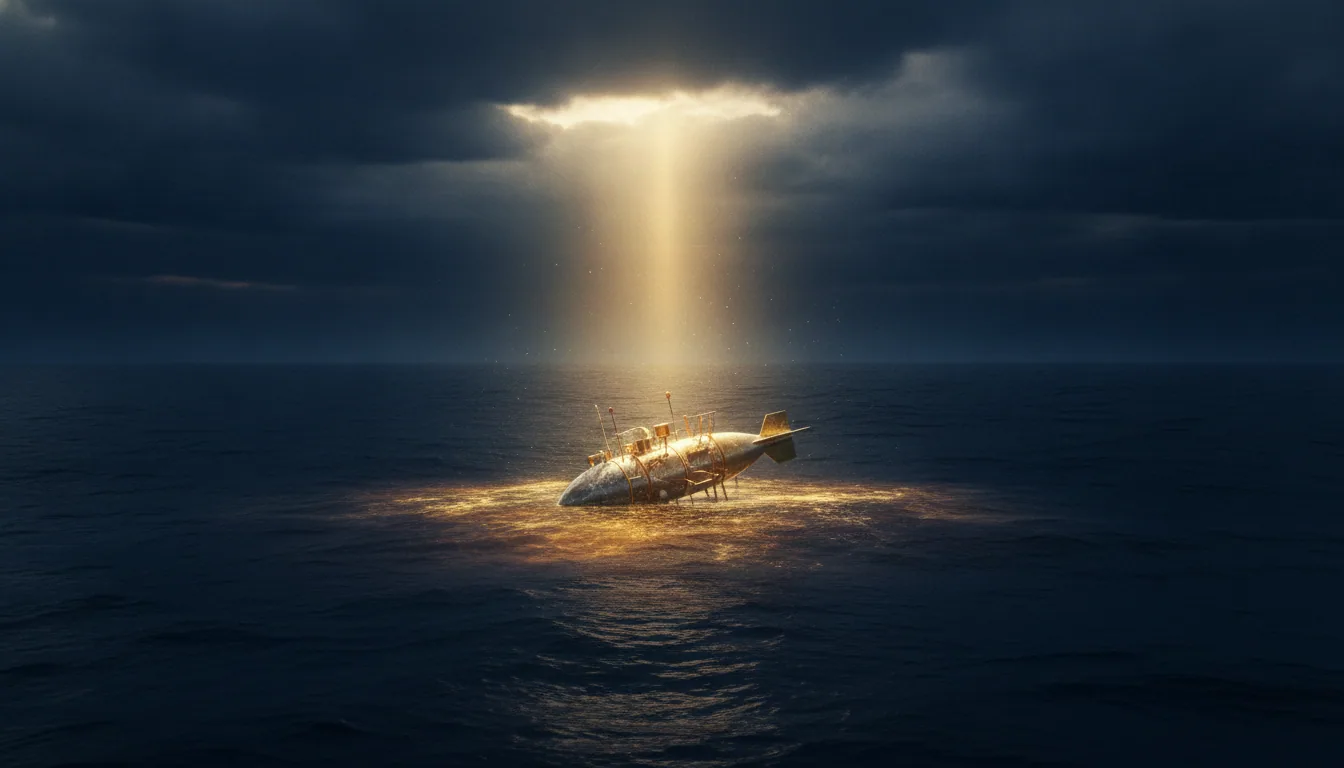
Three nautical miles off the coast of Mazara del Vallo, the seabed usually belongs to the silt and the silence. In August 2026, two amateur divers, Giacomo De Mola and Igor Bisulli, found a massive shape that had been waiting for over 2,100 years. This ancient merchant vessel has sat undisturbed for two millennia, defying the grinding motion of the tides.
One local fisherman called the sight the most incredible discovery of his career. For decades he had looked at the sea, but this was the moment the sea finally looked back at him. To someone standing here in 1610, this scene would have been indistinguishable from magic.
Ceramic Code: Reading the Dressel 1A
The ship was laden with hundreds of Dressel 1A amphorae, the standard ceramic wine jars of the ancient world. Each vessel is a time capsule, a clay heartbeat from a trade network that once tied the entire Mediterranean together. Archaeologists view these jars as the hard drives of ancient commerce, storing economic data in fired clay.
These vessels are the hard drives of ancient commerce, storing economic data in fired clay.
The Romans had achieved a level of industrial standardization we usually associate with modern logistics. Every jar was built to a specific template to stack perfectly in a ship's hold. This was not just a craft, but a sophisticated shipping network that spanned the entire Mediterranean.
By analyzing the mineral signature of the clay, researchers can pinpoint exactly where the wine was produced. This makes a single jar act like a GPS for a lost economy. The find near Mazara del Vallo proves Sicily was the vital junction for this ancient superpower.
The Industrial Legacy of the Roman Shipwreck off the Coast of Sicily
Finding a wreck is just the start of a massive logistical dance managed by the Soprintendenza del Mare and the Carabinieri TPC. When Minister Alessandro Giuli announced this find, it served as a moment where cultural bookkeeping meets genuine wonder. It is a formal recognition that these artifacts belong to our collective human story.
On the seafloor, researchers documented two massive lead anchors and a mysterious lead structure. These are the heavy fingerprints of ancient engineering. While the ceramic jars tell us what the merchants traded, the lead tells us how the ship itself survived the crossing.
Protecting a site at this depth is a logistical headache that requires constant vigilance. How do you guard a museum where the doors are forty-six meters of pressurized, salt-laden seawater? It is a constant battle between our desire to see the past and our duty to keep it safe.
A Sea Littered with Ambition
In June 2026, researchers recovered eleven bronze naval rams and several helmets from the site of the Egadi battle. These are essentially three-pronged bronze teeth designed to tear open the belly of a ship with terrifying efficiency. They represent the industrial side of ancient warfare, where metal and momentum met wood and bone.
While most wrecks are left to be mapped in the dark, the Marausa 2 success story shows what modern technology can salvage. Between 2023 and 2024, archaeologists managed to raise an entire twelve-meter-long ship from the seabed in a single operation. Raising fragile history intact is a feat of engineering that would have been unthinkable just a generation ago.
We are learning that the sea was never a quiet void between landmasses. It was a crowded, dangerous highway, littered with both grand ambition and sudden catastrophe. Each recovered ram and timber helps us redraw the map of a world that was as connected as our own.
The Industrial Deep: Alum and the Chemistry of Trade
Not every ship carried wine; at Capo Murro, researchers found a vessel holding a rare type of container known as the Richborough 527. These specific jars were the industrial packaging of the ancient world. They carried alum, a mineral that functioned as the invisible backbone of Roman manufacturing.
Alum was the substance that allowed vibrant dyes to bite into fabric and stay there. Without this white powder, the bright red cloaks of the legions would have faded into a muddy pink after the first rain. This was a sophisticated chemical supply chain, a direct precursor to our modern global industry.
The Unfinished Map of the Mediterranean
The data from Capo Mulini is forcing a radical rewrite of our Republican-era trade maps. We once viewed these waters as simple transit lanes, but the economic reality was far more sophisticated. The sheer density of wrecks suggests a complex maritime network that functioned with industrial precision.
These people in 100 BC were exactly as clever and economically complex as we are today. They managed standardized shipping containers while tracking minerals across the sea. The Mediterranean was a buzzing regional highway, far more active than history books previously suggested.
Each new discovery reminds us that the past is a mirror, not a silent museum. We are still redrawing the maps our ancestors used, realizing their world was never as static as we once assumed. The Roman shipwreck found off the coast of Sicily reminds us that the ocean keeps its secrets well, but gives them up just often enough to keep us looking at the horizon.