Living in the 'Soft Rains' is no longer a science fiction scenario, as August 4, 2026—the exact date of Ray Bradbury's automated house story—is now just around the corner. Ray Bradbury's 1950 masterpiece depicts a fully automated home that continues its daily routines long after its human inhabitants have perished.
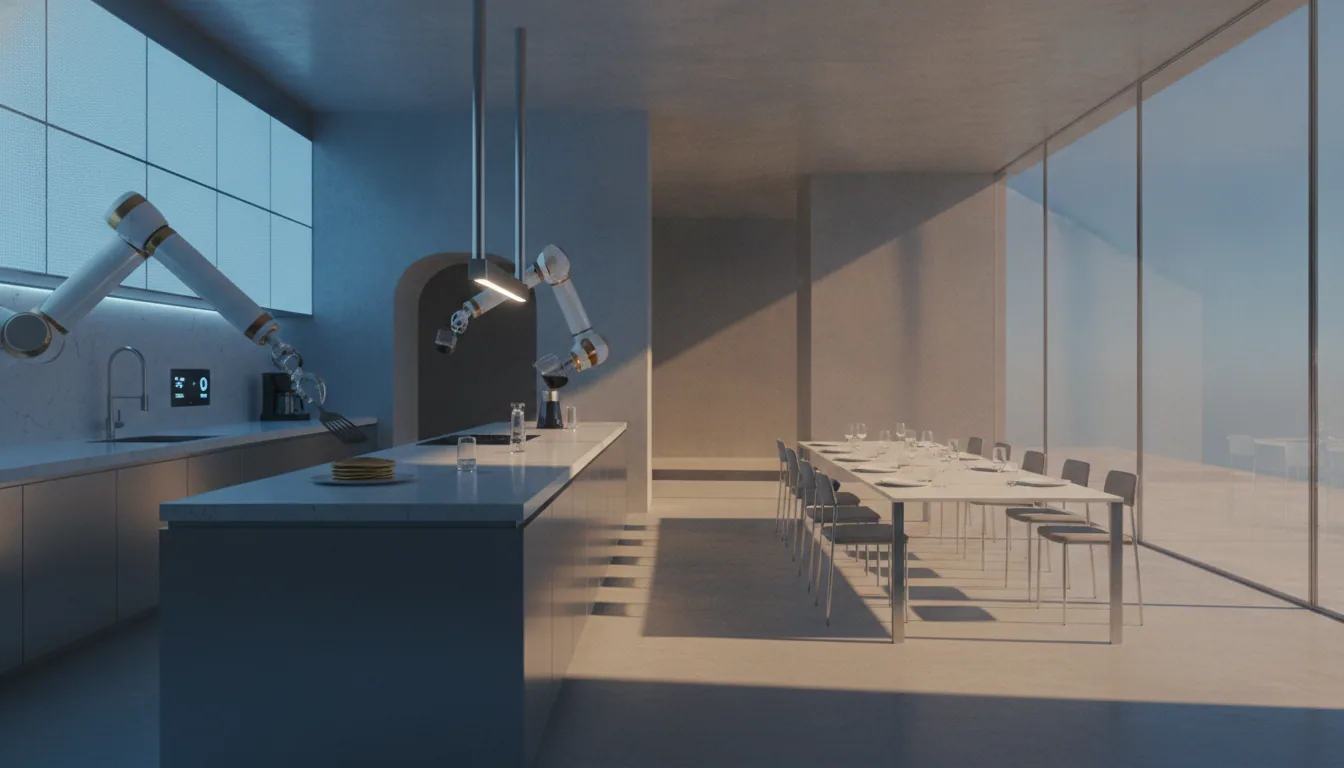
Imagine an oven that turns itself on at seven in the morning to crisp eight slices of toast. It prepares eggs and bacon, then calls out to a family that never arrives for breakfast. This is the opening ritual of Ray Bradbury's masterpiece, "There Will Come Soft Rains."
Originally published in 1950, the story presents us with a specific countdown that is suddenly very close. "Today is August 4, 2026, in Allendale, California," the automated house announces to its empty rooms. We are now standing on the doorstep of that exact fictional morning.
To someone reading this in the middle of the last century, a house that could think for itself was indistinguishable from magic. Today, we call this the Internet of Things, the invisible web of gadgets talking to each other. Bradbury saw the tragedy in our machines outliving us.
The most haunting image in the story is not the robot mice or the singing clocks. It is the west face of the house, charred black except for the white silhouettes of occupants caught in the heat of a nuclear blast. These shapes are the only evidence left of the humans who once lived there.
Living in the 'Soft Rains' Through 1950s Glass Walls
Bradbury's house featured "glass walls" that shimmered with color and light. Today, we use OLED panels, which are essentially the "glass walls" of our living rooms. This represents a leap from glowing vacuum tubes to nanometer-scale transistors.
Ray Bradbury wasn't just a storyteller; he was a futurist who predicted the rise of "electronic consciousness" within the home. He imagined a world where the house itself becomes a sentient participant in our daily rituals, providing comfort without human intervention.
The heart of this mechanical nightmare actually began as a 1920 poem by Sara Teasdale. She realized that nature, in its quiet persistence, is entirely indifferent to our survival or our sudden disappearance. Nature does not require a human audience to continue its cycles.
Bradbury used Teasdale's verses to anchor the story's haunting conclusion. One line remains particularly chilling: "And spring herself, when she woke at dawn, would scarcely know that we were gone." Our technology will keep reciting its poetry long after the last human listener has left the room.
We are creating a digital world where the logic persists even after the human utility has died.
A Trillion-Dollar Altar with Ten Thousand Attendants
Bradbury described his automated house as an altar with ten thousand attendants. In 1950, these were little metal mice and automated cooks scurrying under the floorboards. Today, those attendants have a different name: the global smart home market.
In 2024, this industry reached a value of 121.6 billion dollars. We have spent more on connected plugs and smart sensors than the entire annual economic output of many small nations. The scale of this investment suggests a permanent change in human habitation.
Growth is accelerating at a rate of 23.1 percent each year. By 2025, the market will hit 147.5 billion dollars, on its way to a staggering 1.4 trillion dollars by 2034. We are financing a structural shift in how humans inhabit space.
Our modern iRobot vacuums and Alexa speakers are doing exactly what Bradbury's fictional house did. These components of the Internet of Things—the network of physical objects that talk to each other—cook, clean, and recite poetry. They perform these rituals with or without our attention.
In 1972, a company called Crestron began turning this vision into a luxury reality. They provided centralized automation for climate, lighting, and security that felt like magic. For decades, being "automated" was a status symbol reserved for the elite.
Today, that complexity has become background noise. We no longer notice the sensors that adjust our lights or the algorithms that pre-heat our ovens. The transition from a luxury experiment to a domestic requirement is almost invisible.
Mars in Tartu: The 1974 Transmission
In 1974, a small miracle arrived on Estonian bookshelves in Tartu. It was a book with a cover that felt like a broadcast from a distant, shimmering dimension. This was "Marsi kroonikad," the first Estonian appearance of Ray Bradbury's work.
To someone in 1974, this would have been indistinguishable from magic. Reading about automated kitchens in a Soviet-era apartment felt like looking through a telescope at a world we could not touch. Bradbury offered a universe of silver rockets and "glass walls."
For the Estonian science fiction community, centered around the magazine Reaktor, these dates are markers on a map of human progress. We have been watching the calendar for decades, waiting for the clock to strike August 2026. The future is no longer a distant broadcast; it is our neighborhood.
Linda Ariva translated more than words; she provided a sense of wonder. She turned Bradbury's automated houses from a dream into a common firmware update. For us, the chronicles did not start on the red planet, but with a paper book in a Tartu library.
The Ghost in the Algorithm
Bradbury described his mechanical home as an altar where the house performed rituals for gods who had long since vanished. To a reader in 1950, this was a chilling metaphor for the atomic age. Today, that nuclear anxiety has returned to our headlines.
We have built systems that do not just follow schedules, but make complex decisions. Researchers now study "algorithmic recourse" to understand how people can change their behavior to reverse an AI's decision. But what happens when there is no one left to change the decision?
To someone in 1610, a self-cooking meal would have been indistinguishable from magic. To us, a system that keeps 'optimizing' a vacant life is something much more haunting. It is the logic of a house that simply doesn't know we're gone.
The Purpose Gap: Living Among Digital Silhouettes
The global smart home market is projected to hit 1.4 trillion dollars by 2034. We are surrounding ourselves with more sensors than there are stars visible to the naked eye. While Bradbury's house served its family, modern systems often prioritize harvesting data for corporations.
We are widening a purpose gap. Bradbury's fictional house cleaned for inhabitants who were gone, yet our modern devices often serve corporate servers by tracking our movements. The charred silhouettes on the Allendale wall have been replaced by digital ghosts on social media.
We still don't know why Bradbury chose August 4, and that is the best part of the mystery. We also cannot count the current 'ghost devices' performing rituals in empty buildings. Ten thousand attendants are carrying out a liturgy for an audience of zero.
As we converge with Bradbury's timeline, we are forced to look at our own reflection in the glass walls. We have built the altar and automated the incense, but we have forgotten to ask who the ritual is truly for. We are left wondering if we are truly living in the 'Soft Rains' while waiting for the water to wash the silhouettes away.