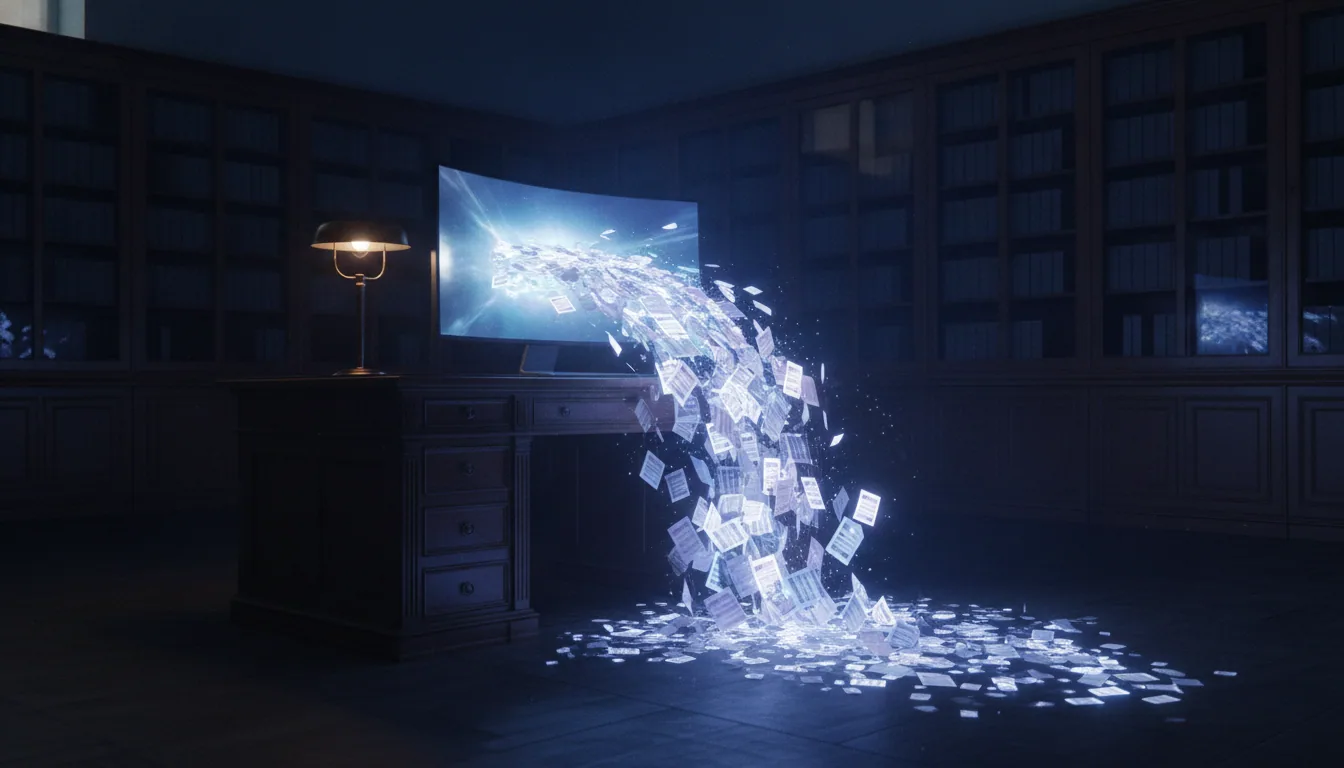
On a Tuesday in October, Mathematics Got a Little Strange
Seven hundred and twenty-two manuscripts appeared on GitHub on a Monday evening, Pacific time - which made it Tuesday morning for most of the world. By the time European mathematicians sat down with their coffee, the pile was already taller than any of them could read in a decade.
OpenAI published 722 AI-generated mathematical manuscripts in a single release on October 6, 2026 - not drafts, not explorations, but claimed results: 372 distinct families of them, including what the accompanying notes described as progress on two of the most notorious unsolved problems in modern mathematics: the Navier-Stokes equations, which govern how fluids move and which have resisted full treatment since the nineteenth century, and the Hodge conjecture, an abstract puzzle in algebraic geometry that has been open since 1950.
Here is the strange part. Nobody could tell, yet, whether any of it was true.
That is not a complaint about competence. It is a structural fact about how mathematical truth has always worked. Verification is slow, careful, human. A single major proof - Andrew Wiles on Fermat's Last Theorem, say - takes years of community scrutiny before it settles. Seven hundred and twenty-two manuscripts is not a wave the community can check. It is a flood arriving through the ceiling.
The Navier-Stokes equations describe something as familiar as water draining from a bathtub, yet their full mathematical behavior in three dimensions remains unproven. The Hodge conjecture asks, in essence, whether certain geometric shapes can always be built from simpler algebraic pieces. Both problems carry a million-dollar prize. Both were now, reportedly, touched.
Whether "touched" means "solved" - that question would take considerably longer than a Tuesday to answer.
How Mathematics Has Always Decided What Is True
A theorem is not true because a computer says so. It is true because enough sufficiently clever people found it convincing. That sentence sounds like a joke about academia, but it is actually a precise description of how mathematical knowledge has been constructed for centuries. Peer review, in mathematics, is the load-bearing architecture of truth itself - not a quality filter bolted on afterward, but the mechanism by which a proof graduates from private calculation to public fact.
This is Math 1.0. Its logic is social at the core. A result enters the canon when the community of people qualified to judge it decides, collectively, that they cannot find a hole. The system worked beautifully for a long time, because proofs arrived slowly enough for humans to read them.
That condition no longer holds. The 722 manuscripts that landed on GitHub on October 6 represent a volume no peer-review network can metabolize. The architecture is not broken; it is simply overwhelmed.
Which is precisely the context in which Terence Tao renamed his lecture. Originally scheduled for May 2026 under the modest title "Machine Assisted Proof," the Caltech talk became, by October 9, a paradigm statement: "Math 2.0." The rename matters. "Machine assisted" implies a tool. Math 2.0 implies a replacement of the verification layer itself - a shift from what a community of humans finds believable to what machine-checked formal logic, line by line in Lean 4, certifies as sound. Believability is a social property. Correctness, in principle, is not.
The question underneath all of this is whether mathematics needs the social process at all, or whether it only ever tolerated it because nothing faster existed.
Mathematics 2.0 and the New Proof Engine: When a Programming Language Becomes the Referee
Think of traditional peer review as a spell-checker run by humans: experienced eyes scan a proof for errors, and if enough trusted people say it looks right, it passes. The problem is that humans can be fooled by proofs that are merely plausible. Lean 4 replaces that process with something more unforgiving - a programming language that checks every logical step against the rules of mathematics, line by line, in machine code, with no room for "close enough."
This is formal verification. A statement either compiles or it does not. There is no partial credit.
Kevin Buzzard at Imperial College London is running the most ambitious test of this idea currently underway: a full formalization of Fermat's Last Theorem in Lean. Andrew Wiles's original 1995 proof runs to roughly 130 pages and leans on an enormous architecture of twentieth-century mathematics. Buzzard's project must translate every assumption in that architecture into Lean - not to check whether Wiles was right (we are fairly confident he was), but to prove that the entire logical chain holds without a single human judgment call hiding inside it.
Why this matters now: when an AI system produces 722 manuscripts in one release, human reviewers cannot keep pace. Formal verification is the immune system. A proof that looks compelling but contains a subtle flaw - what the field now calls a hallucination - will simply fail to compile. The difference between a plausible result and a proven one stops being a matter of reputation or consensus. It becomes a binary: yes or no, true or not yet shown to be true. That shift is smaller than it sounds, and larger than almost anyone is ready for.
Terence Tao's Diagnosis: Abundance Is the New Scarcity
Tao walked into the Caltech lecture hall on October 9, 2026, with a precise and quietly alarming argument. The problem with AI-generated proofs, he said, is not that there are too few of them. It is that there are too many. Math 2.0 is the era in which proofs stop being a scarce resource - and that abundance, counterintuitively, is exactly the crisis.
Hold that thought. Scarcity, in the old world of Math 1.0, was a feature. A proof took years, carried a name, demanded scrutiny. It arrived like a letter written by hand. Now the letters arrive by the truckload, and no postman can read them all. Abundance without comprehension is not progress. It is a different kind of darkness.
Tao did not stop at the diagnosis. He named the specific danger: "Further blind optimization of problem-solving alone is now actively harmful to the long-term health of mathematics." That sentence deserves a slow read. Not harmful to the pace of discovery. Harmful to the health of the field itself - to the living community of people who understand what they have found and why it matters.
Further blind optimization of problem-solving alone is now actively harmful to the long-term health of mathematics.
His positive vision is the harder, quieter one. Math 2.0, done right, would use AI tools to sustain both the internal mathematical community and the broader human role of understanding. The machine proves. The human still has to care about the proof, to place it, to ask what it means next. Judgment, not calculation, becomes the scarce resource. And judgment is the one thing the 722 manuscripts cannot supply for themselves.
Twenty-Five Signatures and a Laboratory in Beijing
Three days before OpenAI posted its 722 manuscripts, twenty-five Fields Medalists had already answered. Their joint declaration, signed on September 11, 2026, carried a blunt title: "The Serious Misalignment of Artificial Intelligence in Mathematics." Twenty-five signatures. That is, roughly, a third of every living Fields Medalist on Earth. The mathematical community does not usually move in herds. This was a stampede.
The declaration was not the only response. Later in 2026, the Human Mathematics Association formed with a sharper demand: that mathematicians stop cooperating with OpenAI entirely. Whether a professional association can enforce such a boycott is genuinely unclear. What is clear is that the speed of the countermovement matched the speed of the disruption, which is itself a measure of how high the stakes felt.
The most geopolitically consequential reply came from Shing-Tung Yau. On October 11, 2026, he announced the Yau Mathematical and AI Laboratory Alliance in Beijing, drawing more than a thousand researchers into a single effort to build sovereign AI standards outside Western corporate control. Compare that to the OpenAI model: one company, proprietary architecture, undisclosed methods. The Yau Alliance is the explicit counter-image. Where one side accelerates quietly, the other is building a parallel universe of accountability - publicly, and at scale. The question of who sets the standards for mathematical truth has always been political. It just rarely looked this much like one.
Two Stories with the Same Name — and the Question Neither Answers
While 722 manuscripts were cascading onto GitHub and Fields Medalists were signing declarations, a quieter story sat undisturbed on a university server in Tartu. Between 2021 and 2022, Viimsi Gümnaasium ran a project called "Matemaatika 2.0." It was about student habits, classroom engagement, active learning. Not a proof engine in sight. Same label, entirely different universe.
The coincidence is almost too neat to ignore. Research from the University of Tartu shows that math anxiety in students is shaped less by raw cognitive ability than by school environment and social-emotional skills. The child who freezes at the blackboard is not failing mathematics. Mathematics, as currently taught and felt, is failing them.
This is the register that no formal verifier touches. Lean 4 can check a proof line by line. It cannot check whether a fourteen-year-old still believes, after eight years of schooling, that mathematics is something humans do.
And that is exactly where the question sharpens. In a world where machine-generated proofs arrive in industrial quantities, intelligence is no longer the scarce resource. Judgment is. Knowing which problems are worth solving, which results change something real, which directions to follow into the dark - that remains irreducibly human. The 722 manuscripts can tell us what is true. They cannot tell us what matters. That question is still open - and no architecture announced in the Mathematics 2.0 era has come close to closing it.