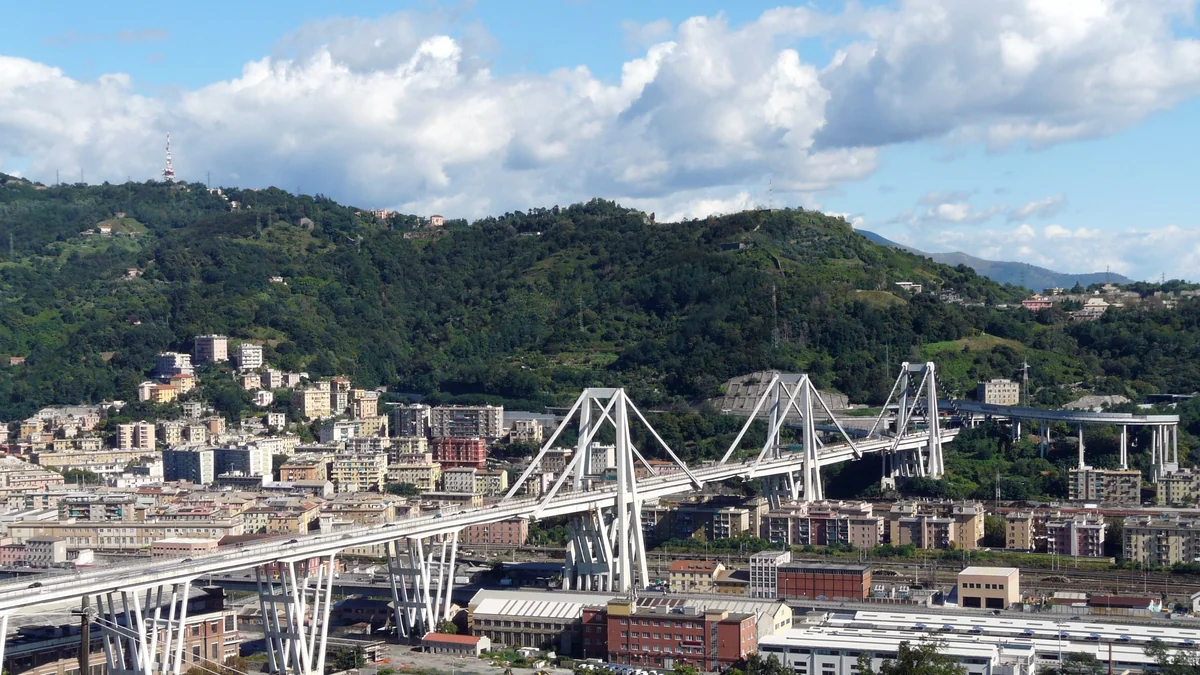
The Genoa Bridge Disaster Verdict has finally been delivered, sentencing former motorway chief Giovanni Castellucci to twelve years in prison for his role in the 2018 Morandi bridge collapse. This first-instance ruling concludes a massive trial involving fifty-seven defendants accused of neglecting vital maintenance to prioritize corporate dividends.
Eight Years on the Autostrada
In the late Soviet period, the concrete of the Baltics had a particular way of failing, a slow surrender of the internal steel rebar that mirrored the decay of the state itself. The Morandi bridge in Genoa followed a similar path before it snapped on August 14, 2018. The collapse during that summer storm revealed a structural rot that no amount of cosmetic repair could hide.
Forty-three people fell with the road into the Polcevera valley. The bridge was a vital infrastructure artery linking northern Italy to the French border, a load-bearing wall for European trade. For the small nations relying on these transit corridors, such a mistake is a strategic blackout that maps cannot fix.
The wire says the trial is over, but the original Italian text says something colder: sentenza di primo grado. This first-instance ruling arrives nearly eight years after the rain. In the time it took to reach this point, empires have shifted and spreadsheets in Rome have been quietly updated while the families waited.
The twelve-year sentence handed to the former motorway chief is a structural diagnostic of this exhaustion. This was never about a simple design flaw, but rather the failure of a state to protect those who get sold when maintenance margins are cut. The trial asks a fundamental question: who is the borderland here, and who is the empire?
The Ledger of Fifty-Seven Names
The Italian state responded to the debris of the Morandi bridge with the sheer weight of its paperwork. Since July 2022, the court in Genoa has served as a theater of procedural exhaustion. It took 284 individual hearings to reach this first-instance verdict for the fifty-seven names on the ledger.
This is the density of modern accountability, where the volume of the legal record matches the physical scale of the tragedy. The list was a map of the Italian corporate and regulatory architecture, from the executive suites of Atlantia to the technical offices of the maintenance firm Spea. Engineers and ministry officials were processed alongside the men who oversaw the vital artery to the French border.
I have heard this promise of accountability before in 1991 Moscow. It failed then because the bureaucracy was designed to protect the structure of power rather than the people. In Genoa, the trial became a technical study in the maintenance-to-profit ratio.
When the spreadsheet becomes the priority, the physical world begins to rot.
Corporate Strategy and the Genoa Bridge Disaster Verdict
Prosecutors in Genoa argued that maintenance was repeatedly delayed to ensure continued profit flows for Autostrade per l’Italia and its parent company, Atlantia. It is a cold, mathematical trade involving maintenance-to-profit ratios. When the balance sheet becomes the priority, the physical infrastructure of a nation begins to decay.
The defense lawyers offered a more convenient truth, arguing the collapse was caused by an undetectable design flaw in the cables. I have seen this defense before as decorative molding, a narrative built to protect the decider by blaming the materials. If the flaw is truly undetectable, then negligence becomes impossible to prove in the eyes of the law.
But structural reality is less forgiving than a legal brief. The prosecution insisted that the structural warning signs were not invisible, merely expensive to address. The forty-three people who died were the collateral of a ledger that refused to balance safety against financial gain.
The Statute of Limitations as a Tool of Power
In the marble halls of the Italian justice system, time is a commodity rather than a constant. The prescrizione functions as a structural trapdoor where a crime simply ceases to exist because the calendar turned too many pages. While the central charge of manslaughter held, the accusations of document forgery were allowed to lapse.
The wire says these were "lesser charges," but the record says they were the primary evidence of the intent to deceive. From the small-nation floor, a forged signature is the first brick in a catastrophe. The system treats truth as something with a shelf life, allowing the legal clock to provide a shield for the accused.
When the state allows a falsified document to become legally irrelevant, it tells the citizen that the record is secondary to the process. This is how the hierarchy protects itself from the ledger. The bridge falls, the people die, and the paperwork eventually burns itself out in the archives.
The Two Sentences of Giovanni Castellucci
Giovanni Castellucci is a man defined by two sentences. The first was a six-year term for a 2013 viaduct accident; the second, delivered by a Genoa court on July 16, 2026, is twelve years. The math of institutional failure is rarely linear, yet here the price of corporate negligence has precisely doubled.
It takes forty-three deaths to move the needle of Italian justice this far. Castellucci presided over a culture that treated structural integrity as a variable cost on a balance sheet. That is the load-bearing wall of this catastrophe—everything else is molding to be stripped away when dividends are at risk.
On July 15, 2026, the company he once led attempted a final coat of paint with a formal apology letter. The wire calls it a moment of corporate reckoning, but the original says something colder: a calculated plea for leniency. A letter is a cheap substitute for a bridge that stays standing during a storm.
The Thirty-Month Horizon
The verdict in Genoa is a milestone, but a first-instance ruling is merely a structural load test. We are now entering a phase defined by the 30-month horizon of the appeals process. Castellucci and the remaining defendants will move the battle from physical evidence to the systemic friction of procedure.
The trial already spans nearly eight years, a pace that treats forty-three deaths as a technicality of the archive. By the time the Corte di Cassazione issues a final word, more than a decade will have passed since the Morandi bridge fell. Ignore the courtroom photography and watch the procedural calendar to see if justice can outrun the clock.
If finality arrives before 2029, the Italian state has asserted its sovereignty over its corporate infrastructure. However, if the clock runs out on the remaining charges, the spreadsheet has won. The ultimate legitimacy of the Genoa Bridge Disaster Verdict depends on whether the law prioritizes maintenance-to-profit ratios over corporate procedural friction.