
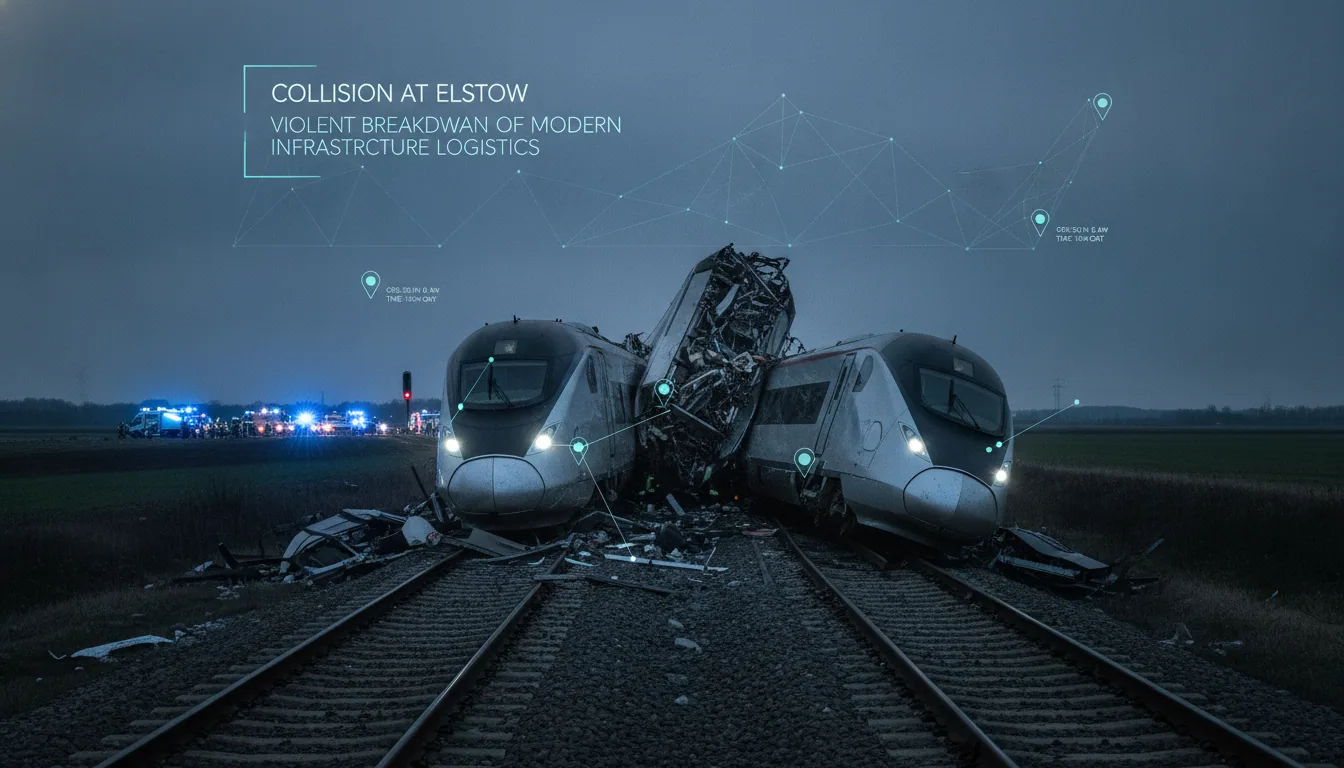
The anatomy of the Bedford rail accident reveals how a 40-mph rear-end collision occurred on June 19, 2026, when a moving Class 360 train struck a stationary Class 810 Aurora near Elstow. This event paralyzed the Midland Main Line, resulting in one fatality and 89 injuries due to a catastrophic failure in digital signaling protocols and manual oversight.
We celebrate the precision of digital signaling as the end of human fallibility, yet we remain vulnerable to archaic transport disasters. On June 19, 2026, at 17:12 BST, a stationary train near Elstow was struck by a following service traveling at 40 mph. This collision south of Bedford station turned a routine peak commute into a formal major incident declaration.
The physics of a rear-end impact at 40 mph reveals a terrifying gap in our modern safety protocols. A Corby-to-London Class 360 unit collided with a stationary Nottingham-to-London Aurora Class 810, causing a total blockage of all lines between Luton and Bedford. This immediate infrastructure paralysis highlights the inherent fragility of the Midland Main Line as a vital economic artery.
In the Estonian context, the Elstow event serves as a warning against the emerging paradigm of total automated safety. If the institutional behavior of modern operators assumes technology is infallible, we risk rewriting the old order with new, digital-age vulnerabilities. This collision represents a failed socio-economic blueprint where human oversight and technical monitoring failed to synchronize effectively.
The force of the impact was sufficient to derail at least one carriage and required the mobilization of seven air ambulances and 20 road units. While investigators analyze sequential data logs, this event signals a paradigm shift in how we must perceive rail security. Our drive for high-velocity infrastructure may be outpacing our current ability to manage the correlation between technological trust and physical risk.
Technical Decoupling and the Anatomy of the Bedford Rail Accident
High-velocity technological sophistication often meets the brittle reality of legacy safety protocols in ways that are difficult to predict. The stationary Aurora Class 810 unit (No. 810 015) came to a halt on the Up Fast line due to a technical fault involving its Automatic Warning System (AWS). This 2026 collision highlights a fundamental friction between the new fleet and old logic within the paradigm of semi-automated transport.
If a train stops because of a safety trigger, then the surrounding infrastructure should theoretically isolate that track section to prevent disaster. Yet, the moving Class 360 unit (No. 360 115) entered the occupied block and struck the stationary service from behind at significant speed. This failure points toward a deeper institutional behavior regarding technical debt where rapid modernization outpaces the underlying signaling fabrics.
In the Estonian context, our push for synchronized digital infrastructure mirrors the UK's Midland Main Line ambitions for high-speed efficiency. The collision near Bedford proves that when fail-safes decouple from their intended logic, they create entirely new, unforeseen vulnerabilities for modern operators. Systemic complexity itself has become the primary risk factor for both passengers and railway professionals.
A cross-border correlation exists between rapid fleet deployment and the widening gaps in legacy signaling protocols that govern modern rail tracks. Rewriting the old order of rail safety requires a rigorous behavioral mapping of how these economic actors manage and mitigate systemic risk. We must ask if our current blueprint for connectivity is overlooking the physical and digital limits of the systems designed to protect lives.
The socio-economic blueprint of passenger safety often overlooks the kinetic reality of how bodies are thrown when automated certainty vanishes.
The Human Factor: A Socio-Economic Blueprint of the Victims
High-velocity infrastructure promises a world of automated certainty, yet the kinetic reality of June 19 exposes a deep-seated fragility. While we invest billions in signal digitization, a single operational failure near Elstow claimed the life of one train driver and left 89 people injured. This tragedy underscores the heavy price paid when institutional behavior fails to protect the human operator.
The RMT union confirmed the deceased was a former representative. If the Midland Main Line is the backbone of British connectivity, then the driver remains its most exposed and critical node. This tragedy forces a cross-border correlation between the erosion of traditional labor protection and the rapid adoption of semi-automated technology.
In the Estonian context, where we are currently rewriting the old order of regional transport, the Bedford collision serves as a sobering case study for policy makers. We must move beyond viewing the operator as a legacy component of the cockpit who only exists to override computer errors. The emerging paradigm demands a radical re-evaluation of the operator's status in an increasingly hands-off environment.
This socio-economic blueprint reveals that 89 injuries are not mere statistics. We are witnessing a paradigm shift where the driver is no longer just a navigator, but has become a primary risk-absorber for technical malfunctions. The state must ensure that the next generation of transport protects the individual as fiercely as it protects the infrastructure.
Emergency Logistics and the Anatomy of Passenger Trauma
Sophisticated engineering promises a future of frictionless movement, yet the physical reality of a carriage derailment near Elstow felt like a primitive explosion. The metal-on-metal scream at 17:12 BST signaled the end of a Friday commute and the start of an unprecedented medical mobilization. Before the casualty count reached 89, the air was already thick with the sound of seven air ambulances descending on the corridor.
The logistics of the response reflected a highly coordinated piece of institutional behavior. Alongside the aerial units, 20 road ambulances converged on the site to manage a trauma map of significant complexity. For the 11 passengers classified with critical or very serious injuries, survival depended entirely on this rapid concentration of resources.
A further 22 individuals sustained serious injuries, including complex fractures that speak to the violent energy transfer within the carriages. Another 56 passengers were treated for minor injuries, often involving the psychological shock of seeing the familiar interior of a train buckle and twist. Even a 40-mph rear-end impact exceeds the containment capacity of modern cabin designs when automated certainty vanishes.
In the Estonian context, where we are currently rewriting our own rail infrastructure, this incident offers a vital cross-border correlation. It highlights a paradigm shift where the success of a transit network is measured by its logistical resilience during a system failure. Our national strategy must account for the massive medical surge required when semi-automated transport meets the brutal physics of a mechanical breakdown.
Institutional Accountability and the Shift in Transit Safety
Sophisticated bi-mode technology meets the archaic, kinetic reality of a fatal rear-end collision on the Midland Main Line. The Rail Accident Investigation Branch (RAIB) and the Office of Rail and Road (ORR) have launched formal investigations to dissect this complex systemic failure. This signals a profound reckoning with the emerging paradigm where automated safeguards and human oversight must be perfectly synchronized.
In contrast to the legacy of diffuse accountability, the modern political response has become a real-time metric of institutional behavior. Prime Minister Keir Starmer's official statement reflects intense institutional pressure, calling the collision "hugely concerning" and a systemic threat to public trust. The stakes have clearly and permanently changed for all modern European rail operators.
When examining the cross-border correlation between the UK and wider European networks, Bedford provides a chilling institutional critique of digital transit safety. Unlike historical accidents where mechanical fatigue was the primary culprit, this event exposes the vulnerability of digital signaling in the age of bi-mode units. The paradigm shift toward semi-automated transport requires an urgent and data-driven re-evaluation.
In the Estonian context, this collision serves as a warning for our own burgeoning infrastructure projects like Rail Baltica and local networks. As we transition to high-speed digital integration, the behavior of our regulators will define our safety culture while rewriting the old order. We must analyze the lessons found in the anatomy of the Bedford rail accident to ensure our future systems are designed for long-term institutional resilience.