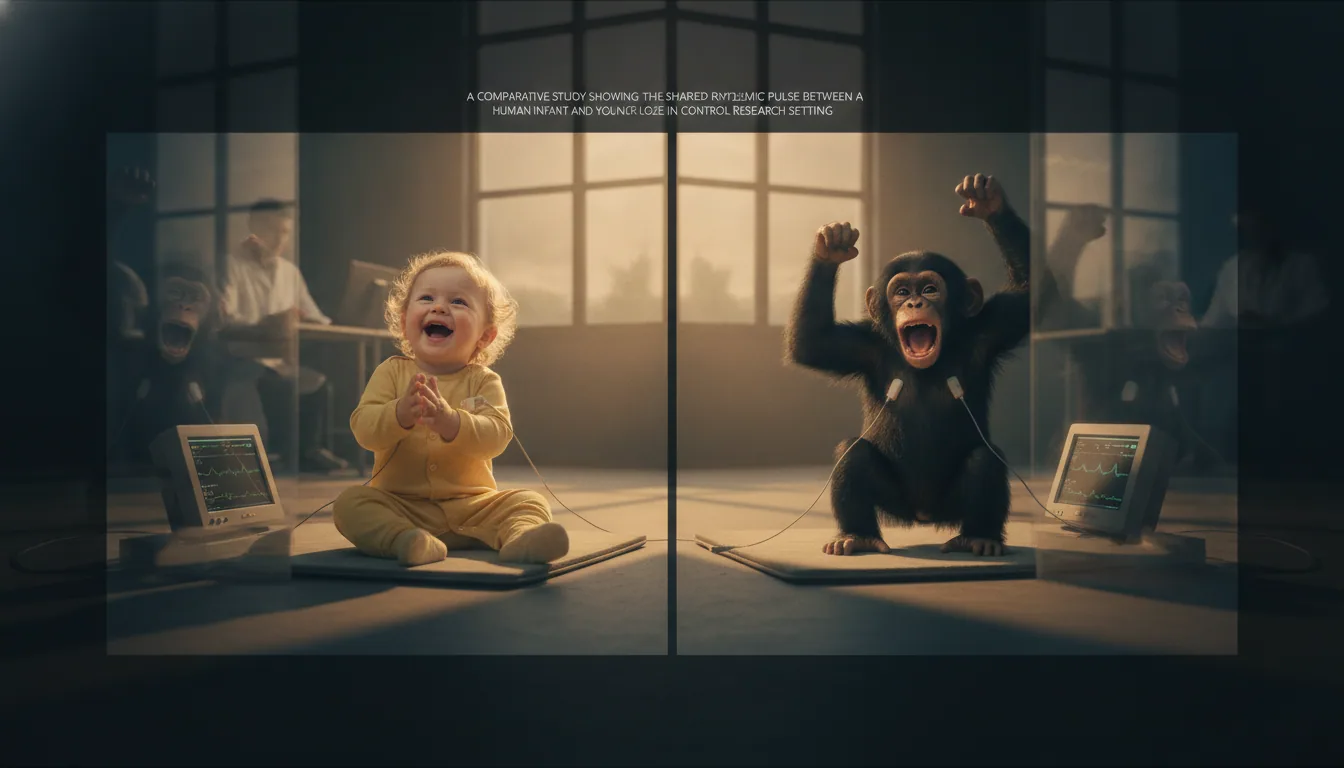
The primate roots of laughter trace back 15 million years to an ancient rhythmic template that served as the biological foundation for human speech. Researchers at the University of Warwick recently analyzed 140 laughter sequences across great apes and humans, discovering that our rhythmic chuckles are homologous ancestors to the "play-panting" signals used by gorillas and chimpanzees to manage social tension.
Imagine a room where a researcher is gently tickling a six-month-old human child. A moment later, the same researcher turns to a young chimpanzee and does exactly the same thing. The sounds that follow are different, yes, but they share a pulse that has not changed in eons.
In a study published in Communications Biology on June 25, 2026, researchers recorded 140 laughter sequences across five species, including 13 captive great apes and 4 human children. They were searching for the rhythm hidden beneath the breath.
When a gorilla "laughs," it sounds like a series of rhythmic, heavy pants. To an untrained ear, it might sound like a struggle for air, but to a scientist, this sound is a vocal fossil.
Tracing the Primate Roots of Laughter Through Evolutionary History
We have known since a landmark 2009 study that these tickle-induced sounds in apes are homologous to our own. This means they are not just similar by chance; they are direct descendants of the same ancient behavioral branch.
The Warwick team traced this rhythmic signature back 15 million years. This beat was already old before our ancestors even learned to walk on two legs.
While we see laughter as a uniquely human expression, it is actually a deeply conserved primate inheritance. It is the biological foundation that eventually gave us the power of speech.
To understand why a chimpanzee's breathy "huh-huh" matters to us, we have to look at isochrony. This is a way of saying the sounds happen at regular, evenly spaced intervals, much like a drummer keeping a steady time.
In the wild, play is a dangerous business. When two young gorillas wrestle, a misplaced bite could easily be mistaken for an attack. To prevent a friendly tumble from turning into a fight, primates use a rhythmic play-panting signal as a social safety valve.
Laughter is a living artifact that bridges the gap between our silent past and our talkative present.
The Metronome in the Throat
This sound acts as a constant vocal reminder that the aggression is pretend. It triggers the release of endorphins, those feel-good chemicals that help glue a social group together.
Researchers discovered that all great ape species produce laughter utilizing an identical structural signature. This rhythmic consistency is ancestral to all hominids.
Imagine a biological drumbeat passed down through a lineage of parents and children that connects a nursery in Estonia to a rainforest in Borneo. While the basic pattern is the same, the tempo is not.
Human laughter has evolved to be significantly faster and more variable than that of our cousins. Because spoken language leaves no physical remains in the record, laughter serves as a vocal fossil.
A Race Toward the Punchline
Imagine a family library where every book represents a single generation of your ancestors. You would have to walk past six hundred thousand volumes before finding a face like yours. Yet this rhythmic beat of a chuckle has been echoing through every single one.
While the beat is ancient, the tempo has been steadily creeping up. Evolution seems to be pressing the fast-forward button on our vocal cords as we move from the slow pulse of an orangutan to something more urgent.
Bonobos and chimpanzees laugh at a higher tempo than gorillas. They have traded the slow drum for a quicker beat because complex social groups require signals that are both fast and frequent.
When we arrive at the human species, the rhythm finally breaks into a sprint. Our laughter is significantly faster and more structurally variable. This vocal plasticity functions less like a metronome and more like high-speed jazz.
When the Brain Took the Reins
Imagine watching Tobby, a young orangutan, lost in a wrestling match. When his playmate flashes a wide "play face," Tobby mirrors the expression in less than a second.
For Tobby, this reaction is a reflex born of millions of years of primate history. His laughter and expressions are hard-wired into the subcortical regions of the brain. These are the deep, ancient basements that manage our rawest instincts.
In the human lineage, the evolutionary script eventually flipped. The brain's sophisticated outer layer, the cortex, began to take the reins.
This neurological shift moved laughter from the instinctive basement up to the executive command center. We are the only species that can consciously dial the speed of our laughter up or down based on social context.
A chimpanzee's rhythm is dictated by the physical sensation of a tickle. Humans, however, can modulate tempo to signal everything from polite agreement to shared belonging.
Naming the technical term, cortical control, is a way of saying the brain learned to pilot the voice like an instrument. We took an ancient, 15-million-year-old beat and made it the foundation of human connection.
The Fossil That Doesn't Leave a Bone
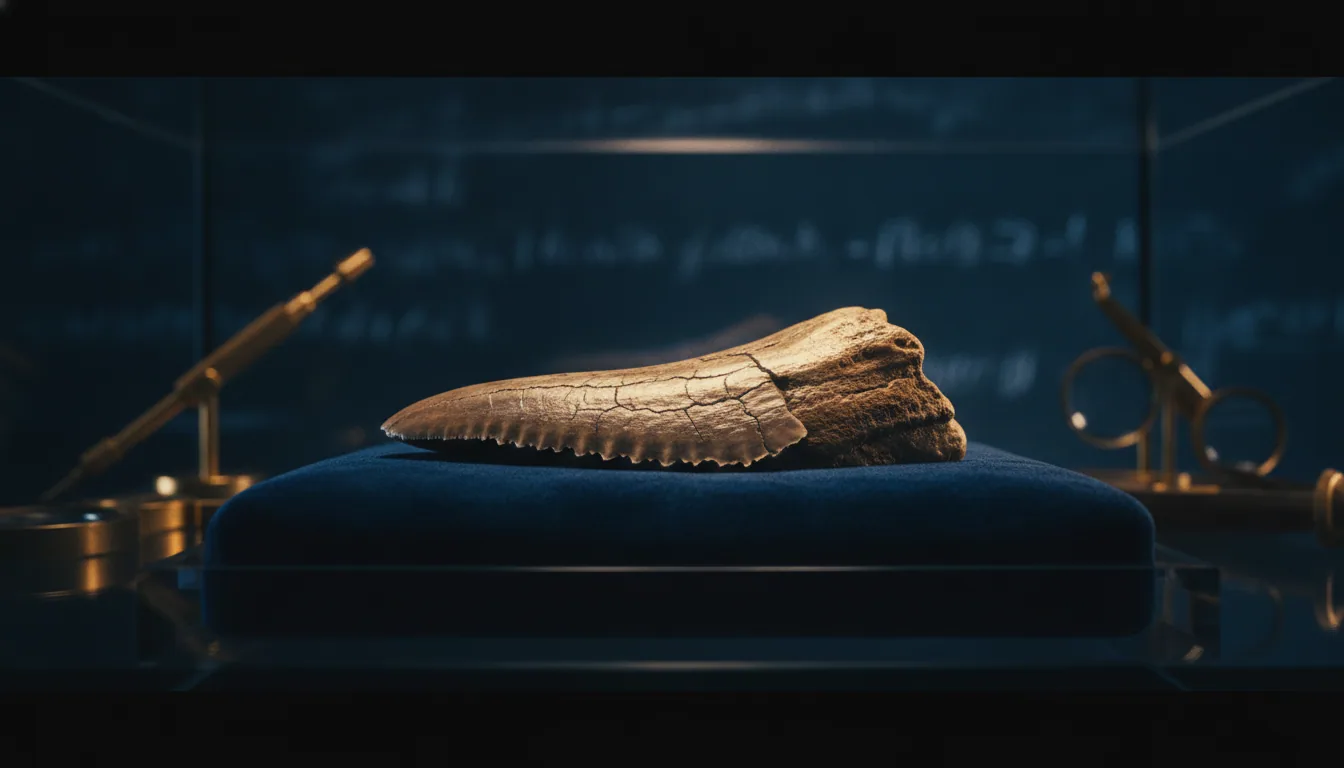
If you want to understand how an ancient ancestor moved, you find a fossilized femur. To see what they ate, you look at their teeth. But speech leaves no bones in the dirt.
This is why researchers call laughter a "vocal fossil." It provides the evidence we need because spoken language leaves no physical remains in the archaeological record.
Speaking is actually a feat of athletic timing. To talk, you need the motor control to modulate your vocal cords with extreme precision. Millions of years of primate vocal-cord modulation provided the neurological building blocks for this skill.
Laughter taught our ancestors isochrony, providing the pulse that had to exist before the song of language could begin. It served a vital purpose long before we had words to explain why something was funny.
This creates a neurochemical glue that facilitates social bonding within the group. In the end, understanding the primate roots of laughter reveals that the chuckle isn't just a reaction to a joke—it is the ancient scaffolding upon which our entire social world was built.