
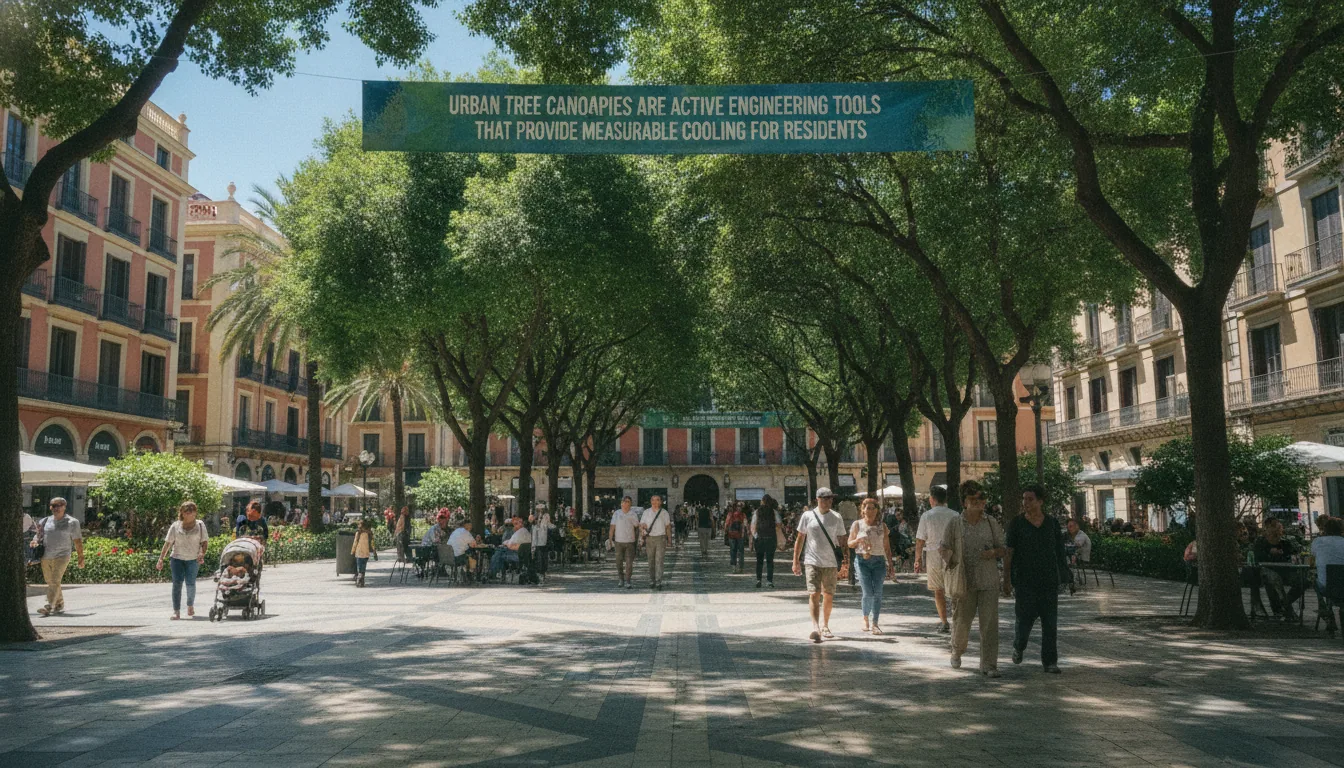
European heat resilience is the capacity of urban areas to mitigate extreme temperatures through systemic infrastructure like district cooling, tree canopies, and climate shelters. By reducing the urban heat island effect, these measures directly lower heat-related mortality and protect energy-vulnerable populations during record-breaking summer peaks.
Enhancing European heat resilience requires shifting from individual air conditioning to systemic urban cooling infrastructure that lowers ambient temperatures for all residents.
The Barcelona Model: Here’s What Actually Works
Barcelona has turned its public libraries, schools, and public buildings into a network of "climate shelters." Residents find immediate relief here when the mercury spikes. This is a functional infrastructure shift that treats cooling as a public health right.
The need for such levers is stark. In 2024, heat-related mortality in Europe reached approximately 62,800 cases. While it feels like an individual problem to be solved with a personal air conditioner, the data tells a different story.
Roughly 26% of EU households reported they could not afford to keep their homes sufficiently cool last summer. This is not a personal failure; it is a systemic gap that municipal leaders are finally beginning to bridge.
Valencia is proving that municipal scale is where the real work happens. As the 2024 European Green Capital, the city has implemented over 400 separate actions to mitigate urban heat. These range from technical sensor networks to the restoration of wetlands, which provide natural cooling of 4.9 °C.
This is a systematic rejection of the idea that we must simply endure the heat. The urban heat island effect can make cities 15 °C hotter than the surrounding countryside. These cities are utilizing part of the 100 billion euros in cohesion funds available for sustainable development.
Despair is just procrastination with better PR. These cities show that treating cooling as infrastructure moves the needle for everyone, not just those who can afford a high energy bill. That is not a gesture; that is a lever.
The 15-Degree Differential: Quantifying European Heat Resilience
The temperature difference between a city center and the surrounding countryside is a result of engineering choices rather than just the climate. Dark asphalt and dense concrete absorb solar radiation during the day and release it slowly at night, keeping the air trapped in a cycle of warming.
Thermal retention is now visible in human mortality data. Heat-related deaths in Europe reached approximately 62,800 cases in 2024, following a peak of 68,000 only two years prior. WHO data indicates that European heat-related mortality has increased by nearly 30% over the last two decades.
Europe is particularly vulnerable to these trends because it holds 9.21% of the global population, making it the fourth most populous area facing these specific thermal risks. Losing 62,800 people means losing nearly the entire population of an Estonian city like Narva or Pärnu in a single summer season.
Our current urban materials are working against us by functioning as batteries for heat rather than shedding it effectively. This physical reality is why we must move past small aesthetic changes to address the thermal mass of our streets.
Nature-Based Math: Why Tree Canopies are Engineering Tools
Data across more than 600 European cities shows that urban trees reduce local air temperatures by an average of 0.8 °C. This is a measurable baseline performance that provides a reliable starting point for municipal planning.
To move the needle on public health, we need a specific density of shade. Increasing city tree coverage to 30% can lower summer temperatures by 1.3 °C. This single change is enough to prevent 33% of heat-related deaths across the continent.
Research published in Nature highlights that while trees halve the urban heat island effect globally, these benefits only modestly mitigate broader climate-change warming. A park is a defense, not a total cure.
Botanical gardens provide the highest natural cooling capacity at -5.0 °C, while wetlands follow closely at -4.9 °C. These heavy-duty cooling units of the natural world operate with far more power than a typical line of street oaks.
For the average resident, this math changes the map of the city. We should stop viewing urban greenery as an aesthetic luxury for wealthy districts. It is a necessary piece of municipal infrastructure that only works if we build it to scale.
Centralized Cooling: Moving the Needle
Walk into the basement of a modern office block in Helsinki and you will hear the low, steady hum of cold water circulating through massive insulated pipes. This is district cooling, which carries chilled water to absorb building heat, much like the heating systems used in Tallinn.
Individual window units are often just a gesture because they pump waste heat onto the sidewalk, making the city hotter for everyone else. Centralized infrastructure is a lever. The European district cooling market is growing at 9.17% annually and is expected to reach $3.67 billion by 2025.
A centralized pipe is always more efficient than ten thousand buzzing boxes on balconies.
Sweden uses renewable energy for 67.8% of its heating and cooling, while Finland follows closely at 62.6%. These nations treat temperature management as a collective utility rather than a private luxury.
Across the EU, renewable energy now accounts for 26.7% of the heating and cooling sector. Germany and the UK have identified the efficiency gains and are now the leading markets for large-scale technological cooling infrastructure.
Building these networks is a slow, capital-intensive process that requires digging up city streets. However, as heat-related risks rise, a centralized pipe is always more efficient than a balcony unit. That is how you move the needle.
The €100 Billion Plan: Financing the Transition
In 2018, only 26% of cities had a specific plan to handle rising heat; today, that figure has reached 51%. This represents a shift from viewing heat as a temporary weather event to treating it as a permanent infrastructure challenge.
Cohesion funds are investing over €100 billion into sustainable urban development between 2021 and 2027. For a city like Krakow, this funding is the difference between a theoretical study and a physical construction site.
Rakvere, an Estonian city, has been presenting its sustainable concepts at European summits to show that mid-sized municipalities can implement cooling without massive overheads. The European Urban Initiative supports this work with a dedicated €395 million budget for city-level innovation.
The European Commission is currently preparing a new Heating and Cooling Strategy for Q2 2026 to formalize these standards. We are finally treating the thermometer like an accounting ledger.
The Cooling Divide: Addressing Energy Poverty
Urban parks must reach the 26% of EU households that reported an inability to keep their homes sufficiently cool in 2023. For a family in a poorly insulated apartment, this energy poverty is a health crisis linked to 62,800 heat-related deaths.
Barcelona has responded by creating a network of "climate shelters" in public schools and libraries. These shelters provide a vital lever for social equity, ensuring every resident is near a safe, tempered environment regardless of their income.
Research from Climate Analytics in Germany shows that tracking specific heat risks is the baseline for using cohesion funds for residential retrofitting. This shift moves cooling from an individual luxury to a collective urban utility model.
Only structural engineering will move the needle for the one in four Europeans currently left in the heat. Retrofitting a standard apartment block can reduce internal temperatures by several degrees without any extra energy.
The Honest Scorecard: Will Northern Havens Remain Cool?
Tallinn, Helsinki, and Stockholm are projected as the destinations with the highest natural cooling capacity for summer 2026. The European Environment Agency (EEA) marks these cities as the continent's safest thermal anchors.
Migration toward cooler climates will force Northern infrastructure to handle higher density without creating new heat islands. The Joint Research Centre (JRC) guidelines show that a city-wide district cooling network is a lever, while a flower box is a gesture.
With 62,800 heat-related deaths in 2024, the stakes are measurable. Increasing tree coverage to 30% can lower summer temperatures by 1.3 °C and prevent 33% of these fatalities.
Homeowners should prioritize external shading to keep heat out rather than buying larger fans. Policymakers must direct the 100 billion euros in cohesion funding toward district cooling and permanent canopy growth to secure long-term European heat resilience.