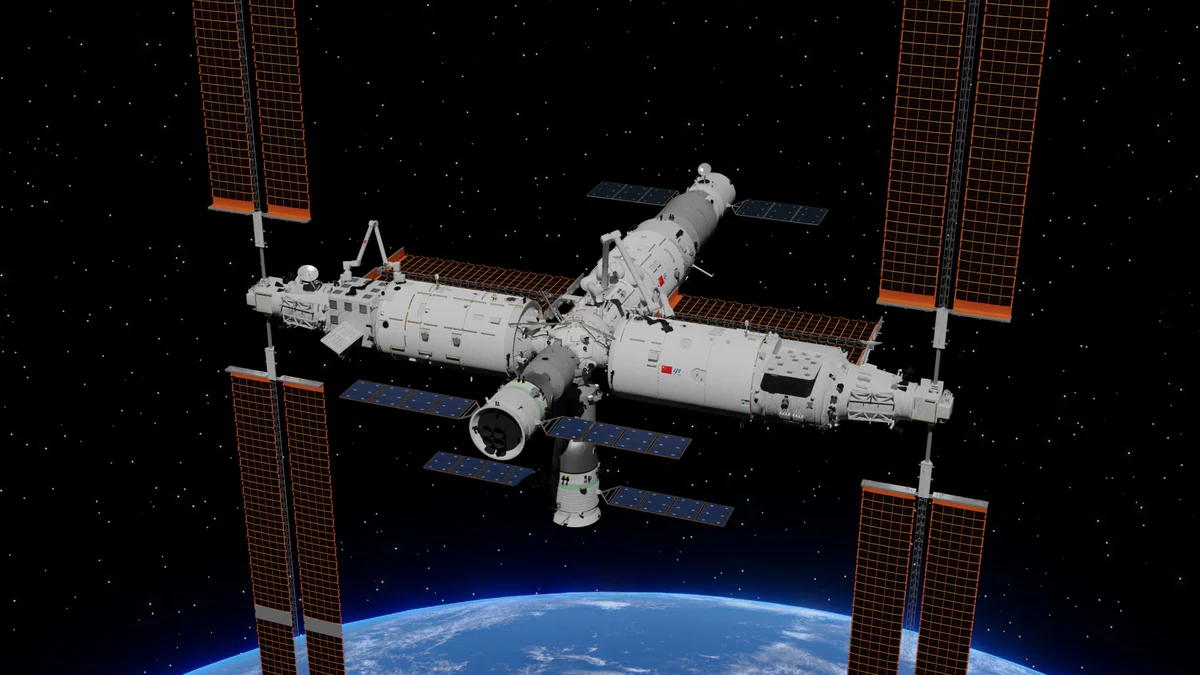
On May 24, 2026, the China Manned Space Agency launched the Shenzhou 23 mission to the Tiangong space station, carrying Commander Zhu Yangzhu, Pilot Zhang Zhiyuan, and Payload Specialist Lai Ka-ying. The mission features China’s first year-long orbital stay to study human physiological adaptation in preparation for a 2030 manned lunar landing.
China’s first year-long space mission officially began when the Shenzhou 23 spacecraft successfully docked with the Tiangong "Heavenly Palace" just 3.5 hours after lifting off from the Jiuquan Satellite Launch Center. This mission transitions the Chinese space program from standard six-month rotations to extended biological endurance tests.
The Geometry of the Long Stay
For most of us, a year is a cycle of seasons and the slow migration of the sun across the floor. To the crew of Shenzhou 23, a year will be measured in approximately 5,840 sunrises and sunsets, flashing past the station windows every 90 minutes.
One member of this crew will remain in orbit for a full 12 months rather than returning after the usual six-month shift. This marks the first time in China’s space history that an astronaut will endure such a duration of isolation.
We often view space travel as a feat of engineering, but the most complex component is the human body. Living in microgravity is a profound biological negotiation where the body begins to reshape itself the moment the Earth’s pull is removed.
The Biological Challenges of China's First Year-Long Space Mission
Without weight to push against, your bones decide they are no longer needed and begin to shed calcium like an old building losing bricks. The heart, no longer tasked with hauling blood against gravity, grows lazy and slightly rounder during extended stays in orbit.
Spending a year in space is comparable to spending a year in bed without moving; the body eventually forgets how to be a body. The Shenzhou 23 mission documents this process in meticulous detail to serve as a biological bridge for future lunar explorers.
The human body, evolved for millions of years to thrive under the constant pull of Earth’s gravity, begins to reshape itself the moment that pull is removed.
To refine their understanding, researchers will compare orbital data with terrestrial Antarctic isolation studies. Both environments subject the human mind and body to extreme stresses of confinement and sensory deprivation.
A Crew of Firsts
The crew members represent a significant broadening of who participates in the "Heavenly Palace" missions. Commander Zhu Yangzhu makes history as the first Chinese flight engineer to serve in the role of mission commander.
Alongside him are Pilot Zhang Zhiyuan and Payload Specialist Lai Ka-ying. Lai Ka-ying’s presence is a milestone as the first astronaut from Hong Kong to join a Chinese space mission.
Before her selection, Lai was a police inspector with expertise in computer forensics. Her background in meticulous reconstruction is ideal for handling the mission’s 100 scientific projects involving life sciences and microgravity physics.
The Ladder of Progress
To understand where Shenzhou 23 is going, we have to look at how the program evolved from its modest beginnings. In 1999, the unmanned Shenzhou 1 completed just 14 orbits before returning to Earth.
This steady progression has built the confidence necessary to eventually leave Earth’s orbit entirely. Every mission provides a data point that informs the safety and success of the next.
- 1999: A single unmanned craft circles the Earth 14 times.
- 2003: A single human spends 21 hours in orbit.
- 2024-2025: The Shenzhou 21 crew spends 204 days in orbit.
- 2026: Shenzhou 23 prepares for a 365-day stay.
The year-long rotation of Shenzhou 23 also creates a strategic opening for international cooperation. A future Pakistani astronaut is expected to visit the station during the subsequent Shenzhou 24 mission.
The Looming Moon
China has set a firm objective of landing humans on the moon before 2030. If the Tiangong space station is the laboratory, the moon is the field expedition that requires tested gear and crew.
To someone standing on the lunar surface, the distance back to Earth will be approximately 384,400 kilometers. This mission is the rigorous preparation required to make that vast distance feel surmountable for the human body.
| Mission Element | Detail |
|---|---|
| Launch Rocket | Long March 2F (Y23) |
| Docking Time | 3.5 hours after launch |
| Total Experiments | 100+ (Life sciences, materials, physics) |
| Previous Stay | Shenzhou 21 (204 days) |
| New Milestone | 12-month orbital stay |
| Lunar Goal | Manned landing by 2030 |
The Value of the Unknown
While China operates Tiangong independently, the scientific questions being asked are shared by researchers globally. Even small nations like Estonia contribute to this story through specialized technology like the OPIC deep-space camera.
We don't yet know the full psychological toll of a year in the "Heavenly Palace," as that decision depends on how the crew adapts. Science is a process of asking better questions rather than just collecting finished answers.
The horizon remains open for China’s first year-long space mission as it paves the way for the 2030 lunar window. We are learning that the most important thing we carry into space is our capacity for wonder and our refusal to stop asking "how."