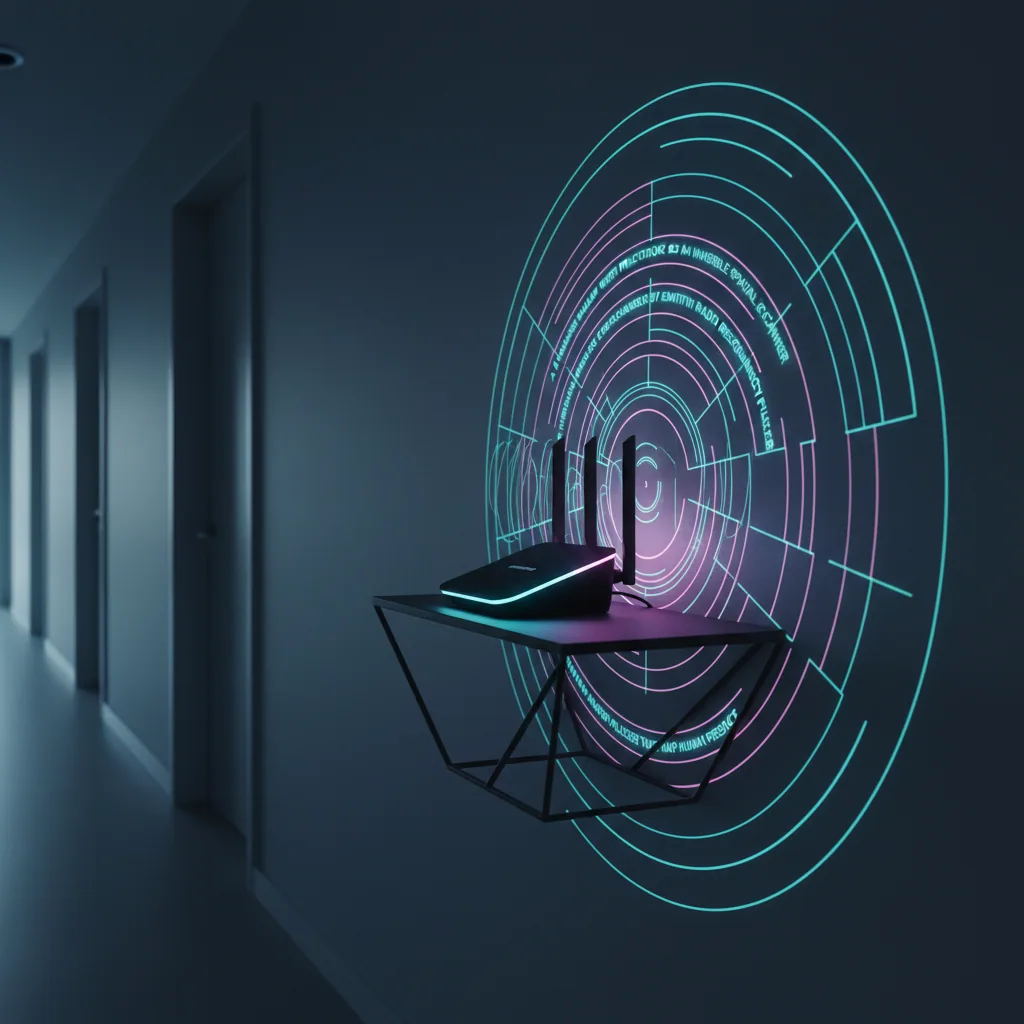
Researchers and technology firms reported a significant shift in wireless infrastructure between 2024 and 2026. Standard WiFi signals, originally designed for packet delivery, have evolved into sophisticated biometric monitoring tools. The router in your hallway is no longer just a gateway to the internet; it has become a high-resolution spatial sensor.
WiFi-based tracking identifies people by analyzing how radio frequency disruptions create unique digital signatures through movement. This technology interprets Channel State Information (CSI) to map human presence without requiring cameras, microphones, or wearables. By 2026, standard routers have effectively transitioned from communication hubs into invisible biometric scanners.
The industry is currently transitioning from passive communication to active sensing. While WiFi has always bounced off physical objects, new algorithms allow systems to interpret these reflections with startling granularity. This development offers new capabilities for elderly care but introduces a category of invisible surveillance.
The Engineering of WiFi-based tracking
To understand this shift, we must look at the radio environment from first principles. In engineering terms, this relies on CSI, which describes how a signal propagates from a transmitter to a receiver. When a human body moves through a field, it creates unique disruptions through a phenomenon known as multipath propagation.
Between 2024 and 2026, firms like Origin AI demonstrated that standard signals can function as biometric tools. By analyzing CSI, these systems identify individuals and track movement through walls. This creates a digital map of human presence based entirely on radio frequency interference.
The engineering tells a different story than the marketing brochures. While companies focus on detecting falls in elderly care, the underlying physics allows for much more. Standard signals can now identify specific individuals with near-perfect accuracy, according to reporting from Tech Explorist.
From Communication to Biometrics
This is a tradeoff, not just a solution. Most users view WiFi as a utility, similar to water or electricity. However, Startup Fortune noted that ordinary signals are becoming a recognized biometric risk for technology startups.
If the wireless environment can identify a person by their gait, every enabled space becomes a data collection point. WiFi sensing capabilities are being integrated directly into smartphone and router chips for everyday use. Future standards are being designed to natively support these advanced sensing applications.
The precision of these systems results from improved Signal-to-Noise Ratio (SNR) and complex antenna arrays. Tools like NetSpot already allow engineers to detect SSID, channel, and SNR to optimize coverage. When you combine signal clarity with machine learning, the network stops being a blind pipe and starts being an observer.
The signal that carries your emails is the same signal that identifies your heartbeat.
The Privacy Paradox of Lenses
The current marketing narrative, cited by sources like Sify, frames sensing as a privacy-preserving alternative to cameras. The logic suggests that because it does not capture visual data, it is inherently less invasive. Cognitive suggests that WiFi Motion is inherently private compared to solutions that rely on cameras.
Here is what the demo didn't show you. A camera is a visible sentinel with a clear lens and field of view. WiFi sensing is invisible and capable of detecting movement even when the subject is behind walls. The lack of a lens simply means the surveillance is harder to opt out of.
SciTechDaily has issued warnings that infrastructure could be transformed into an invisible mass surveillance system. Unlike a traditional camera system like the EZVIZ H80f, WiFi sensing has no physical orientation. It is everywhere the signal reaches, which is nearly everywhere in a modern urban environment.
Infrastructure and Management
The technical reality of maintaining these networks is becoming increasingly complex. In Estonia, technical support experts like Mari-Liis Elion from Telia provide guidance on proper router placement. Proper placement is no longer just about ensuring Netflix doesn't buffer; it is now about the "field of view" for biometric sensing.
For corporate environments, the stakes are higher. Network security relies on segmentation and RADIUS servers to maintain cyber hygiene. As ProIT editorialized, "Jälgimine on usaldusväärse IT süda" (Monitoring is the heart of reliable IT).
| Component | Standard WiFi Function | Sensing Evolution |
|---|---|---|
| CSI Data | Signal optimization | Biometric identification |
| Multipath | Interference to be mitigated | Data source for motion mapping |
| Router | Data distribution hub | Spatial awareness sensor |
| WIDS | Intrusion detection (Network) | Intrusion detection (Physical) |
We are also seeing the integration of these signals into larger monitoring stacks. IT infrastructure tools like Zabbix are used for tracking server and network health. Real-time monitoring and Wireless Intrusion Detection Systems (WIDS) are now used to detect both network anomalies and physical presence.
The Global Inventory of Signals
The scale of the existing infrastructure is the real moat for this technology. Databases like WiGLE contain millions of access points submitted by users through wardriving. There are over 300,000 verified access points in the WiFi Space database alone.
This existing density means that high-accuracy sensing doesn't require new hardware deployment. It only requires a firmware update. Consumer devices like the TickTalk communication tool already rely on this consistent connectivity for 300,000 families.
On platforms like Digitark, advice often focuses on improving frequency management to avoid saturation. In engineering terms, a saturated environment is "noisy" for sensing. The goal of network optimization is shifting from maximizing throughput to maximizing the visibility of the environment.
Regulatory and Ethical Realities
If you are a startup founder or a building manager, WiFi is now a potential liability. If signals are legally classified as biometric data, "free WiFi" may soon carry the same regulatory burden as fingerprints. The engineering has reached a point where the distinction between a data signal and a physical signature has dissolved.
The cost-efficiency of this technology is driving rapid adoption. Some research suggests potential cost savings of 64% in cloud provisioning when using AI-driven management. But these savings come at the cost of turning every private space into a readable data field.
For the average user, iOS apps that allow for monitoring signal interference are a double-edged sword. They help you fix your connection, but they also highlight just how much data your router broadcasts. WiFi-based tracking represents a fundamental shift in the architecture of privacy that our current policies are not yet prepared to handle.