On November 15, 2026, the IRGC launched six drones at the Al-Riffa helicopter base. Bahraini and U.S. forces intercepted all six. The Iranian attack on Bahrain was claimed directly by the IRGC — no proxy, no deniability — and framed as the first phase of a named campaign against American forces in the Gulf.
The Smallest Kingdom and the Largest Fleet
In the summer of 1991, as the Soviet Union ran out of time, the Baltic states held their breath and watched the great powers decide whether to notice. They had no armies worth mentioning and no leverage except geography. What they had was location - and location, as every small state eventually learns, is the thing the empires fight over last.
Bahrain has known this arithmetic for decades. A kingdom of 1.5 million people, it sits at the western rim of the Gulf and hosts the permanent headquarters of the U.S. 5th Fleet: Naval Support Activity Manama, the institutional anchor of American naval power in the region. That designation does not make Bahrain a combatant. It makes Bahrain a target.
Shortly after 04:00 local time on November 15, 2026, the Iranian Revolutionary Guard Corps launched six drones toward the Al-Riffa helicopter base. Explosions were reported over Manama and Muharraq as the incursion unfolded across a window of roughly two and a half hours, running until 06:30. Bahraini Defense Forces, operating integrated air defense systems alongside U.S. assets, intercepted and destroyed all six drones before they reached their intended targets. The Ministry of Interior issued a nationwide shelter alert, and residents of the capital woke to sirens in a war Bahrain had not declared and could not opt out of.
Ask the small question first: who is the borderland here, and who is the empire? The IRGC did not strike Bahrain. It struck the address where the 5th Fleet receives its mail. The distinction mattered in Manama - the Bahraini government had to explain to 1.5 million people why their airspace had become a theatre - but it mattered less to the drones, which do not read sovereignty agreements.
How the Ladder Was Built: Iran's Escalation Path to Bahrain
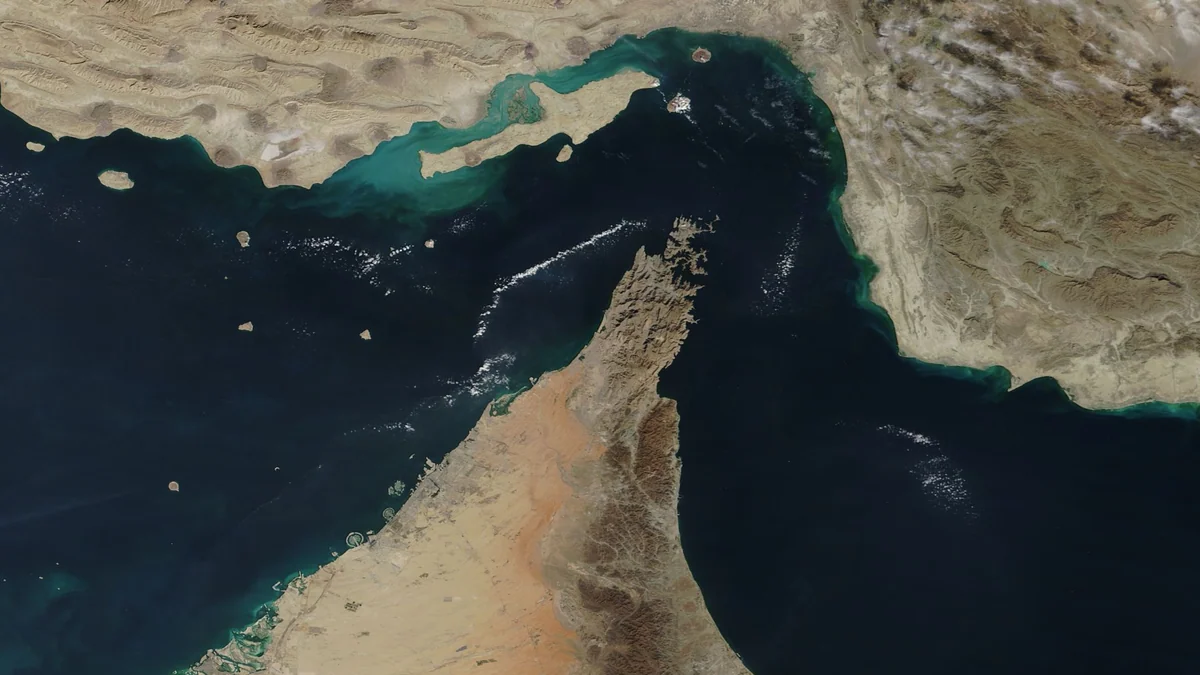
The chain of justification Iran now presents has the internal logic of a ledger: each entry references the one before it, and the original debt is always somebody else's. Work backwards from the six drones over Al-Riffa on November 15 and you arrive, rung by rung, at a U.S. strike package against 90 Iranian military targets near Sirik, on the coastal approaches to the Strait of Hormuz. Those targets included air defense batteries and maritime logistics infrastructure. Donald Trump's public framing was direct: the strikes were retaliation for Iranian attacks on commercial shipping in the strait.
That framing is contestable in timing and emphasis but not in outline. Iran had been harassing Hormuz traffic as a pressure lever long before the current cycle, and CENTCOM did not trouble itself to present the Sirik operations as anything other than a deliberate degradation of Iranian military capacity. The IRGC statement describing the November campaign as the "first phase of defensive blows against American agreement-breakers" is self-serving language, but the operational sequence it references is real. The question worth asking is not whether the chain exists, but where the original link sits, and that link predates 2026.
The June 28 strikes on Issa airbase and the 5th Fleet base in Manama are the rung that tends to drop out of the Western wire summary. Those strikes came before the November 15 attack and after Sirik, slotting into the middle of a ladder that Iran now presents as a single, coherent defensive arc.
Each party reads the same sequence and identifies a different first mover. That is not confusion. It is the standard architecture of an escalation cycle that neither side intends to be held accountable for starting. The ladder was built collaboratively, one rung at a time, and the naming rights to the bottom rung remain, for now, disputed.
The Competing Ledgers: What Iran Claims and What the Record Shows
Two days before the November 15 drone salvo, the IRGC announced that it had destroyed a U.S. early-warning radar system in Bahrain. CENTCOM issued a flat denial: two drones had been intercepted, no damage sustained. Neither side published footage that settles the question.
That gap is not incidental. The recurring discrepancy between Iranian strike claims and verifiable interception outcomes is a structural feature of this conflict phase, not a failure of communication. When Iran claims 85 objects struck in July and CENTCOM's damage assessments show something considerably more modest, the communiqué is doing separate work from the battle damage assessment. The claim is not addressed to the radar technician; it is addressed to the domestic audience in Tehran and to every regional government calculating whether U.S. air defense is as reliable as advertised.
The language around November 15 makes the design explicit. IRGC officials described the Bahrain attacks as the "first phase" of defensive strikes against what they called American agreement-breakers.
"First phase" is a phrase engineered to keep an adversary looking over its shoulder. It costs nothing to issue and nothing to withdraw. It converts a failed drone salvo into an open threat, and it does so without committing to a timeline or a target.
Here is what the record forces us to hold separately: the physical outcome, which Bahraini and U.S. forces describe as a clean interception of six drones, and the informational outcome, which Iran has already claimed as a successful assertion of pressure. In asymmetric campaigns, the communiqué is load-bearing in its own right. Intercepted hardware is recovered; a "first phase" announcement stays in circulation until the second phase either materialises or quietly does not.
Intercepted hardware is recovered; a "first phase" announcement stays in circulation until the second phase either materialises or quietly does not.
The Kingdom Within the Kingdom: Bahrain's Internal Security Dimension
The drones from outside were the visible part. The network inside had been running longer.
In May 2026, Bahraini authorities dismantled a 41-member operative cell directed by Iranian intelligence, the largest such operation the kingdom had announced in years. The timing - parallel to the aerial escalation - was not incidental. The domestic front and the aerial one are not two stories; they are one operation at two altitudes.
The legal record confirms the pressure. In April 2026, five individuals received life sentences in Bahraini courts for espionage on behalf of Iran. Bahraini prosecutors have since sought the death penalty for individuals photographing restricted military sites - a threshold that marks where a government stops counting threats and starts measuring them in capital charges. That is the watermark of a state that knows the inside is as contested as the sky.
The ground had been prepared before any of this. Saraya al-Ashtar, the Iran-backed group the United States designates as a terrorist organisation, had already conducted drone operations from inside Bahrain targeting Israeli interests. The sequence has a structure: proxy reconnaissance, proxy action, then the IRGC steps forward under its own name. Each phase normalises the next.
This is the domestic dimension the communiqués leave out. The shelter order issued to Bahraini citizens at four in the morning on November 15 was the final notification in a process that had been moving for months - through courts, prisons, dismantled cells, and photographed perimeters.
The kingdom within the kingdom had been active long before the drones appeared on radar. The question is not whether Iran had reach inside Bahrain. The court record settled that.
The Mask Dropped: What Direct IRGC Action Changes — and What It Does Not
Proxy operations carry deniability as their primary return. When the IRGC brands a strike directly, signs it, and frames it as the "first phase" of a named campaign, it has surrendered that return. The acceptance of attribution costs something: it converts a harassment operation into a declared posture, and declared postures carry escalatory obligations the IRGC high command will now find difficult to walk back without visible loss of standing.
What it does not change is the technical reality. Six drones were launched on November 15; none reached their target. The November 13 radar-destruction claim ran into CENTCOM's flat denial within hours, with two drones downed and no damage recorded.
This gap between the IRGC's announced ledger and the intercepted hardware is not a one-day anomaly - it is the operational signature of a Sammad-type platform being fed into a coordinated regional air defense umbrella it was not designed to defeat. The simultaneous interceptions over Bahrain and Kuwait on the same morning describe a networked system, not two separate lucky shots.
The Strait of Hormuz remains a different matter. Drone campaigns that fall short of their claims do not close a chokepoint; geography does.
Iran's durable leverage over global oil transit has never required accurate targeting. The drone campaign and the strait operate on separate ledgers, and conflating their fortunes is precisely what the IRGC communiqué invites.
The marker to watch is narrow: whether the declared second phase of Iran's attack on Bahrain materialises, and whether its target list moves from military radar installations toward commercial infrastructure in or near the strait. That movement would answer the one question this round of strikes leaves open - whether Iran has decided the cost of attribution is worth paying at a scale that changes something structural, or simply at a scale that fills a press release.