
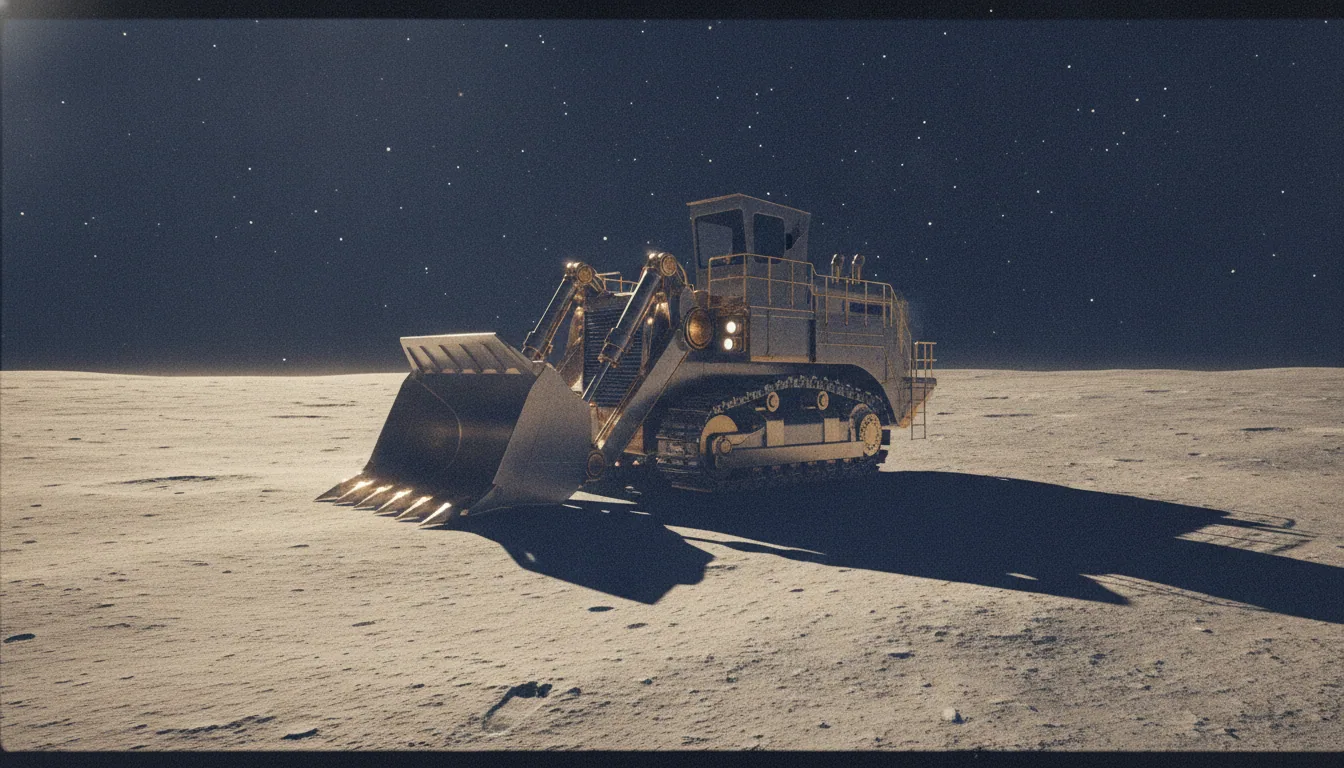
By 2027, the Moon will no longer be a distant museum of human footprints; it will be an industrial site. The race for Helium-3 and water ice is bypassing outdated international laws, creating a "Wild West" where technological power dictates resource rights, threatening both our scientific heritage and the fragile lunar environment.
Imagine you are dropped onto the lunar equator at dawn. Before you can even think about your surroundings, you are facing a survival crisis. On the sunlit side, the temperature climbs to a staggering 150 degrees Celsius—hot enough to boil your blood. But wait a few hours for the shadow to move, and the ground beneath you plummets to -180 degrees Celsius.
Here is the strange part: most materials we use on Earth simply aren't built for this. Metals expand until they warp or shatter; plastics become as brittle as thin glass. Yet, despite an environment that seems designed to destroy machinery, a private company called Interlune—alongside several national programs—is planning to land industrial excavators there as early as 2027. This isn't science fiction anymore. It is a business plan.
But the real prize isn't at the equator. To find that, we have to look into the craters of the lunar South Pole, where the sun hasn't shone for billions of years. In these "permanently shadowed regions," temperatures drop to -250 degrees Celsius. In these pockets of absolute cold, the Moon has been hiding its most valuable secrets: frozen water and Helium-3.
The Gas Station in the Sky
We used to think of the Moon as a bone-dry rock. Now we know it is a vault. Over eons, comets crashing into the surface delivered water, which drifted into those frozen polar craters and stayed there, trapped in the dark.
Now, hold that thought, because to an industrialist, that ice isn't for drinking. It is a double-resource. Through a process called electrolysis, we can split that water into oxygen and hydrogen—the primary ingredients for rocket fuel. If we can harvest ice on the Moon, we don't have to haul every liter of fuel up from Earth's heavy gravity well. The Moon becomes the gas station for the rest of the solar system, making deep-space travel orders of magnitude cheaper.
This is why the lunar South Pole has suddenly become the most strategic real estate in the galaxy. It is not about romance or exploration for its own sake; it is about the strategic seizure of resources.
Science, as it often does, is acting as the scout. Mihkel Pajusalu from the Tartu Observatory is leading the 2025 LUMI mission to map these very regions. You cannot mine what you haven't found, and in this new era, science and industry are not competitors—they are partners in a very high-stakes game. Already, NASA's IPEx excavator is designed to churn through ten tons of regolith (lunar soil) in just 11 days. The technical feasibility is no longer a question; the question is who gets there first.
A Law That Stops at the Stratosphere
To someone standing in 1967, the idea of a private company owning a piece of the Moon would have been indistinguishable from a fever dream. That year, the Outer Space Treaty was signed, stating clearly that no nation can claim the Moon as its own.
But here is the loophole you could drive a bulldozer through: the treaty was written for state-run space programs, not private corporations. It forbids territorial sovereignty, but it says absolutely nothing about whether a private company can dig up the soil and sell it. Without clear, modern regulations, we are looking at a lunar "Wild West."
The Artemis Accords were designed to fix this, creating a framework for transparency and the protection of heritage sites. However, it is a political agreement, and major players like China and Russia haven't signed it. This means there is no unified world order on the lunar surface.
Estonia joined the Artemis Accords in October 2024. For a small nation, this isn't just about diplomacy; it's about positioning. In a world of giants, the ability to draft faster, more precise legislation is a small country's greatest leverage. While researchers from the Universities of Vilnius and Utrecht have called for a moratorium on industrial development to study the environmental impact, the industrial clock is ticking much faster than the scientific one.
Dust: The Tiny Assassin
If you want to understand the biggest threat to lunar science, don't think of a catastrophic explosion. Think of dust.
Lunar regolith isn't like the soft sand on a beach. Without wind or water to erode them, these particles are like microscopic shards of ground glass, made even sharper by constant cosmic radiation. On the Moon, there is no atmosphere to drag these particles down. When an engine fires or a drill starts, the dust doesn't just settle—it drifts and coats everything.
Scientific instruments won't die by fire; they will die by dust. Even the historic Apollo 11 landing site—a monument to human achievement—is at risk if a commercial quarry opens too close to it. Industry doesn't naturally distinguish between a valuable mineral deposit and the first footprint of our species.
We are already seeing infrastructure move in. Nokia plans to launch a 4G network on the Moon by 2025. For these systems to survive, we need solutions like NASA's Electrodynamic Dust Shield (EDS), which uses electrostatic charges to flick dust away. It works, but whether it can handle the sheer volume of a full-scale mining operation is something we still don't know.
The Estonian Niche: From Cameras to Cyber-Defense
In Estonia, if a company leaks industrial waste, they face strict directives and heavy fines. On the Moon, there is no such thing as an environmental inspector. It is a collision of two realities, separated by 384,400 kilometers.
Estonia has already found its seat at the table. The company CrystalSpace has developed stereo cameras for NASA missions, proving that in the space economy, precision is more valuable than bulk. But the real frontier for Estonia might be digital.
The more hardware we put on the Moon, the larger the "attack surface" becomes for hackers. If a navigation system is compromised, or a communication link is hijacked, the physical consequences are absolute. Estonia's expertise in cyber-defense is becoming a concrete advantage in securing the lunar infrastructure.
As the Ministry of Economic Affairs and Communications prepares the Estonian Space Act for 2026, the goal is to eliminate the "gray area" and define corporate responsibility beyond our atmosphere. Clear rules aren't just red tape; they create the stable environment that innovation needs to thrive.
But without China and Russia in the Accords, we are essentially looking at a border patrol without a guard. If one nation's mining drone accidentally destroys another nation's telescope, who is liable? The current treaties are silent.
The Moon's exosphere is a fragile, micro-structured system that we are only just beginning to understand. Humanity first went to the Moon to answer deep questions about our origins. Now we return with a new set of challenges. We are forcing ourselves to find answers to questions that, in 1969, we weren't even clever enough to ask.