Kraków, 7 November: What Happened at the Rynek Główny
Nice, July 2016: a truck drove the length of the Promenade des Anglais for nearly two kilometres before anyone with authority to stop it could act. The security implications of Poland's shooting at Rynek Główny invite the same comparison — and like most tempting comparisons it is only partially useful: the vehicles, the squares, the Saturday crowds are similar; almost everything structural about the two contexts is not.
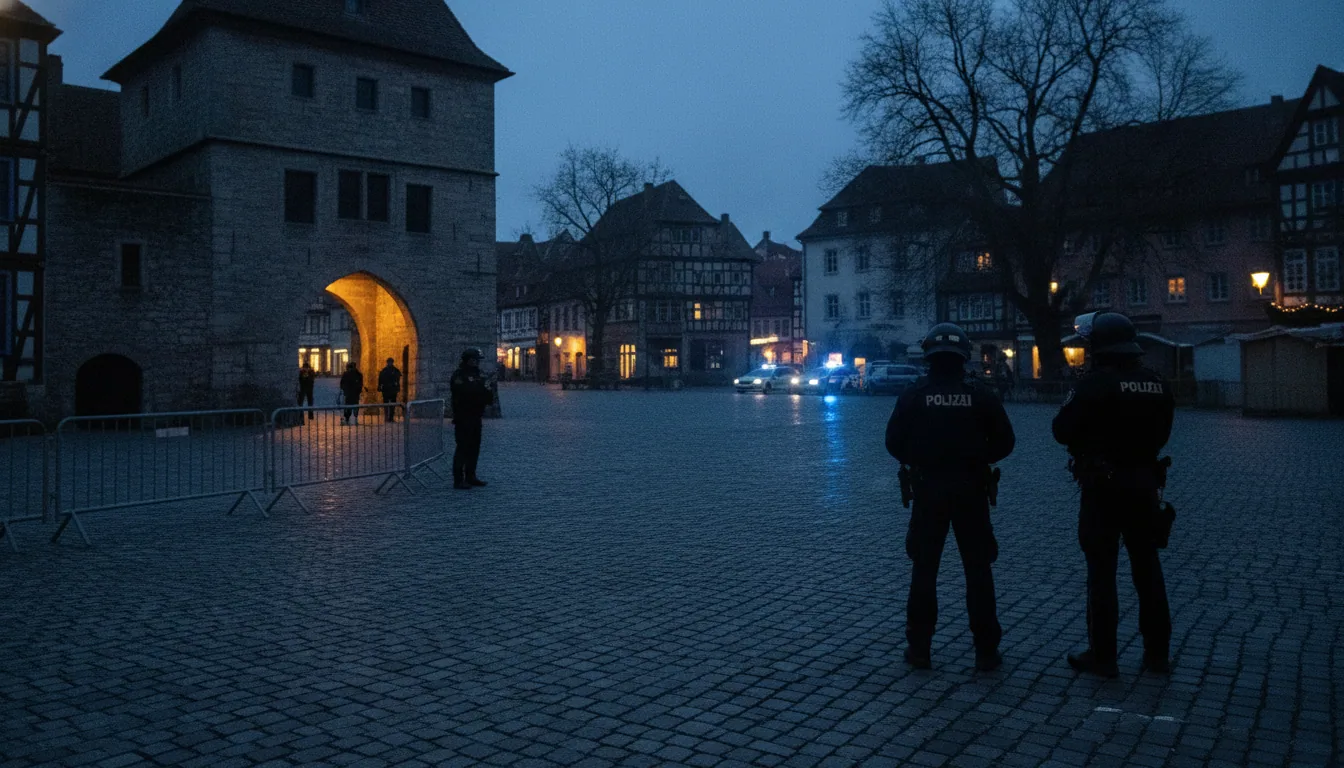
What is on record is this. On the afternoon of Saturday, 7 November 2026, an individual drove a vehicle into Rynek Główny, the historic Main Market Square of Kraków, Poland's second-largest city, and opened fire on pedestrians. Five people were killed. At least ten others were wounded, among them police officers who had responded to the scene.
Polish police shot the suspect during the apprehension; he was subsequently hospitalised. Prime Minister Donald Tusk confirmed the attack through official channels, describing it, in a Postimees-quoted statement, as a "traagiline tulistamine" — a tragic shooting.
The sequence matters: vehicle first, then gunfire. That ordering shifts the event from a category the security services had spent months calibrating — border incursions, drone corridors, hybrid pressure from the east — into a category they had not publicly prioritised. Poland had, by November 2026, deployed some 20,000 police officers nationally following a series of school attacks in October.
Law enforcement was present. Officers were still among the wounded. The investigation into the suspect's identity, nationality and motive remains open, and those gaps are not minor details — they are the load-bearing questions everything else waits on.
Already on Alert: The Security State Poland Assembled Before the Attack
Poland was not caught unprepared in any conventional sense. Following a series of school attacks in October 2026, the government deployed 20,000 police officers across the country in a sustained public-security posture that was still in effect when the gunman drove into Rynek Główny. After the Kraków shooting, that alert was not scaled back — it was extended and deepened. The machinery was already running.
Behind those patrol numbers sits a heavier architecture. The Shield East programme — a 10 billion PLN investment in fortifying Poland's eastern flank — has reoriented the country's security spending toward the border with Belarus and Russia. New rules passed in August 2024 authorised security forces at the border to use lethal force without criminal liability under defined conditions, the legislation catalysed in part by the 2024 killing of soldier Mateusz Sitek at the fence.
By October 2026, air defence protocols had been updated further: pilots may now engage unidentified objects on radar data alone, without visual confirmation.
The architecture is real, and its eastern orientation is rational — ninety per cent of those caught crossing illegally from Belarus were found carrying Russian visas. But the Kraków attack happened inside all of it. The city's patrol density was elevated before 7 November. The 20,000 officers were on the streets.
The perimeter held, and the attack occurred anyway — in a pedestrian square, on a Saturday afternoon, in the city centre. That is the operational problem the hardware does not resolve.
The perimeter held, and the attack occurred anyway — in a pedestrian square, on a Saturday afternoon, in the city centre.
The Eastern Wall: Border Pressure and the Logic Behind It
The frontier came first. Poland's security establishment had been fighting a different kind of war along its eastern border for years before a gunman reached the Rynek Główny, and that war reshaped the legal and institutional landscape of the entire country.
The numbers from the border are not random. Ninety per cent of individuals intercepted attempting to cross illegally from Belarus carried Russian visas. That figure does not describe spontaneous movement; it describes a logistics operation.
The buffer zone restricting civilian access along the Belarusian border remained in effect through late 2025, a formal acknowledgment that the frontier was an active front, not an administrative line.
The legal shift came in August 2024, after soldier Mateusz Sitek was killed at the border fence. President Andrzej Duda signed legislation authorising security forces to use firearms at border crossings without criminal liability under defined conditions. The catalyst was a death; the product was a doctrine.
Lethal force, once confined to the extreme edge of emergency, became a normalised instrument of frontier management.
What this means practically is that the Polish state had already moved its threshold — the point at which a security officer may fire — well before Kraków. That consensus was built to address hybrid pressure from state actors using migration as a weapon. It was not built for a pedestrian square on a Saturday afternoon.
The institutions are consistent; the terrain shifted. Shield East can harden a border. It cannot harden every open space in a city of eight hundred thousand, and the architecture designed for one problem does not automatically transfer to the other.
Shield East and the Airspace: Where Poland's Defence Investment Points
Ten billion złoty buys a great deal of concrete, sensor wire and radar dish. The Shield East programme, the centrepiece of Poland's eastern flank strategy, commits precisely that sum to hardening a border where nine in ten irregular crossers arrive carrying a Russian visa. The investment is real and, on its own terms, coherent.
The airspace rules completed the picture. On 1 October 2026, protocols came into force authorising Polish pilots and air defence crews to engage unidentified objects on radar data alone. Defence Minister Kosiniak-Kamysz and General Nowak oversaw the implementation; the threshold that had always required visual confirmation was quietly lowered.
The change followed years of Russian drones crossing Polish airspace and landing in fields, and at least one Patriot battery spending a long night tracking something that never announced itself.
The architecture is worth admiring on its own terms. It is calibrated for a state actor probing from the east — patient, signal-emitting, trackable by the systems Shield East was purchased to run. A formation of unidentified rotorcraft over the Bug river is exactly the threat this money was built to price.
Rynek Główny on a November Saturday afternoon is not. The medieval square fills with families and tour groups; the stalls that have stood there since the thirteenth century do not come equipped with radar. The 10 billion PLN and the new engagement rules point east and upward — precisely the directions the Kraków shooter did not come from.
That is the load-bearing wall. The question the investigation has not yet answered is what, if anything, sits beneath the other one.
The Gun Question Poland Has Not Been Forced to Ask — Until Now
Poland does not have a gun culture. That sentence requires no qualification. Civilian firearm ownership is tightly regulated, licensing is demanding, and the political consensus around those restrictions has held across governments of left and right for decades.
By European standards, Poland sits closer to Germany than to the Czech Republic on this question, and no serious domestic pressure has dislodged it.
The comparison worth making is not to the United States, which is too easy and therefore useless. The instructive contrast is with Poland's own eastern-flank security logic. Since 2024, Warsaw has expanded the conditions under which security personnel may use lethal force at the border without criminal liability.
The soldier Mateusz Sitek died there; the law followed. The airspace protocols that took effect on October 1, 2026, allow pilots to engage unidentified objects on radar data alone. The direction of travel is unmistakable: the state's threshold for kinetic response has been moving steadily downward.
The Kraków attack introduces a different variable into that trajectory. What weapon was used, and where did it come from? The investigation has not yet answered either question.
If the firearm was legally held, the debate opens in one direction. If it crossed a border — any border — it opens in another. Poland's strict civilian ownership rules may prove entirely beside the point, or they may become the centre of the argument. That depends on a single fact no one has released.
The Security Implications of Poland's Shooting: What the Investigation Has Not Answered
Three days after Rynek Główny, the investigation has confirmed five dead and roughly ten wounded. It has not confirmed who the shooter was, where he came from, or where the weapon came from. Motive remains undisclosed. Nationality is unestablished. The firearm's origin is unknown.
That last gap matters more than it may appear. Poland's civilian gun laws are among the most restrictive in the European Union, which makes the weapon's provenance a load-bearing question, not a footnote. If the firearm entered Poland through the same eastern pressure channels that the border apparatus was built to monitor, the architecture failed in a direction nobody planned for.
If it did not, the problem is different and closer.
The absence of a confirmed hybrid link is itself a significant data point. No foreign connection has been established. That is not an exoneration of any state actor; it is an open file. Investigators and commentators alike should resist the temptation to close it prematurely in either direction.
The marker to watch is narrow and specific: the nationality finding in the official investigation report, and the precise language Donald Tusk uses when he announces it. If he says "coordinated," watch the border. If he says "isolated," watch the interior — the 20,000 officers already deployed, the gun-law debate that has not yet started, and the question of whether Poland's security investment will pivot.
One word in that announcement will determine which problem this was — and with it, the full security implications of Poland's shooting.