The thousand-year error hiding in every history of English
For most of the twentieth century, textbooks placed the Germanic language family in Scandinavia around 5,000 years ago. That date appeared in courses, encyclopedias, and confident professorial lectures. It was, it turns out, off by roughly a thousand years.
In November 2026, a team from the University of Copenhagen and Leiden University published findings in Nature that force a rewrite. Their dataset was not modest: 4,500 ancient individuals from across Europe, with 712 genomes sequenced specifically for this study. That is not a sample. That is a population. When you can read the DNA of that many people who actually lived through the Bronze Age, hypotheses stop being hypotheses.
Germanic language foundations arrived in Scandinavia approximately 4,000 years ago, not 5,000. One millennium, gone.
A thousand years might sound like a rounding error on the scale of deep prehistory. It is not. Bronze Age Europe was not static. Climates shifted, trade networks rose and collapsed, entire cultures appeared and vanished within a few centuries. Pushing the Germanic arrival forward by a millennium places it inside a completely different set of Bronze Age circumstances, different migrations, different neighboring peoples. The whole explanatory story has to move.
Lead author Hugh McColl put it plainly: his team discovered a previously unknown migration from the Baltic region into Scandinavia at exactly the time and place where the earliest form of Palaeo-Germanic would have been spreading. The error was not in the ambition of earlier scholars. It was in the evidence available to them. They simply did not have 712 new genomes to work with.
What a tooth can tell us about a language
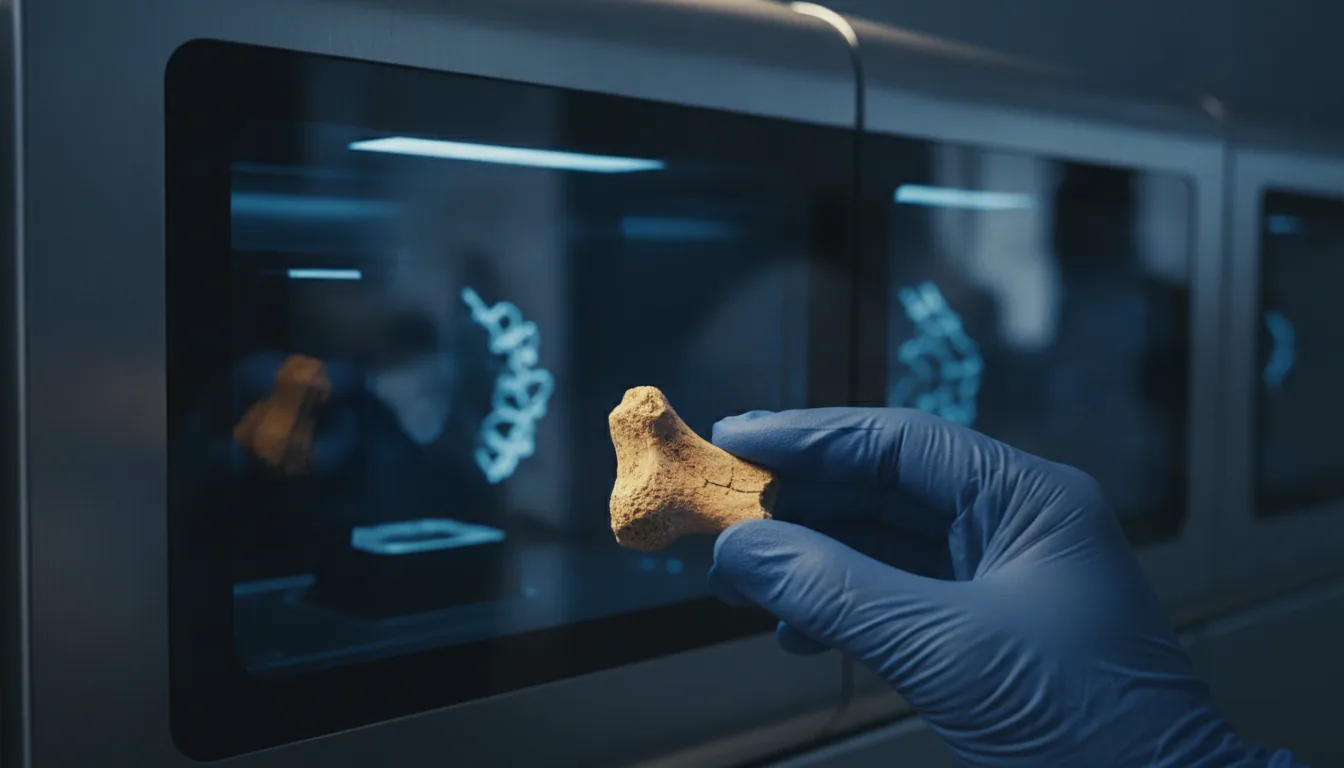
Pull a molar from a 4,000-year-old skeleton, grind it down, sequence the DNA inside, and you will learn something remarkable. You will learn where that person's ancestors came from. You will not learn a single word they spoke.
That distinction matters more than it might seem. Ancient DNA is a proxy, not a transcript. It tracks the movement of bodies through landscapes, and because language tends to travel with people, the two signals often rhyme. But they are not the same signal. Anna Graff's framing has become something like a working mantra for the field: DNA is the hardware; language is the software. A machine can run a new operating system without its physical components changing at all.
Here is where the picture grows genuinely strange. When populations mix, their combined gene pool becomes more diverse, a wider library of inherited variation. Yet what linguists observe in the resulting contact languages runs the opposite way: structural features tend to converge, grammars simplify, distinctions collapse. More biological variety, less linguistic variety. Migration and mixture simultaneously scatter the genes and smooth the language. The two processes are cousins, not twins.
This is exactly why no single discipline can answer the question alone. Genetics maps the bodies. Archaeology maps the objects they left behind and the trade routes they used. Linguistics maps the grammar changes and borrowed words that betray one population learning to speak like another. Each field sees a different shadow of the same moving figure. Only when you overlay all three shadows does anything like a human story emerge.
The Baltic strangers who gave Scandinavia its tongue
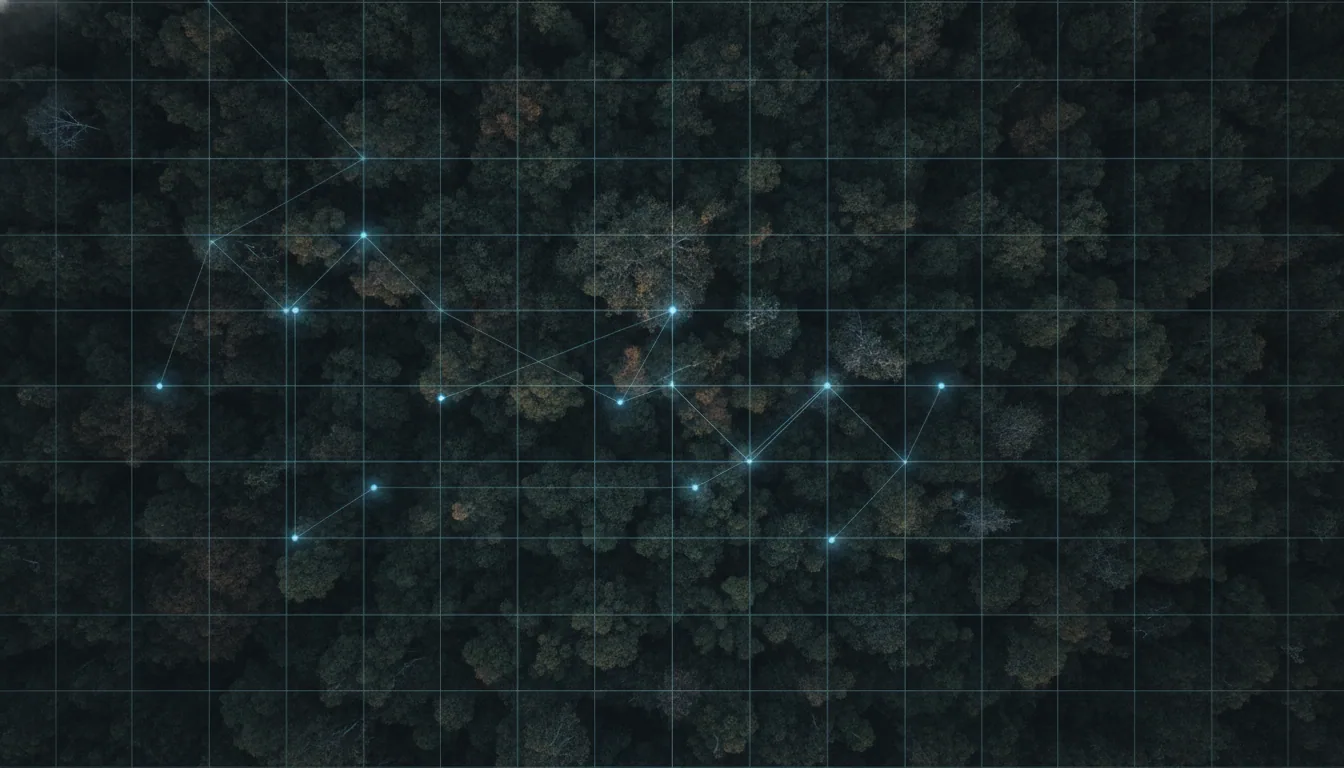
Picture a map of northern Europe 4,000 years ago. Someone is moving north. We didn't know about them until last year.
The 2026 Nature study uncovered a migration from the Baltic region into Scandinavia that had left no trace in any existing historical record or linguistic model. This was the population that most likely carried Palaeo-Germanic, the ancestor of every language from Norwegian to Afrikaans, into the Scandinavian peninsula. Hugh McColl, the lead author, put it plainly: "We discovered a previously unknown migration that occurred at exactly the time and place where we would expect the earliest form of Germanic to be spreading." That is not a small thing. That is finding the people nobody knew to look for.
The story then forks. Around 1,500 years ago, a second movement pushed out of northern Germany into Denmark and southern Sweden, and that wave is what shaped the population we now associate with the Viking age and Old Norse. Meanwhile, the ancestors of the Anglo-Saxons turn out to have come from the eastern North Sea coast, specifically northern Germany and southern Jutland, not from Sweden as older models suggested. Each branch of the Germanic tree has its own boarding gate, and they are nothing like what the textbooks drew.
The Celtic story runs in parallel, and it is equally disruptive. The old theory held that Celtic languages grew along the Atlantic coast and spread inward. The DNA evidence says the reverse: Celtic moved westward out of Central Europe roughly 3,000 years ago, pushing toward the ocean, not away from it. The continent's linguistic map was redrawn from the inside out.
Then there is the Wielbark culture in Poland. Ancient DNA from these people carries ancestry from eastern Scandinavia, which lines up with Roman-era accounts of Gothic migration moving southward from Scandinavia through the Baltic. For once, the ancient sources and the genomes are telling the same story.
DNA maps the vessel, not the cargo.
Two thousand kilometres further east than anyone thought
Place your finger on the Ural Mountains. That is where linguists spent most of the twentieth century pointing when asked about the cradle of Uralic languages, the family that includes Finnish, Hungarian, and Estonian. It seemed reasonable: the mountains form a natural boundary, a geographic seam between Europe and Asia. The finger was in the wrong place by roughly two thousand kilometres.
Ancient DNA analysis published in 2025 traced the ancestral Uralic-speaking population not to the Urals but to Yakutia, in northeastern Siberia, near the Lena River, 4,500 years ago. Picture the landscape: boreal forest giving way to open steppe, the Lena wide enough to swallow a small sea. Someone there spoke a language from which Estonian would eventually descend, though the path between that moment and this one is long, indirect, and propelled partly by metal.
The engine of westward movement was the Seima-Turbino phenomenon, a Bronze Age metallurgical network that knitted together enormous distances across Eurasia. Bronze was the period's most coveted technology, and the people who cast it carried both their tools and their tongue. By roughly 3,000 years ago, the genetic signature of that Siberian population, including the Y-chromosome marker known as haplogroup N3a, had reached the territory of modern Estonia. Genes and language arrived together, though not necessarily in the same hands: the Y-chromosome signal suggests the spread was driven disproportionately by men.
Estonian itself is a younger story still. The language differentiated from its Finnic relatives approximately 2,000 years ago, which on a geological timescale is barely a breath. The tongue spoken in Tartu today is, in that sense, a recent invention, assembled from very ancient parts.
Why it was usually the men
Look at the Y-chromosome data from Europe's major language transitions, and the same pattern keeps surfacing: it was not simply that people moved, it was that men moved, and the women they found were largely already there. Linguistic transmission correlates strongly with the Y-chromosome signal in these migrations, which is a quietly striking fact. It suggests that the social machinery of language replacement was not symmetrical.
There are two explanations, and both are probably partly true. One is dominance: incoming groups held military or economic power, and their tongue came with the terms. The other is prestige: speaking the language of the new arrivals opened doors that staying quiet did not. Distinguishing between these two from ancient bone is, honestly, not yet possible.
Here is the strange part. The Gothic case in southern Europe breaks the pattern sideways. Some individuals absorbed Gothic language and identity entirely through cultural contact, with no detectable Scandinavian ancestry at all. Their chromosomes told one story; their grammar told another. That is not an anomaly to be explained away. It is evidence that language can jump populations without anyone carrying it in their blood.
What this forces on the question of linguistic identity is uncomfortable and clarifying in equal measure. Speaking a language is not the same as inheriting it biologically. It is a choice, a negotiation, sometimes a surrender, sometimes an ambition. The DNA traces the road. It does not tell us why any particular person decided to walk down it.
What Ancient DNA Cannot Tell Us About Language Origins — Yet
Four thousand five hundred ancient individuals analyzed. Seven hundred and twelve new genomes sequenced from scratch. It is the most detailed genetic portrait of prehistoric Europe ever assembled, and it still cannot tell us why the ancestral Uralic speakers left Yakutia in the first place. No signal in the autosomal DNA explains the trigger. Climate shift, population pressure, the magnetic pull of the Seima-Turbino trade network? All plausible. None confirmed.
The silences multiply from there. We can place Palaeo-Germanic in Scandinavia roughly 4,000 years ago, carried by migrants from the Baltic coast. What we cannot recover is a single phoneme of it. The sound of that language, its vowels and consonants, the rhythm of a sentence spoken beside the North Sea, is gone past any recovery genetics can offer. And the substrate languages it displaced, the pre-Indo-European tongues erased across Europe, have no graves, no dates, no genomes of their own.
DNA maps the vessel, not the cargo. As Eske Willerslev put it plainly: sequences do not tell us which language people spoke. The moment a word first crossed someone's lips leaves no fossil. Whether Celtic spread through prestige or pressure, whether Gothic was chosen or imposed, those questions live in a gap the genome cannot close.
That gap is not a flaw in the research. It is the most honest coordinate ancient DNA and the study of language origins can offer: here is where we stand, here is the edge, and beyond it the next generation of ancient genomes will push a little further. Some things, perhaps, will remain permanently just out of reach. That, too, is a kind of answer.