The Coup That Turned on Itself
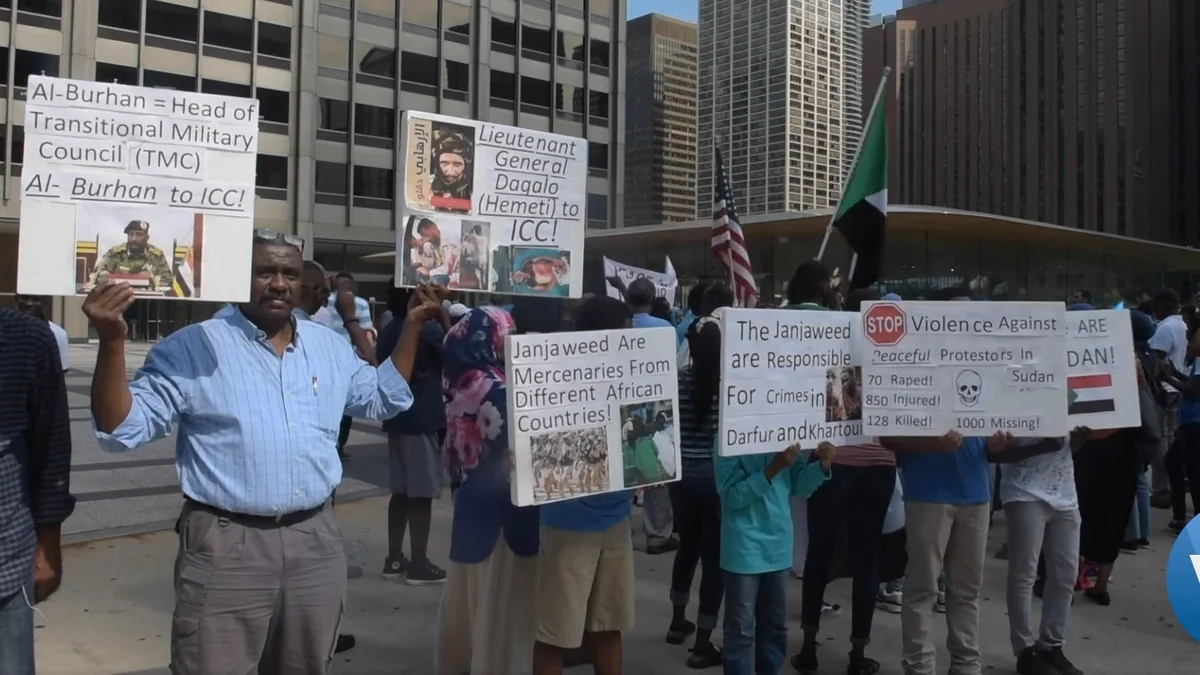
Sudan's escalating war crimes did not begin on April 15, 2023. They began on October 25, 2021, when Abdel Fattah al-Burhan and Mohamed Hamdan Dagalo, known as Hemedti, jointly dissolved the transitional civilian government and locked up its prime minister. They built the trap together. Then they stepped into it.
The Yeltsin comparison is useful only up to a point, and here is exactly where it breaks: Yeltsin had a state to fight over. Al-Burhan and Hemedti had something more fragile — a provisional arrangement in which the Sudanese Armed Forces held the institutional letterhead and the Rapid Support Forces held the guns and the gold. When that arrangement collapsed into open war, both men carried full command responsibility into the wreckage. Al-Burhan stands accused of war crimes including the use of chemical weapons. Hemedti faces sanctions for genocide and systematic sexual violence.
Ask the small question first: who is the borderland here, and who are the empires? Sudan's civilians are the borderland. The RSF is not a new army; it is the Janjaweed with a budget and an acronym, recycled from Darfur's earlier catastrophe into a national force, and now recycling that catastrophe at national scale.
El Fasher: What Sixty Thousand Means
El Fasher was the last city in Darfur that the Sudanese Armed Forces held. After a siege measured in months, RSF forces completed their takeover in late 2025 or early 2026. Within the first three days, at least 6,000 people were killed.
That number — 6,000 in seventy-two hours — is not a rate of battle. It is a rate of execution. The distinction matters for how the dead are later counted and by whom, and for what legal category eventually attaches to the men who gave the orders.
The total death toll from El Fasher is now estimated to exceed 60,000. That figure comes from monitors working without physical access to the city. Communication blackouts, the systematic severing of internet infrastructure, and the absence of any independent investigator on the ground mean the 60,000 is a floor, not a count. ACLED records between 28,000 and 40,000 deaths across the broader conflict; the El Fasher figure alone, if verified, would dwarf that range. The arithmetic is not yet possible.
This is the verification problem at the centre of everything that follows. No prosecutor can build a genocide case on numbers that cannot be confirmed. No humanitarian operation can scale to a famine it cannot fully map. The blackout is not incidental — restricting information is itself a tactic, and whoever controls the perimeter controls the record.
Ask the small question first: who is the borderland here, and who is the empire? In El Fasher the answer is the same population that answered it in 2003, and the structural arithmetic has not changed. Sixty thousand is what we can say. What we cannot say may be larger.
The October Arithmetic: Drones, Displacement, Famine
The UN Human Rights Chief Volker Türk reported that drone strikes in the first three weeks of October 2026 killed at least 306 civilians. One strike alone, at a displacement site in West Kordofan, killed 25 people who had already fled once. The arithmetic is not complicated: these were not combatants, and the sites were not military targets.
Sudan now holds the world's largest displacement crisis. The International Organization for Migration counts up to 15 million people who have fled their homes since April 2023. To place that number: it is larger than the entire population of Belgium, and it is still growing.
The humanitarian ledger closes on a single technical classification. IPC Phase 5 — confirmed famine — has been declared at Zamzam camp in Darfur. The IPC scale was designed so that Phase 5 would never be reached; it exists as the outer boundary of a system built on the assumption that someone would intervene before the line was crossed. At Zamzam, no one did.
Across Sudan, 33.7 million people — more than half the population — require urgent humanitarian assistance. That figure comes from OCHA, and it is a conservative measure of a collapse that communication blackouts make impossible to fully document. The unrecorded deaths in severed rural areas are not in any table.
The practical meaning of these numbers is specific. Famine in a displacement camp is not a natural event; it is the terminal outcome of blocked aid corridors and deliberate siege. Drone strikes on displacement sites are not accidents of war. Each figure in this ledger has a structural cause, and the cause is a command decision made by someone with a name and a rank.
The blackout is not incidental — restricting information is itself a tactic, and whoever controls the perimeter controls the record.
The Command of Atrocity
On October 26, 2026, the United Kingdom sanctioned fifteen commanders for weaponized rape and starvation — two instruments that require sustained logistics, a chain of supply, and an officer who does not stop the order. Sanctions lists are not convictions. But they are a record, and records have a way of surviving the regimes that produce them.
The name that broke the standard ledger was Khademallah Khashmin Herika — an RSF commander, and a woman. The conventional map of sexual-violence command places a man at every node. Herika's sanctioning does not dissolve the pattern of male-directed atrocity that defines this war; it complicates the diagram prosecutors and advocates use to explain it. Complexity in a command structure is not an exculpation. It is a harder problem.
The mechanism in East Jazirah was simpler, in the way that punitive logic is always simple. Local communities defected to the Sudanese Armed Forces. The RSF responded with collective reprisal — attacks that displaced 135,000 people and left villages functioning as warnings to the next settlement considering the same calculation. This is attrition warfare stripped of its strategic language: not the destruction of a military capability, but the destruction of a social one.
Command responsibility is the legal bridge between the general who does not pull a trigger and the subordinate who does. Prosecutors call it linkage evidence — the document, the signal intercept, the witness who places an order inside a chain. The ICC's deputy prosecutor Nazhat Shameem Khan described what investigators found in Al Geneina and El Fasher as a "paradigm shift" in that evidentiary record. What she meant, plainly stated, is that the distance between order and act is closing.
The Second Sudan: Nyala, Colombian Contractors, and the Logic of Partition
The RSF and the Sudan Founding Alliance have established what they call a Government of Peace and Unity in Nyala. The name is doing a great deal of work. What exists in South Darfur is not a transitional arrangement — it is a parallel administration with its own ministries, its own army, and its own territorial logic, and the gap between that label and that reality is where Sudan's future is being quietly decided.
The Libya comparison is not lazy here, though it demands inspection before it hardens into a ruling. Libya after 2014 fractured into two administrations — Tripoli and Tobruk — neither capable of eliminating the other, neither willing to formalise the split, and the stalemate became the equilibrium. Sudan is tracing a similar geometry. The SAF controls Khartoum and the east; the RSF controls Darfur and increasingly the narrative of legitimate governance in the west. Neither side will announce partition, because announcing it would mean accepting it. The logic is already load-bearing.
One detail sharpens the picture. The UN Fact-Finding Mission confirmed that the RSF has employed Colombian private military contractors. The war has acquired a labour market. That is not insurgency drawing on local grievance — it is an administration procuring professional services across continents, which is something else entirely.
The African Union has refused to recognise the Nyala government. That refusal is the one institutional line still holding. Watch whether it holds after the next set of negotiations — a change there would tell you more about the trajectory than any communiqué.
Sudan's War Crimes, the ICC, and the Linkage Evidence
ACLED has recorded between 28,000 and 40,000 deaths since April 2023. The gap between those two numbers is not a statistical dispute. It is the shape of a conflict fought behind communication blackouts, in rural areas where severed infrastructure ensures the dead are never formally counted.
ICC Deputy Prosecutor Nazhat Shameem Khan described the current evidentiary threshold as a "paradigm shift." What she meant, precisely, is that investigators now hold linkage evidence connecting senior leadership to atrocities in Al Geneina and El Fasher — documentation that traces the chain of command, not merely the field crime. Command responsibility is the load-bearing legal concept here; without it, the court indicts executioners and leaves the architects untouched.
Al-Burhan's precise location remains unconfirmed as of this writing. Hemedti governs from Nyala. Both facts are noted not as exculpation but as operational context for any enforcement question the court may raise.
The one marker worth watching before the end of 2026 is whether the ICC issues named arrest warrants for Al-Burhan or Hemedti. If warrants are issued and no state moves to execute them, the court's accountability architecture will have revealed itself as moulding, not load-bearing — decorative framing around a structure that was never designed to hold the weight of the powerful. Sudan's war crimes have generated an evidentiary record that did not exist for Bashir in 2009. Whether that record produces different consequences is the only question left that the law can still answer.