Every August, Someone Publishes a Very Confident List of Nonsense
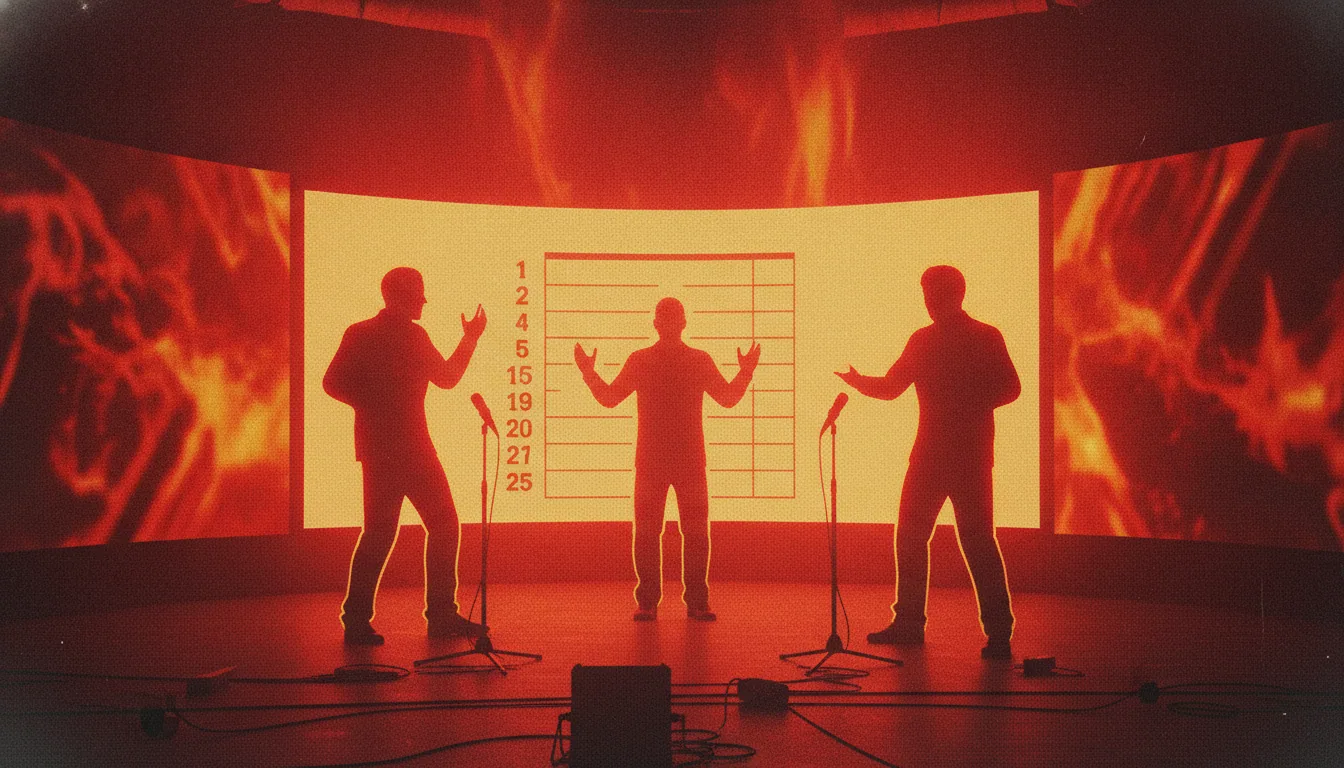
The preseason poll is not a prediction — it's a content product disguised as analysis, and the 2026 season has made that harder to ignore than ever. Picture a room full of sports journalists in early August, squinting at spreadsheets, debating whether a team that hasn't played a single down of football yet deserves to be ranked fourteenth or nineteenth. Nobody has tackled anyone. Nobody has fumbled anything except, perhaps, their dignity. And yet, on August 17, 2026, like a groundhog emerging from a hole wearing a scarlet and gray jersey, the Associated Press released its preseason Top 25 with Ohio State at number one, because some things in this universe are simply constants, like gravity, entropy, and the collective assumption that Ohio State is probably fine.
The Coaches Poll, arriving shortly after like a photocopy of a photocopy, produced 24 of the same 25 teams the AP had already ranked. Twenty-four. Out of twenty-five. You would think, with hundreds of coaches surveying hundreds of rosters across an entire country, that someone, somewhere, would have a contrarian hot take — a dark horse, a sleeper, a team they believe in that nobody else does. But no. The coaches looked at the AP ballot, nodded politely, and reproduced it with the creative ambition of a mid-tier printer running low on toner.
When someone finally asked AP voters what the point of this whole exercise actually was, the answer was, magnificently, "generating discourse." That is analyst slang for "we know this is made up but it is good television." The preseason poll exists because August is a dead zone between the Fourth of July and actual football, and television abhors a vacuum almost as much as it loves a countdown graphic. It fills the calendar. It generates takes. It manufactures urgency out of pure vibes and institutional habit, which, if you think about it, is also how most economic policy gets made.
You Are Ranking a Team That Does Not Technically Exist Yet
Here's the thing about a preseason Top 25 that nobody wants you to understand: the team being ranked in August is not the team that will play in October. Roster turnover in the NIL and transfer portal era now averages between 30 and 50 percent annually per team. You are, quite literally, ranking a concept.
Think about what 30 to 50 percent turnover actually means at scale. Half the starters you scouted in January might be wearing a different jersey by September. The depth chart you memorized from spring practice is a historical document, a fossil, a receipt from a restaurant that fired half its kitchen staff over the summer and hasn't updated the menu yet.
Preseason scouting used to mean something. When the same 85 guys came back every year, a seasoned analyst could watch last October's tape and make reasonable projections. That era is structurally over — not declining, not transitioning, structurally, architecturally, load-bearingly over. The transfer portal turned the offseason into a fire sale where programs are simultaneously losing proven starters and acquiring strangers from three different conferences whose film you watched once at 2am.
This matters because the poll voters aren't ranking football teams. They're ranking brand equity, projected vibes, and the residual memory of what a program looked like eight months ago. Ohio State at number one in August 2026 is a ranking of Ohio State's reputation. The actual Ohio State — the one made of specific humans who practiced together for maybe two months — is somewhere still figuring out the playbook.
The Scoreboard Has Been Trying to Tell You Something Since September
Indiana won the 2025 national championship. They started the season ranked 20th. Let that settle in for a second, like bad news you already knew but weren't ready to hear out loud.
Florida State entered 2024 as a preseason Top 10 team and finished 2-10. Not 10-2. Not a disappointing 8-4. Two wins. Ten losses. The kind of record that doesn't just embarrass the team — it retroactively embarrasses everyone who typed their name into a ballot in August while wearing a confident face. The preseason poll didn't predict that. The preseason poll was busy generating discourse.
Only 10 of the 12 teams that made the 2025 playoff were even in the preseason AP Top 25, meaning two teams earned their way in from complete August anonymity. The poll didn't see them coming. Nobody did. That's not a rounding error. That's the whole methodology failing a basic audit.
By week four of the 2026 season, every single team in the original AP Top 25 had changed positions. Every. Single. One. That's not movement. That's a complete document rewrite happening in real time while people act like the original draft was scripture. Four teams ranked in the top two lost within a three-week span in 2026, a frequency not seen in nineteen years — which means you have to go back to 2007 to find a comparable collapse, and 2007 was also a year when everyone agreed the polls were broken and then continued using them anyway.
The scoreboard is not being subtle about this. The scoreboard is doing everything short of standing on a chair and screaming. The data reads like a formal complaint filed by reality against the concept of August certainty, and the complaint has been upheld, repeatedly, by October.
The poll didn't see them coming. Nobody did. That's not a rounding error. That's the whole methodology failing a basic audit.
Clemson Fell Out of the Rankings and the Sun Continued Its Normal Operations
Sometime in early September 2026, Clemson dropped out of the AP Top 25 for the first time since 2011. Fifteen years of uninterrupted ranking residency, gone. The sports media reacted with the specific energy of people discovering that a building they walk past every day has quietly been demolished — shocked, briefly, then already thinking about lunch.
This is the part where poll inertia becomes visible, like mold. Poll inertia is the mechanical tendency for programs with historical prestige to stay ranked longer than reality warrants, coasting on their August reputations the way a bad restaurant coasts on a Michelin star from 2009. Historically dominant programs — the ones analysts call blue-blood programs with genuine reverence, as if lineage counts in a sport where 40% of your roster transfers out every winter — benefit from this bias enormously, disproportionately, and with almost no acknowledgement from the people doing the ranking.
Analysts have started pointing at Week 8 like it's a crime scene. Every year, around that mark, the preseason narrative completes its visible collapse — like a controlled demolition that somehow manages to surprise every single person watching despite being publicly scheduled. Four of the top-two ranked teams lost within a three-week span in 2026, a frequency not seen in nineteen years. Clemson's absence from the rankings wasn't an anomaly. It was Week 8 doing its job. The gap between what the polls said in August and what the scoreboards said in October had grown wide enough to drive a television truck through — slowly, comfortably, with room to spare.
The Big 12 Did One Correct Thing, Possibly by Accident
The Big 12 Conference abolished its preseason football media poll for 2026 — which sounds like a minor administrative decision until you realize it's the first conference to formally admit out loud what everyone has been quietly thinking since approximately September of every year for the last decade. Texas Tech and its conference siblings no longer get a meaningless August number assigned to them by journalists who are, by their own admission, just guessing. This is progress. Slow, accidental, almost certainly unintentional progress, but progress.
The structural logic behind the decision is embarrassing in how obvious it is. The CFP expanded to 12 teams in 2024, which means a program can now absorb early losses and still reach the playoff on a decent November run — the catastrophic cost of a bad August ranking simply evaporated. More damaging still, the CFP Selection Committee doesn't release its first official rankings until November, creating a bizarre dual-ranking ecosystem where the AP poll operates as functional authority right up until the moment it doesn't, which is the moment it matters. You're governing by horoscope and then wondering why the astrologer isn't on the Selection Committee.
Now factor in the proposed expansion to 24 teams by 2027. Twenty-four. At 24 teams, a preseason ranking has approximately the predictive authority of a Magic 8-Ball operated by someone who learned about college football three hours ago. The Big 12 didn't fix college football. But they looked at the thing everyone was pretending was useful and said no, and sometimes that's the entire job.
Why the Preseason Poll Refuses to Die: ESPN and FOX Are Fine, Actually
The preseason AP Top 25 generated millions of social media impressions in 2026 and anchored opening-weekend broadcasts on ESPN and FOX. Every panel, every chyron, every analyst confidently wrong in high definition. The numbers were good.
That sentence is the entire autopsy.
The poll has not died because it stopped working. It has survived precisely because working was never the assignment. It exists to fill three hours of programming in August when nothing real has happened yet, to give Scott Van Pelt something to be performatively skeptical about, and to sell the fiction that college football is already in progress when it is, structurally, still in pre-production. Accuracy is not the product. Discourse is the product. The poll is a content delivery mechanism wearing the costume of analysis.
ESPN and FOX have no structural reason to replace it with something more honest, because honesty does not drive engagement — outrage does, and a poll that might be wrong is infinitely more useful to a broadcast schedule than a poll that admits it is guessing. The Big 12 killed their version quietly. Nobody else will bother.
The death of the preseason poll will not be announced on a chyron or acknowledged in an August press release. It will just slowly stop mattering until everyone agrees, without saying so, that it never did — which is, come to think of it, exactly what happened to your last relationship.