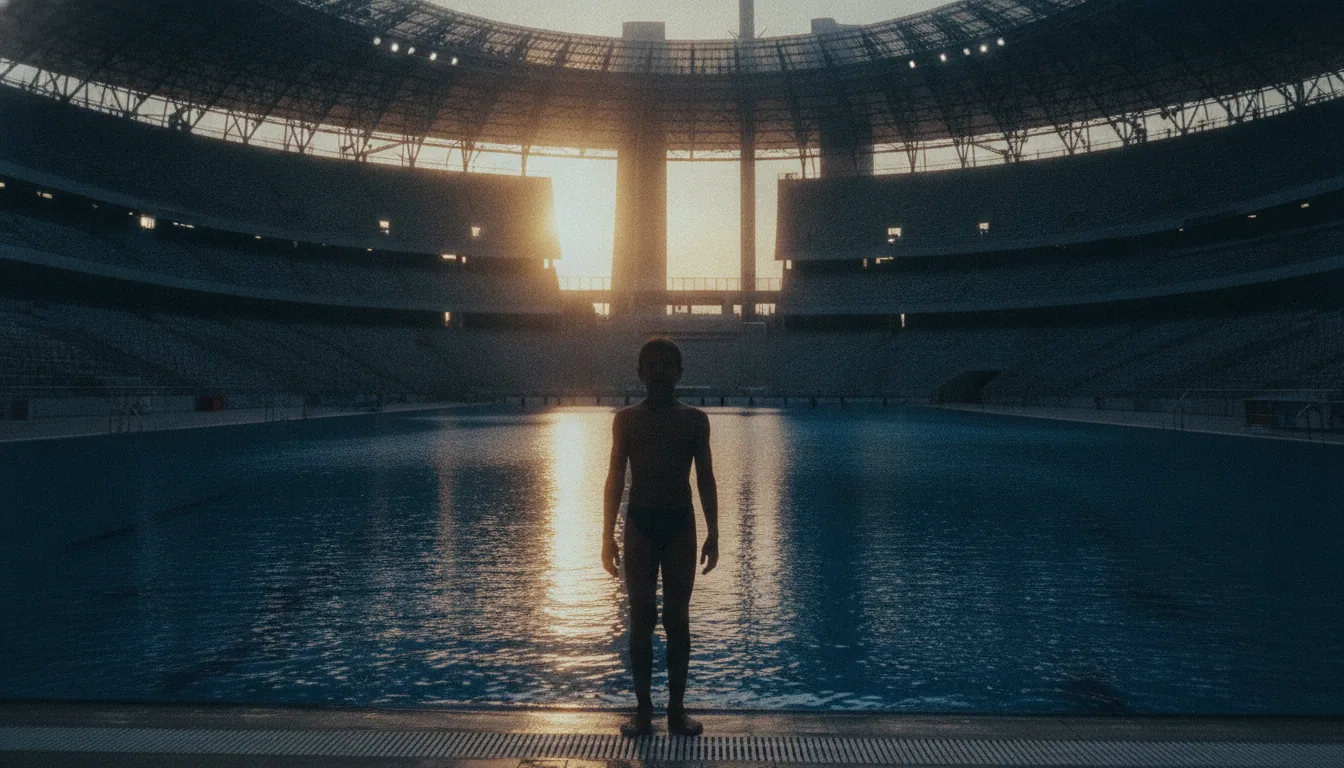
Yu Zidi, a thirteen-year-old swimmer from Hebei province, China, won three individual gold medals at the 2026 Asian Games in Tokyo — setting an Asian record and world junior record in the 200m individual medley with a time of 2:06.10, just four-tenths of a second behind the world record.
A Number That Belongs to Adults
The time on the scoreboard was 2:06.10. In the 200-metre individual medley, that is a number that belongs to a very specific kind of person: an elite adult athlete, years deep into training, near the peak of a career built over a decade.
The second-fastest swimmer in history to cover that distance is a teenager named Summer McIntosh, the Canadian world record holder. The gap between McIntosh's record and 2:06.10 is four-tenths of a second, a margin so narrow it would vanish in a single imperfect turn.
The swimmer who posted 2:06.10 at the 2026 Asian Games in Tokyo is thirteen years old.
Her name is Yu Zidi. She arrived in Tokyo and collected three individual gold medals — the 200m individual medley, the 200m butterfly, and the 400m individual medley — across a competition that looked less like a teenager's breakthrough and more like a quiet announcement. Her 200m IM time set both an Asian record and a world junior record in the same stroke of the clock. The times, standing alone, ask a question that the usual vocabulary of sports journalism handles poorly.
Here is the strange part. We have categories for prodigies, for late bloomers, for the generational talent who arrives a few years ahead of schedule. Yu Zidi does not fit any of them comfortably.
She is not slightly young. She is a decade younger than most of her rivals, posting times that even seasoned champions have never touched.
The number doesn't ask us to celebrate or worry, not yet. It asks us to pay attention.
A Six-Year-Old Spotted at a Water Park
Yu Zidi was born on October 16, 2012, in Baoding, a mid-sized city in Hebei province roughly 150 kilometres south of Beijing. Her path into elite swimming began with something closer to luck than design: a coach noticed a six-year-old moving through the water at a local water park with unusual ease. That observation, and the system behind it, did the rest.
She was brought into the Hebei Taihua Jinye Swimming Club, a professional training facility in Hengshui, where she has trained ever since. Olympic medalist Li Bingjie, one of China's most decorated distance swimmers, became a mentor figure — someone already living the career Yu Zidi was being shaped toward.
The club's environment is not a swim school. It is an engine room.
The trajectory that followed was compressed in ways that make career timelines feel elastic. In 2024, at eleven years old, she entered the Chinese Olympic qualifying meet for the 400-metre individual medley. She placed second.
She missed the qualifying time standard by two seconds — a gap that sounds modest but, at that level, is a wall. She did not go to Paris.
A year later, she did go to Singapore. At the 2025 World Aquatics Championships, twelve-year-old Yu Zidi stepped onto a podium and became the youngest medalist in the history of the competition. The bronze medal was historic by any measure. But looking back, it reads less like an arrival and more like a data point — evidence that something was already in motion, gathering speed, waiting for the right meet to announce itself fully.
What Yu Zidi Actually Did in the Pool
Three events. Three gold medals. Three records. At the 2026 Asian Games in Tokyo, Yu Zidi did not simply win — she won in a way that forced statisticians to reach for footnotes.
Start with the 200m butterfly. Her time of 2:05.08 set a new Asian Games record in an event that punishes almost every error a swimmer can make: the double-arm pull, the undulating kick, the brutal oxygen debt through the back half. That time would have been competitive at any senior international final in the last decade. She is thirteen.
The 200m individual medley came next: 2:06.10, an Asian record and a world junior record. The 200m IM is four strokes in sequence — butterfly, backstroke, breaststroke, freestyle — and the transitions between them are where races are quietly lost.
Her 2:06.10 sits 0.40 seconds behind Summer McIntosh's world record. Four-tenths of a second. In competitive swimming, that is the gap between first and fourth at a senior world final.
Then the 400m IM, twice the distance and twice the demand. Four hundred metres of mixed strokes asks something different from a body: not just explosive speed but pacing intelligence, stroke economy, the ability to distribute effort across eight lengths without catastrophic fade. Her winning time was 4:28.56.
Now hold that number. Sustaining that pace for four and a half minutes requires a cardiovascular output that physiologists typically associate with fully mature bodies, not thirteen-year-olds.
After the races, she told reporters she thought she could go faster. That line is thrilling. It is also, depending on where you stand, slightly unnerving.
Fifteen Kilometres Before Breakfast
The Hebei Taihua Jinye Swimming Club in Hengshui is not a leisure centre. It is a production facility, and what it produces is speed.
Children arrive young, live on site, and train under a residency model that has long been the engine of Chinese swimming's rise. Yu Zidi joined this system at six, plucked from a water park by a coach with an eye for movement.
The number critics reach for is 15 kilometres. That is the alleged daily pool volume some young athletes in the Chinese system absorb — roughly the distance from one end of a mid-sized city to the other, covered in a pool, before most thirteen-year-olds have finished their morning homework.
To put that in the body: an adult marathon runner covering 15 km burns through serious glycogen reserves and puts real compressive load on joints. In water, the joints are largely spared, but tendons, growth plates, and the nervous system are not.
Sports science has a name for what can follow. Early specialization syndrome — the constellation of overuse injury, motivational collapse, and physical burnout that arrives when a developing body is pushed past its adaptive ceiling, sometimes years before that ceiling is even fully formed. The research is consistent enough to be a warning label.
Whether that warning is being read at Hebei Taihua Jinye is genuinely unknown. No public data exists on the health monitoring protocols the club applies to its youngest athletes, and none has been made available to outside researchers.
This is not an accusation. It is an absence, and absences matter.
The Rulebook Is Straining
World Aquatics technically requires athletes to be fourteen years old before competing at its major championships. The catch is a door left deliberately ajar: swimmers younger than that may compete if they meet the tougher "A" qualification standard.
Yu Zidi used that door twice. Now the performances she posted on her way through have left the governing body staring at the hinges.
Brent Nowicki, World Aquatics' Executive Director, confirmed that the organisation is reviewing its rules to ensure, in his words, that athlete safeguarding is properly addressed. That review exists because a thirteen-year-old just posted the second-fastest 200m individual medley time in history.
Compare that moment to figure skating, which faced its own reckoning after the Kamila Valieva scandal and responded with a hard age floor, raising the senior minimum from fifteen to seventeen. Swimming chose the "standard-based" route instead of a firm cutoff, and the logic was reasonable: excellence, not birthdays, should set the barrier. The problem is that a twelve-year-old occasionally clears it.
Christian Hansmann, sports director of the German Swimming Federation, put the discomfort plainly: twelve-year-olds competing at world championships invite media scrutiny and coaching pressure that children are simply not equipped to handle. French swimmer Lilou Ressencourt was more direct, saying that bearing such responsibility at twelve years old is not normal.
The structural irony is almost elegant: the exception clause that made Yu Zidi's debut legal was written to reward the genuinely exceptional. Her performances were so exceptional that the federation now wants to reconsider whether the clause should survive her.
Her performances were so exceptional that the federation now wants to reconsider whether the clause should survive her.
Figure Skaters Went First — Will Swimmers Follow?
In 2023, the International Skating Union raised its minimum age for senior competition from 15 to 17. The Kamila Valieva doping scandal was the proximate cause, but the deeper logic was structural: a sport was certifying that its competitive demands were incompatible with childhood. That is a remarkable admission, and it set a precedent every other federation now has to read.
Swimming's approach is architecturally different. World Aquatics does not draw a hard age floor; instead it requires athletes to hit an "A" qualification standard, a performance threshold stiff enough that almost no child can clear it. Almost.
Yu Zidi cleared it at 12. The standard was designed to filter talent, not age, and for a century that worked, because the two things were correlated. They no longer reliably are.
World Aquatics Executive Director Brent Nowicki has said the organisation is reviewing its rules to ensure athlete safeguarding. Whether that review produces a hard minimum age before the 2028 Los Angeles Olympics, nobody outside those meetings knows. The pressure to act is real; so is the pressure not to, from federations and broadcasters whose audiences keep clicking on a 13-year-old going 2:06.
And that is the honest position to end on. We do not know where this goes.
What Yu Zidi's existence forces us to ask is not just about rules or records. It is about what we are celebrating when we celebrate a child outperforming adults, and whether the answer changes anything about the system that makes it possible. The next chapter is unwritten, and sport, characteristically, is in no hurry to pick up the pen.