The Part Where Someone Gets Paid More Than Your Annual Salary to Scream Into a Microphone for Forty-Five Minutes
Wizkid handed an Afrobeats hypeman 20 million naira in December 2023 and somewhere, a financial advisor typed "U for give am govt" and then presumably lay down on the floor and stared at the ceiling for an indeterminate amount of time. This is, on one hand, a completely unhinged use of money.
On the other hand, the top 10 Nigerian artists collectively pulled in roughly $73 million in pre-tax profits in 2025, which means the ecosystem producing these numbers is not a fluke, a bubble, or a fever dream someone had after eating jollof rice at 2 a.m. It is, in the most boring corporate-approved sense of the phrase, an industry.
Here is what that industry contains: professional hypemen — people whose entire job description is to be louder, more alive, and more aggressively present than everyone else in the room — commanding between 5 million and 8 million naira for a single thirty-to-sixty-minute performance. That is, depending on your currency and your pain tolerance for exchange rates, somewhere between £2,800 and £4,500 for less than an hour of work. Nobody in a boardroom predicted this.
Nobody in a boardroom predicted Afrobeats as a global export economy either, which is why you should stop listening to boardrooms entirely. The math is not complicated once you accept the premise, and the premise is this: somebody has to make a thousand people in a room feel like the night is the most important event in human history, and that somebody has a price.
The financial advisors are learning this. The promoters already knew. The rest of us are just catching up to a job market that assembled itself without asking anyone's permission, which is honestly the only way anything interesting ever gets built.
A Brief History of Screaming: From West African Praise-Singers to the Afrobeats Hypeman Your Algorithm Has Been Hiding From You
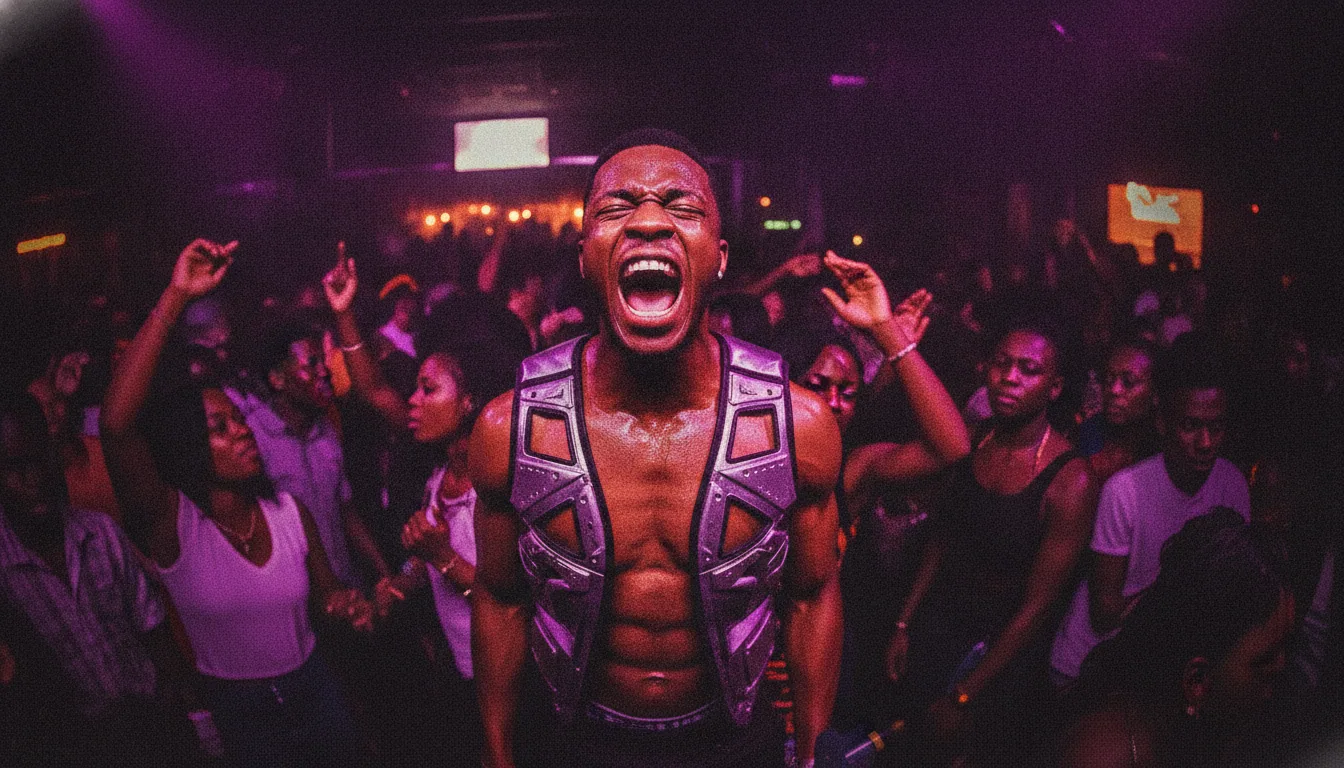
Here's the thing about Afrohype that nobody wants you to understand: it is not new. It is ancient. The modern hypeman standing in the middle of a thousand people at Obi's House on a Monday night, performing a full set of Lamba — improvised vocal ad-libs, onomatopoeic bursts, rhythmic slang fired at the crowd like a pressure washer — is operating from a blueprint that predates the internet, the record label, and probably the concept of a VIP table.
West African praise-singing is the direct cultural ancestor of all of this. Praise-singers existed to validate and amplify the status of patrons, to manage the emotional temperature of a room, to make people feel seen and hyped and important in a way that no algorithm has ever successfully replicated. The connection is documented, cited, traceable — per ResearchGate — and calling the hypeman a new phenomenon is historically illiterate in a very specific and documentable way.
The person most responsible for naming and codifying the modern iteration is Toby Shang — recognized by The Guardian as the evangelist of the Afrohype sub-genre — who also founded the School of Hype as a formal mentoring and masterclass program. Afrohype is characterized precisely by those high-octane vocals, those ad-libs, that whole Lamba vocabulary.
Shang did not invent screaming. He invented the taxonomy for it. That distinction matters more than it sounds like it does.
Vibe Architecture: The Most Legitimately Unhinged Job Title in the Global Economy, and Also a Real One
"Vibe architecture" is the industry term for strategic crowd energy management designed to keep people at their tables and ordering bottles. Read that sentence again. Someone sat down, probably in a room with a whiteboard, and decided that the official language for "making people feel things so they spend money" was architecture.
They were not wrong. This is, structurally, exactly what it is.
Here is how vibe architecture works in practice: ActiveBoy, the resident hypeman at Obi's House in Lagos, performs every Monday night in front of approximately 1,000 people. Not Saturday. Not New Year's Eve. Monday. The man is generating a four-figure crowd on the least psychologically prepared night of the week, which is either a testament to Lagos or to vibe architecture or to both, and honestly the answer is both.
The mechanism is not mysterious. A hypeman who is doing the job correctly does not just entertain the room. They extend what you might call the financial event horizon of the entire venue — how long people stay, how many bottles they order, how many times someone points at a table and says "one more."
The luxury beverage industry does not sponsor Afrobeats events because they enjoy the genre. They sponsor them because someone figured out that a skilled hypeman is essentially a very loud, very charismatic indirect sales mechanism wearing designer clothes.
This is the part where the job title stops being funny. Vibe architecture is a real economic function. It just has a job title that sounds like something a very online interior decorator would put on a LinkedIn profile, which makes it no less real, and actually makes it funnier.
The HypeBusinessman, the School of Hype, and the Quietly Deranged Professionalization of an Entire Craft
Jerry Shaffer did not wait for the industry to take the hypeman seriously. He took himself seriously first, built the infrastructure second, and handed everyone else the receipt third. The man known as the HypeBusinessman created the Hype Concert — a dedicated event format where the hypeman is not a supporting act but the entire reason anyone bought a ticket — and then proceeded to stack brand partnerships on top of it like a man who understood that legitimacy follows money, not the other way around.
Meanwhile, Toby Shang, the 32-year-old who the Guardian called the "evangelist" of Afrohype, went a different direction. He opened a school. Not metaphorically.
An actual mentoring program and masterclass series called the School of Hype, where an oral tradition that ran on instinct and ancestry and years of sweating under someone else's spotlight gets broken down into teachable units. The thing that should not exist as a curriculum somehow became one, and now people pay to learn how to do what their grandfathers did for free.
Then there is Hypeman Ricky, who in August 2024 released a single — "Never to Run," featuring Magnito — as a standalone artist. Not as a hype credit. Not as a feature. As the main act.
The trajectory here is not subtle: background act becomes brand vehicle becomes educator becomes headliner, and at each step, the people who should have seen it coming are standing there with their mouths open. The professionalization of the Afrobeats hypeman is not a trend. It is a completed sentence. Everyone else is just catching up with the punctuation.
The professionalization of the Afrobeats hypeman is not a trend. It is a completed sentence.
Congratulations, You Have Won an Award for a Job That 70% of the Industry Still Thinks Is Decorative
Big Bimi won the Future Awards Africa Prize for Performing Arts in 2025 — first hypeman ever to do it. Let that sit there for a second, like a trophy on a shelf in a house where the electricity keeps getting cut.
The Ghana DJ Awards created a dedicated MC/Hypeman of the Year category around the same time, which is the industry equivalent of finally installing a door on a room people have been living in for decades. You walk in, look around, and realize someone has been paying rent this whole time without a lease. Recognition arrived, eventually, wearing the apologetic expression of someone who just remembered your birthday four months late.
Here is the structural comedy of all this: ActiveBoy estimates that 70% of the industry still undervalues the hypeman role compared to DJs and artists. Seventy percent. That is not a fringe opinion from a bitter guy at a bar.
That is a profession that is simultaneously trophy-eligible and chronically underpaid, which is not a paradox so much as a very old tradition — see: every creative field in human history. The award exists. The category exists.
The gap between cultural legitimacy and financial parity also exists, sitting right between them like an uninvited guest who refuses to read the room.
The Ceiling Nobody Will Say Out Loud, and the Floor Everyone Is Still Arguing About
Afrohype is, by every available metric, a male-dominated profession — which means it operates exactly like every other creative industry on the planet, congratulations, very original. Lili Djely broke into the space anyway, despite the fact that the space was not designed with her in mind, had not left a key under the mat, and was probably still arguing about whether she counted.
That is not a small thing. That is, in fact, the entire thing.
Meanwhile, the structural math remains absolutely cooked. Top practitioners are commanding 5 to 8 million naira per performance. The majority are still negotiating rates informally, without contracts, at venues making serious money off their energy.
ActiveBoy estimates 70% of the industry still undervalues the hypeman role relative to DJs and artists, which means the award-winning, globally touring, brand-partnership-securing top tier is, statistically, the exception operating above a floor that nobody has bothered to pour concrete on.
So here is your final state of the Afrobeats hypeman economy in 2026: ancient roots, global reach, a dedicated award category, a formal school, corporate sponsorships, and 70% of the workforce still making it up as they go. A profession simultaneously winning prizes and arguing about its own worth.
Which is, now that I think about it, a perfectly accurate description of most human endeavors. We're all just hypemen who haven't been paid yet.