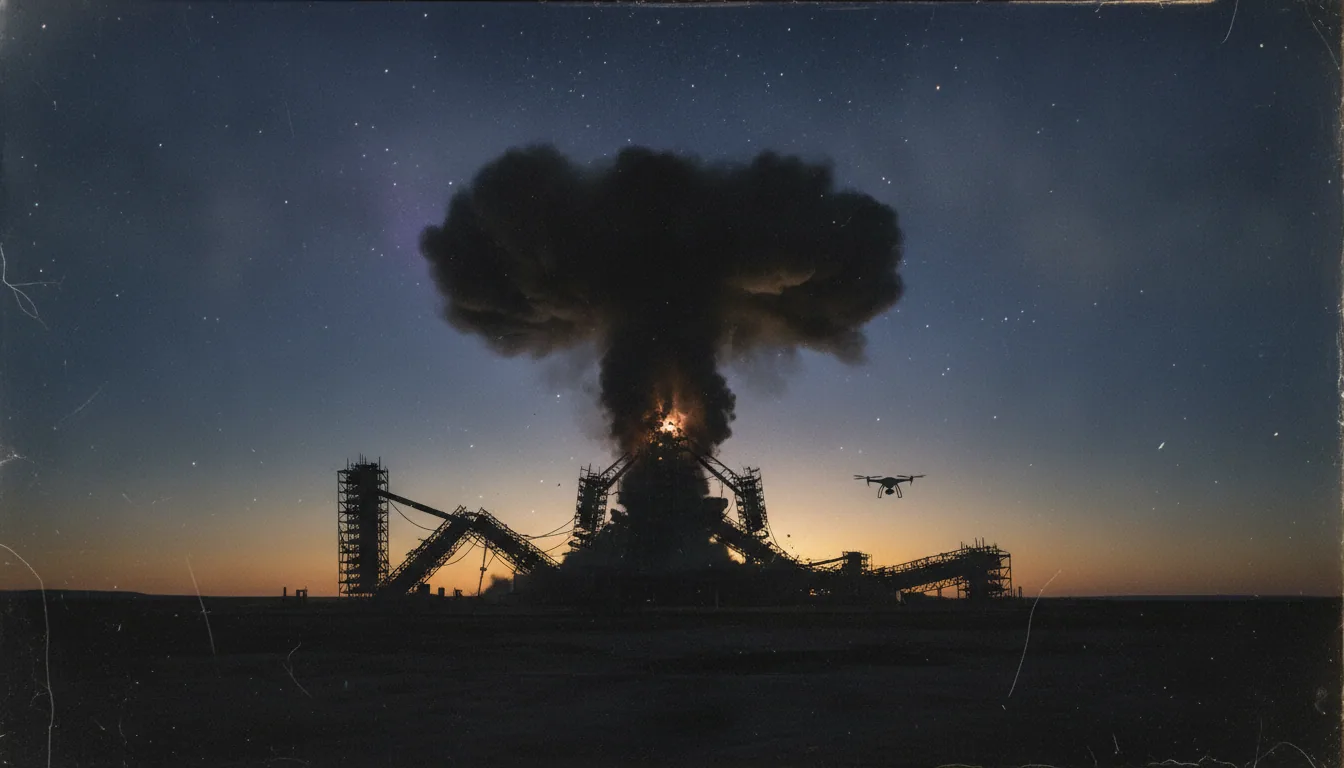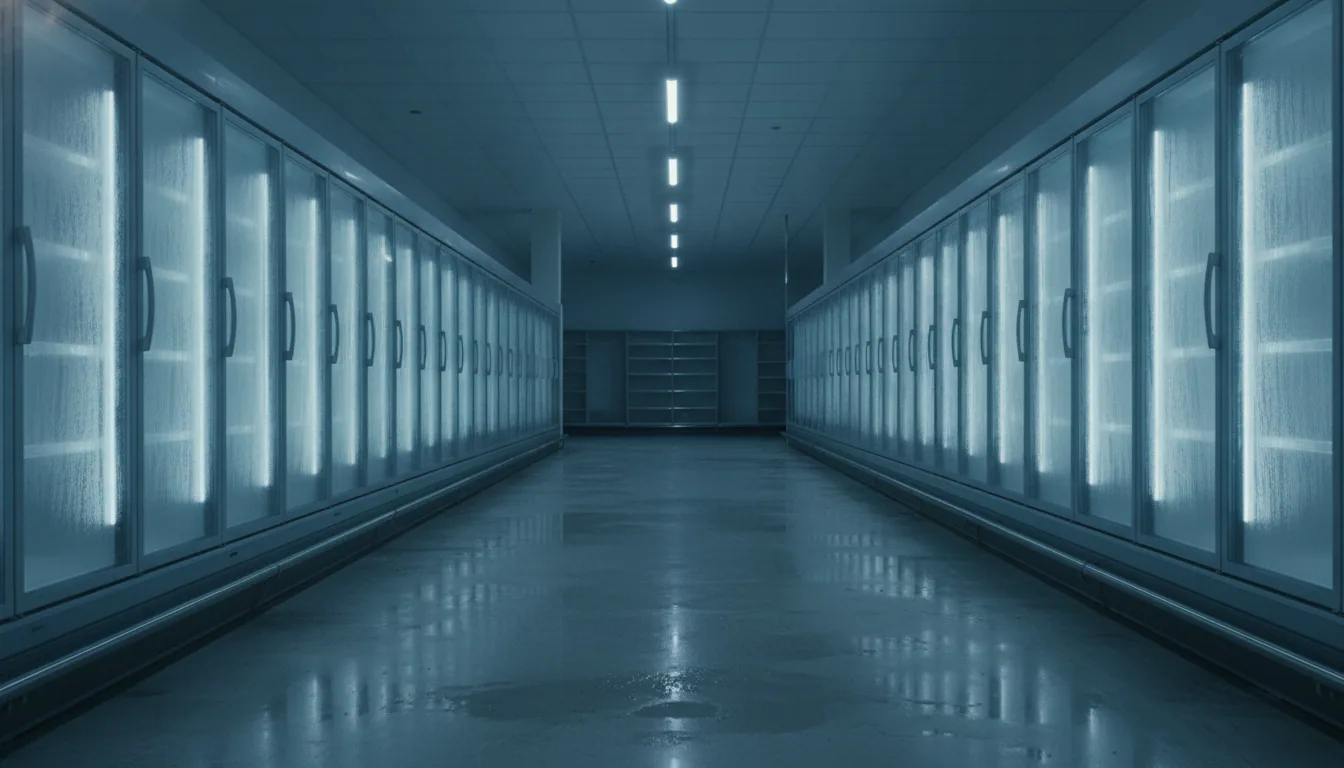
One Night in October: When Digital Access Became Physical Destruction
On the night of October 11-12, 2026, the defrosting sabotage that struck France's grocery infrastructure exposed a contradiction embedded in modern food retail: millions of kilograms of perishable goods suspended near zero degrees, every hour of every day, on a foundation of internet-connected controllers running firmware their manufacturers no longer support.
Four chains were targeted simultaneously: Intermarché, Carrefour, Coopérative U, and E Leclerc. The attack's signature was as deliberate as it was unusual — no ransom note arrived, no encrypted files, no demand for cryptocurrency. The objective, as investigators would soon determine, was purely destructive.
The timing was surgical. A Sunday-to-Monday transition meant overnight skeleton crews, delayed management escalation, and a narrow window before Monday morning deliveries compounded the chaos. What might have been contained in hours instead ran unchecked through the lowest-staffed stretch of the retail week.
The physical consequences were not theoretical. Refrigeration units across an estimated 150 Intermarché stores overheated to the point of triggering localized fires. Tens of millions of euros in perishable inventory were lost. The Paris Prosecutor's Office opened a formal investigation on October 12, describing the event as "unprecedented" — a word that signals not just novelty, but the absence of any prepared institutional response.
What was destroyed that night was not merely food. It was the assumption that digital connectivity in critical supply infrastructure could remain largely undefended.
The Mechanism of Sabotage: How a Defrost Cycle Became a Weapon
Every industrial refrigeration unit runs a defrost cycle. It is routine, unremarkable, designed to last roughly one hour. What the attackers understood, and what supermarket operators apparently did not, is that this ordinary maintenance function could be weaponised with surgical precision.
By remotely accessing internet-exposed Danfoss AK-SM800 and AK-SC355 refrigeration system managers, the attackers overrode standard operating parameters and forced cooling units into a sustained defrost state. The target temperature was not a gradual drift upward. Units were pushed to 50°C and held there, far beyond the thermal threshold of any perishable product.
The one-hour defrost cycle was artificially extended to eight hours. That single manipulation transformed routine hardware into an active destruction mechanism, eliminating inventory in ways a conventional cyberattack on financial data never could. The attack did not steal anything. It simply cooked everything.
The Danfoss controllers targeted here are Industrial Control Systems (ICS) designed to manage complex refrigeration networks across large retail environments. When internet-exposed and unpatched, they become entry points with direct physical consequences. This is the cross-border correlation that security researchers have flagged for years: the merger of operational technology with IP-connected networks creates attack surfaces that legacy risk frameworks simply do not account for.
Critically, the vulnerability exploited was not a zero-day discovery. The method had been published online 63 days before the attack, a quiet countdown that apparently triggered no meaningful defensive response from the affected chains. Many of the compromised units were running firmware more than a year behind on security patches, some classified as end-of-life hardware. The weapon was public. The targets were known. The outcome was preventable.
Sixty-Three Days of Warning Nobody Acted On
The vulnerability was not hidden. Sixty-three days before the attack on Intermarché, Carrefour, and their peers, the exploit recipe for Danfoss refrigeration controllers had been published openly online, available to any competent threat actor willing to search for it. That is not a gap in intelligence. It is a gap in institutional will.
The compromised units tell a structural story. The Danfoss AK-SM800 and AK-SC355 models targeted were frequently either end-of-life hardware or running firmware on the AK-SM 800A series that had gone unpatched for over a year. If you operate active food supply infrastructure on hardware the manufacturer no longer supports, you have not inherited a technical problem — you have made a procurement decision with public health consequences.
Here is the practical question retailers must now answer: who, inside a supermarket chain, owns the firmware update schedule for an industrial refrigeration controller? The answer, historically, has been no one in particular. Responsibility diffuses across facility managers, IT departments, and third-party service contractors, each with competing budgets and no unified liability exposure.
The structural incentive problem is not difficult to diagnose. Replacing end-of-life hardware is a capital expenditure that reduces quarterly margins; ignoring a published vulnerability is costless until the night it is not. This is the exact logic Nassim Taleb would recognise as the accumulation of hidden tail risk, fragility mistaken for stability. The October attack did not expose a flaw in refrigeration technology. It exposed a flaw in how organisations price the cost of inaction against the probability of a sophisticated but predictable threat.
The Damage Ledger: Stores, Fires, and Tens of Millions in Losses
Picture a Monday morning produce manager arriving at an Intermarché in the Loire Valley. The walk-in units are silent. The compressors have run for hours at 50°C. Everything behind the glass — the yoghurt, the vacuum-packed meats, the soft cheeses — is lost. Multiply that scene across approximately 150 Intermarché stores, and the arithmetic becomes brutal.
For some locations, the damage went beyond spoiled inventory. Prolonged overheating in certain establishments pushed refrigeration units past thermal limits, triggering localized fires. Whether those fires were a calculated outcome or a secondary consequence of equipment never designed to sustain eight-hour defrost cycles remains under investigation. The physical evidence — scorched compressor housings, melted cabling, smoke-damaged stockrooms — tells only part of the story.
The financial ledger is still being compiled. Losses are estimated in the tens of millions of euros, a figure that encompasses destroyed perishables, emergency closures, equipment replacement, and the downstream disruption to cold chain logistics that links French distribution hubs to retailers across Europe. Intermarché was not alone. Carrefour, Coopérative U, and E Leclerc all reported impacts, meaning the aggregate loss extends well beyond any single brand's balance sheet.
The cold chain is not a metaphor. It is a precisely calibrated sequence of temperature-controlled handoffs, and a break at the retail node reverberates upstream to producers and downstream to consumers. If tens of millions represents the direct loss, the indirect cost — in wasted logistics, emergency restocking, and reputational damage to digital infrastructure investment — is almost certainly larger. The damage ledger, in other words, has pages still being written.
The weapon was public. The targets were known. The outcome was preventable.
No Ransom, No Signature: Attribution, Investigation, and the State Response
Traditional ransomware attacks announce themselves. They leave a demand, a wallet address, a deadline. What makes the October 11-12 refrigeration assault forensically bewildering is precisely what it lacked: any signature of financial motive.
The Paris Prosecutor's Office opened a formal investigation on October 12, describing the incident as a "large-scale attack affecting connected refrigerators in several major food retailers across France." Prime Minister Sébastien Lecornu moved quickly, instructing ANSSI, France's national cybersecurity agency, to lead the technical forensic probe. The institutional response was calibrated and swift. The investigative clarity it will produce is another matter.
Cyber attribution is always probabilistic. When no ransom demand exists, analysts pivot to behavioral signatures, infrastructure overlap, and ideological alignment. Cybersecurity firm Sekoia has pointed suspicion toward state-aligned hacktivist groups — CARR (Cyber Av3ngers), Z-Pentest, and Sector16 — precisely because the absence of financial motive suggests a political or strategic objective rather than criminal opportunism. Compare this to the Colonial Pipeline attack of 2021: ransomware, a clear perpetrator, a recoverable situation. Here, the motive is opaque, and opacity is itself a strategic tool.
The geographic picture is similarly unresolved. Soft signals tracked by Sekoia suggest the attack may have extended to Spain, Portugal, Poland, Germany, and Belgium, though verification is ongoing. If confirmed, the incident moves from a French domestic crisis into a European infrastructure event, fundamentally altering both the legal jurisdiction and the political stakes.
What emerges is a pattern familiar from hybrid warfare doctrine: plausible deniability maintained through non-state proxies, with state-level precision and ambition. ANSSI will reconstruct the technical chain. Whether that chain leads to a government's door depends on how much institutional will exists to follow it.
Cyber-Physical Sabotage and the Cold Chain: What the Old Order Must Now Rewrite
The October 2026 attack did not emerge from a vacuum. Six years earlier, a janitor at Rensselaer Polytechnic Institute silenced a freezer alarm by switching the unit off manually, destroying two decades of research by Dr. K.V. Lakshmi and triggering a $1 million lawsuit settled in 2023. One human, one switch, catastrophic and irreversible loss. The pattern holds: cold chain security has been treated as an operational afterthought, not a sovereign risk, and the bill for that assumption keeps growing.
The structural problem is architectural. Industrial refrigeration controllers like the Danfoss AK-SM800 sit at the precise intersection of physical infrastructure and networked exposure, yet procurement decisions rarely account for lifecycle security costs. When firmware patches go undeployed for over a year, and a published exploit circulates online for 63 days before anyone acts, the question is no longer whether an attack will occur but who absorbs the damage when it does.
That liability question has no clean answer. European insurance frameworks were not designed for cyber-physical sabotage that mimics an act of war, produces no ransom demand, and leaves attribution deliberately ambiguous. Traditional force majeure clauses offer insurers a defensible exit. Retailers, meanwhile, absorb losses measured in tens of millions of euros with no clear legal recourse against equipment manufacturers, platform operators, or state actors.
If end-of-life IoT hardware can disable a nation's food retail infrastructure through a defrosting sabotage in eight hours, then the regulatory gap between cybersecurity law and food safety law is not a technicality — it is a governance failure. The strategic question now facing European policymakers is direct: when a connected device becomes a weapon, who owns the liability, and does current law even have the vocabulary to answer?