What Happened at King Khalid: The Record of October 10
The Riyadh airport attack on October 10, 2026, invites comparison to Kuwait in August 1990, when an entire international airport fell silent within hours of the Iraqi advance — and like most tempting comparisons, it breaks almost immediately. This was not an army crossing a border but a missile finding a terminal, which is a different kind of problem entirely.
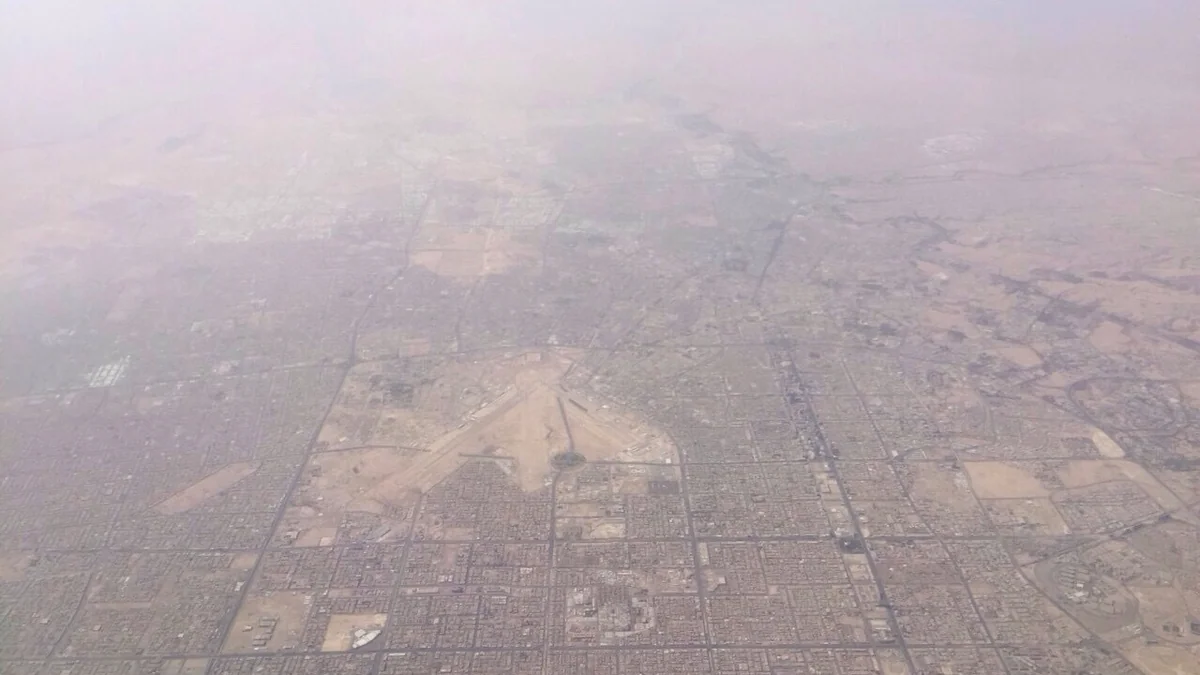
The record of October 10 is plain. A missile struck Terminal 4 at King Khalid International Airport. Twelve people died; 309 were wounded. A Saudia aircraft caught fire at the terminal, and Saudi civil aviation authorities extended the closure indefinitely the following morning.
By Sunday, Flightradar24 showed Riyadh's airspace as empty, and more than 200 flights were cancelled. Lufthansa and Air India suspended operations within hours. The silence over a capital city's primary international hub is its own kind of data point.
Saturday's strike was not the opening move. The Houthi movement had run a campaign across October 7 through 10, accumulating 16 dead — including a Saudia pilot killed on October 8. Houthi spokesperson Yahya Saree then declared Saudi airspace a theater of operations: a phrase with legal implications that the aviation insurance market will have noticed before most governments did.
The dead on October 10 carried passports from Saudi Arabia, the United States, Bangladesh, Egypt, Jordan, Syria, Palestine, and Sudan — Reuters called it the deadliest attack on the kingdom in a decade. That is the record; the structural questions it raises belong to the sections that follow.
The Shield That Wasn't: Air Defence and the Riyadh Airport Attack
A missile reached the primary international airport of a Gulf capital on Saturday. That is the sentence to hold before anything else is said about the kingdom's layered integrated air-defence systems.
Saudi Arabia has spent decades and tens of billions of dollars on those layers — Patriot batteries, theatre missile defence, overlapping radar coverage. The architecture was built precisely to prevent what happened at Terminal 4. It did not prevent it.
The exact technical model of the weapon used remains unconfirmed as of this writing, and that gap in knowledge is itself diagnostic: a system that cannot yet tell the public what it failed to stop has not finished failing.
Surface-to-surface ballistic missiles follow a known trajectory signature; slower drone-type munitions do not. Whether the October 10 strike exploited that distinction, or found some other seam, the air-defence planners in Riyadh will know — and their answer will not be published. What will be published is the casualty count: twelve dead, 309 wounded, a national carrier's aircraft burning on the apron.
The following night, a flying object was reported near King Fahd International Airport in Dammam — the same corridor, a different city. The campaign's geometry is widening. Houthi spokesperson Yahya Saree confirmed as much in plain language: Saudi airspace, he declared, is now a theatre of operations — not a boast, but a formal statement of strategic posture made after the air defences had already demonstrated their limit.
Ask the small question first: who is the borderland here, and who is the empire? The answer, on this occasion, fits no convenient map.
Civil Aviation as a Theatre: Airlines, Warnings, and the Logistics Map
When Yahya Saree declared Saudi airspace "a theater of operations," he was not speaking to generals — he was speaking to scheduling desks in Frankfurt and Mumbai. Lufthansa and Air India suspended Riyadh services within hours: a commercial calculation, not a diplomatic gesture. The insurance underwriters moved first; the timetables followed.
Six governments — the United States, United Kingdom, Germany, Spain, Canada, and Australia — issued urgent travel warnings for the region by Sunday. A travel warning is a bureaucratic instrument with real weight: it voids standard coverage, triggers airline liability clauses, and gives every carrier legal cover for suspension. The warnings did not cause the closures; they ratified what the risk models had already decided.
King Khalid International Airport is not a regional hub — it sits on the East-West transit spine connecting Europe to South and Southeast Asia, carrying both passengers and time-sensitive cargo. Its indefinite closure forces rerouting through Dubai, Doha, or Abu Dhabi: routes that add fuel burn, crew hours, and scheduling complexity at scale. More than 200 flights were cancelled in the first 24 hours, and the secondary ripple runs further.
The mechanism is precise: a military declaration triggers a NOTAM — a Notice to Air Missions — and an airspace exclusion zone, turning a targeting decision in Yemen into an insurance exclusion and a logistics detour across three continents overnight. The infrastructure was struck. The network felt it from Amsterdam to Chennai.
Flightradar24 showed Riyadh airspace entirely empty by Sunday morning — a silence that needs no interpretation.
The Small-Nation Floor: Who Is the Borderland in This War
Twelve dead at a civilian terminal. Citizens of Saudi Arabia, the United States, Bangladesh, Egypt, Jordan, Syria, Palestine, Sudan — eight nationalities scattered across the departure hall of Terminal 4. The word "theatre of operations" has a clean, bureaucratic sound until you read the passenger manifest.
The word "theatre of operations" has a clean, bureaucratic sound until you read the passenger manifest.
The arrow of agency in this war does not originate in Sanaa. The Houthi movement is Iran-backed, Iran-supplied, and Iran-directed to a degree that the communiqués carefully avoid specifying. When Riyadh burns, the decision chain runs through Tehran before it reaches any Yemeni spokesman — that is not analysis, but the public record of a decade of arms transfers: the load-bearing wall, not the moulding.
The Saudi-led coalition chose its legal register carefully when it called the October 10 strike a war crime against civilian infrastructure — the phrase is precise and deliberate. An international airport, open to commercial traffic, hosting eight nationalities: the coalition's lawyers know what they are filing. But the ledger runs in both directions.
The coalition's own decade-long campaign in Yemen produced the conditions — the displacement, the weapons proliferation, the institutional collapse — that made this kind of retaliatory reach possible. Stating that does not cancel the war crime; it does locate it in a causal chain that a single press release cannot contain.
What the casualties at King Khalid prove, concretely, is what "theatre of operations" means in practice. It means a Bangladeshi transit passenger and an American business traveller are the borderland. They are the small nation in this equation — the ones the larger forces are indifferent to, caught between a missile and a departure gate.
Washington's Calculus: Trump, Rubio, and the Intervention Question
Great-power statements arrive before great-power decisions. The gap between the two is the space where small nations learn, slowly and at cost, what they are actually worth.
Donald Trump said he is considering direct military intervention alongside the Saudi-led coalition. The formulation is precise in its imprecision: "considering" commits nothing, forecloses nothing, and maintains every option including the option of doing nothing at all. Marco Rubio called the attacks despicable — a word that belongs to the diplomatic register one step below a policy commitment, the register reserved for outrage that has not yet been priced into action.
Ursula von der Leyen offered "dangerous escalation." The European framing acknowledges gravity without specifying cost, which is the Brussels mode: name the category of the problem, decline to name the remedy.
The comparison worth making is not to 1990, when the United States assembled a coalition and moved in ninety days. The comparison is to every other moment when Washington weighed a threshold formulation against a strategic interest and found the interest insufficient. The Houthis have watched that calculation run before.
Yahya Saree's declaration that Saudi airspace is a theater of operations was not aimed at the Saudi air force. It was aimed at the ledger in Washington where the cost of intervention gets weighed against the cost of restraint.
Rubio's word and Trump's word are not the same word. That distance — between despicable and considering — is the only number that matters this week.
The Marker to Watch: What Comes Next and How to Read It
One number concentrates everything: the duration of the closure. GACA extended the shutdown of King Khalid International Airport indefinitely on Sunday, October 11. That single administrative decision, dry as a ledger entry, is now the most legible indicator available.
Watch the precise word in the next GACA status notice. If the authority uses "suspended," operations can resume when the threat assessment permits. If the word shifts to "relocated," the kingdom has conceded the airport as a target in a sustained campaign, and the calculus for every airline insurer, cargo router, and foreign-investment analyst changes accordingly.
The difference between those two words is not bureaucratic. It is structural.
Saudi Vision 2030 rests on a premise: that the kingdom is a credible, stable environment for capital, transit, and tourism. More than 200 cancelled flights and two international carriers suspending service within 24 hours are a stress-test of that premise, not a refutation of it.
One strike does not erase a strategy. A pattern does.
The technical question about the missile model remains open. If the weapon that struck King Khalid is confirmed as a new-generation platform, air-defence planners from Doha to Abu Dhabi will be running the same quiet recalculations. What the Riyadh airport attack has proved, for now, is this: the terminal stays closed until the kingdom can show it knows what struck it — and how to stop the next one.