The Budget That Preceded the Barricades
France's school protests of autumn 2026 began not with a march but with a maths lesson that never happened — and the 43-billion-euro austerity cut that made it inevitable. In November 1995, French public-sector workers shut down the rail network for three weeks over a pension reform that Alain Juppé had buried in a budget annex. The government called it a technical adjustment. The country called it something else. The 1995 precedent is instructive, but only up to a point: that dispute was between adults and a state that understood adult protest. What broke open in September 2026 was different in kind, not just in scale.
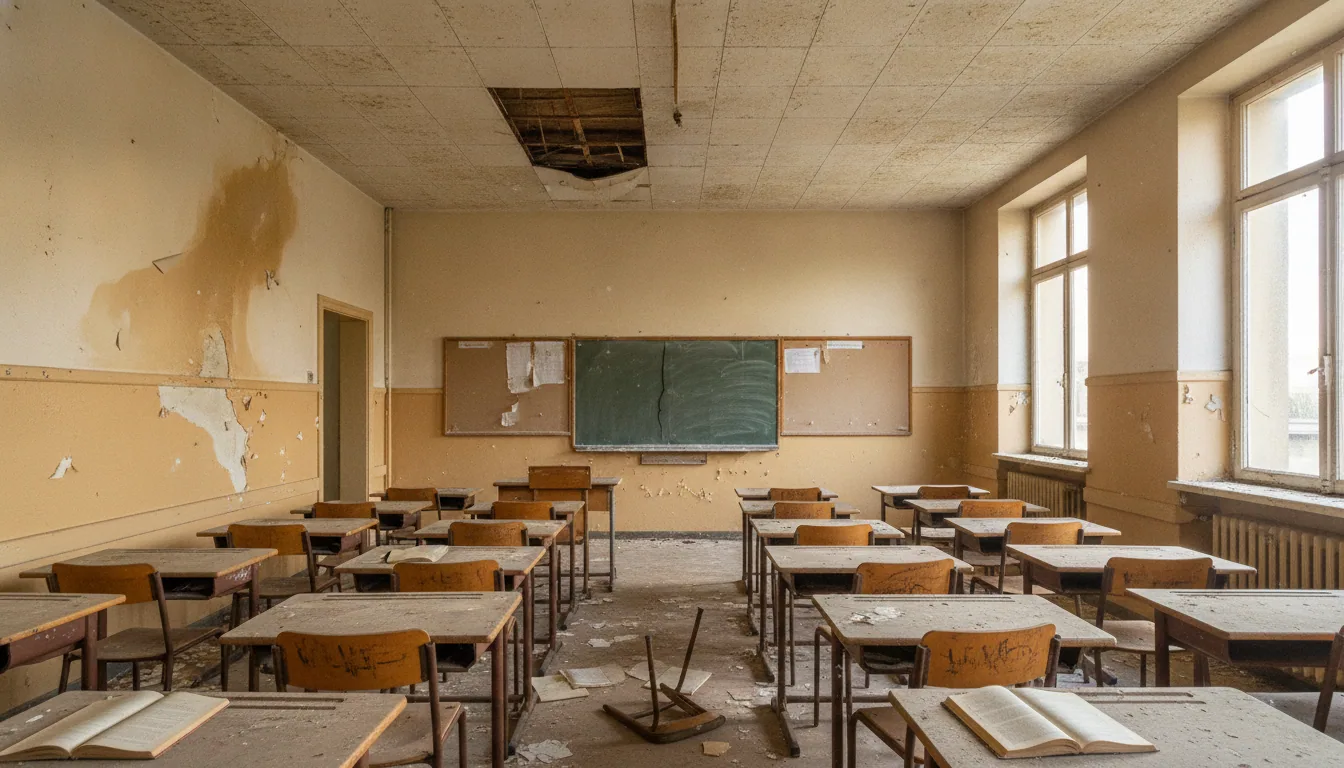
The structural driver was a 43-billion-euro cut to public spending, a figure the cabinet framed as a fiscal necessity — ten-year bond yields climbing, a deficit that Brussels had stopped pretending not to notice. Education was not singled out; it was simply in the path of the arithmetic. The 2026 school year began already hollowed: over half of French schools opened without at least one teacher in post. That is not a policy failure at the margin. That is the load-bearing wall. The announcement of cuts was the moulding — pull it and nothing falls, because the rot was already structural.
Parcoursup sharpened the grievance. In the summer of 2026, eighteen percent of university applicants — more than 163,000 students — passed through the national admissions platform and came out the other side with nothing. No placement, no clear appeal, no visible next step. For a generation that had been told qualification was the contract, the system had simply declined to honour it. The barricades did not appear from nowhere. The schools were already half-empty before a single gate was locked.
From a Gymnasium in Créteil to Twelve Hundred Schools
The first blockade was not spontaneous. Between September 17 and 21, students at the Saint-Exupéry lycée in Créteil occupied the entrance to their school over a specific, verifiable grievance: staff shortages so severe that core subjects had simply ceased to be taught. Laurent Bessiere, a maths teacher there, put the condition on record: "We have no math, French, literature, or history teachers. The school nurse is on sick leave." That sentence is worth more than any government communiqué about pedagogical continuity.
From that single school, the movement spread with the velocity that empty classrooms produce. By early October, between 1,200 and 1,800 lycées across France were affected — a range that itself tells a story. The geography was not confined to the banlieues or to any particular political geography; the blockades reached provincial towns and regional centres alike, wherever the September timetable had been handed to students with blank slots where teachers should have stood.
On October 5, between 400 and 500 schools were closed because security conditions could not be guaranteed — a formulation that moves the burden of closure from the protesters onto the institution, quietly. The following day was the peak: somewhere between 250,000 and 450,000 students and supporters on the streets nationwide. The number that does not vary is the one nobody disputes: Créteil, September 17, one school without teachers.
Riot Doctrine Applied to Teenagers: The Broken Security Boundary
As of October 9, authorities had detained 6,877 people. The number is large enough to cite at a press conference; the composition is what matters. Between 85 and 90 percent of those detained were minors — France had, in effect, processed roughly six thousand children through a system designed for adult crowds.
The two injuries that defined the proportionality debate happened in Lens and Tours. In Lens, a 15-year-old lost a hand to a police shock grenade. In Tours, a 16-year-old lost his sight, reportedly from a rubber bullet — the exact munition remains disputed. Each case was a single data point. Together they were a legal problem the Interior Ministry could not defer.
Laurent Nuñez suspended the specific grenade types implicated in the Lens incident. He also offered, in the same week, what amounted to a doctrinal admission: "A high school movement cannot be handled the same way as an adult one." The sentence is worth reading carefully, because it is not a concession of error. It is a statement of principle — presented after the hand was already lost.
French law contains a proportionality standard for crowd control. Its application to juvenile-led demonstrations is not theoretical; it is justiciable. The government now has two injuries on the public record, a minister's own words as a benchmark, and a suspended munition that was deployed before the suspension was ordered.
The full ledger runs the other way too. More than 300 police officers sustained injuries over the same period. That figure belongs in the account, not in a footnote. Proportionality is a legal standard, not a score. Both numbers sit in the record, and a court that examines either Lens or Tours will be required to weigh them alongside each other.
A promise without a calendar is a different kind of promise.
The Balance Sheet of the Disorder
The numbers from the schools are not abstractions. Seventy-eight school employees injured. Twenty-four buildings looted or set on fire. These are the costs carried by the institution the movement claimed to defend — the kind of damage that hands the government a narrative it did not earn through argument.
In Marseille, a 16-year-old was arrested for allegedly pouring gasoline on a teacher. One incident, one person. But Paris Police Chief Patrice Faure's assessment was the more telling document: the original organizers no longer control what is happening on the ground. The movement that began at a gymnasium in Créteil over missing teachers had acquired a fringe that the students who first walked out of class could not contain and did not intend.
This is the structural problem that the violence creates for the grievance. The legitimate complaint — chronic staff shortages, a 43-billion-euro cut arriving in classrooms already running short — does not disappear because a building burns. But the state's habit is to address the disorder first and the cause only under pressure, and the disorder gives that habit its justification.
Into the vacuum left by policy came Bally Bagayoko, deputy mayor of a Paris suburb, placing himself between students and police lines. A local official performing the function that the Ministry had not. The photograph exists; the budget line that produced the vacancy it documents still does not.
Three Thousand Teachers and a Raised Eyebrow
The government's offer arrived with the customary precision of a round number: 3,000 new teachers. Education Minister Édouard Geffray announced the pledge as the concession that would drain the barricades. No timeline was attached. No deployment schedule, no regional allocation, no date by which the first of those three thousand would stand in front of a class at Saint-Exupéry or anywhere else.
Ryad Rani, who leads the Union Syndicale Lycéenne, read the offer and announced the protests would continue. The student unions' position is arithmetical rather than theatrical. France opened the 2026 school year with chronic shortages already embedded in the system — over half of schools lacked at least one teacher on day one. Three thousand, hired at an unspecified pace, placed against a structural deficit of that magnitude, is not a solution. It is a gesture calibrated to the news cycle.
The institutional unions have now closed the distance. Sophie Vénétitay of SNES-FSU and Sophie Binet of the CGT have aligned their organisations with the student demand, which transforms the character of what the government faces. A lycéen blockade is manageable as an episode; a convergence of secondary-school unions, the CGT, and organised student bodies is a different load-bearing problem entirely. The government announced 3,000 teachers. The unions noted the gap between the announcement and the classroom. Both observations are correct, and only one of them requires a budget line.
The Marker to Watch: January, a Law, and What the Word "Shall" Will Tell Us
One convergence has received almost no attention in the coverage. In January 2027, France moves to full enforcement of its social media access ban for users under fifteen — a law passed this summer, justified on child-safety grounds. The physical security boundary at the school gate and the digital one at the platform login arrive in the same legislative season. Whether that is coincidence or architecture, the French state has not explained.
The arithmetic underneath the concession has not changed. The 43-billion-euro cut to the public sector remains the load-bearing figure. Three thousand teachers, recruited on a timeline the government has not specified, do not alter the envelope — they redecorate it. Eighteen percent of university applicants found no placement through Parcoursup this summer. That number has no announced remedy at all.
Here is what to watch. When the social media enforcement texts are finalised in January, read the operative verb. If the regulation says platforms shall block under-fifteen access, the state has committed a mechanism it cannot easily soften. If it says should, or introduces a review clause, a government that just retreated under pressure from France's school protests is signalling how much room it actually has to manoeuvre — and the students now pausing on the barricades will read that signal as clearly as anyone.