
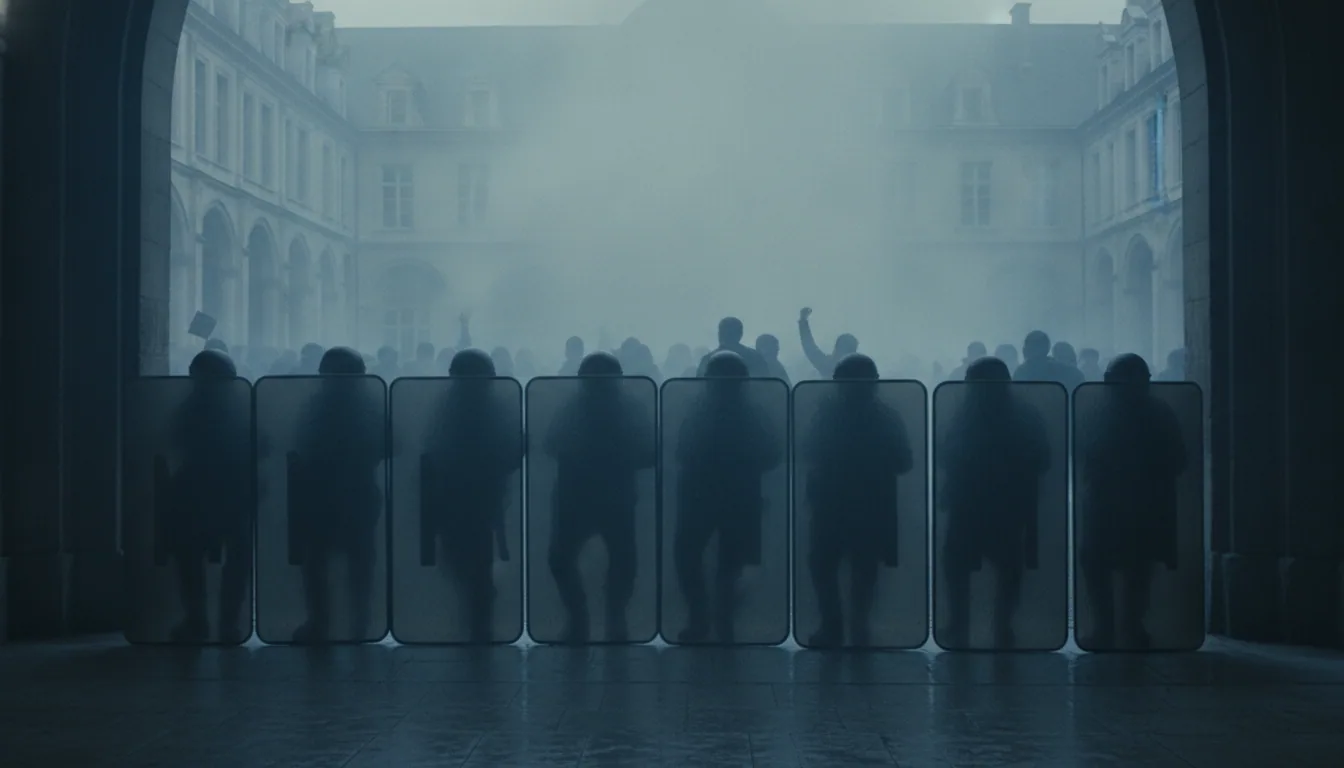
May 1968 haunts the French political memory in a way that ensures every wave of student protest before the Sorbonne is greeted with the same immediate, lazy comparison. It is a convenient rhyme and almost entirely misleading. The autumn of 2026 is not a reprise of a De Gaulle-era existential crisis; it is something more precisely measurable and structurally more brittle. We are witnessing the friction between a state that has promised a republican ideal and a ledger that can no longer afford the maintenance.
According to the Ministry of the Interior’s own ledger, the latest wave of demonstrations across France saw 256,000 participants, with approximately 56,000 in Paris alone. These are not the inflated tallies of an opposition movement, which one might view with a raised eyebrow. These are the numbers the state power used to count itself. The geography of the crisis is equally specific. At the height of the protests, 610 educational institutions were closed nationwide. By the first week of October, that number had receded but remained significant: 413 schools stood locked as of October 5. This is a map that shows not isolated radicalism, but a systematic spread between the provinces and the capital.
The Cost of a Temporary Pause
On October 7, Interior Minister Bruno Retailleau announced a temporary suspension of stun grenade use during student protests. The reason was concrete: a 15-year-old student had lost a hand. Not metaphorically, not as a statistical error, but physically and irrevocably. Retailleau is a man of precise phrasing. He ordered the suspension to last "just long enough to understand what happened." It is a formula of political logic worth taking apart: this is not an admission that the tool is inherently wrong, but a calculation of the time required to determine how to bring the same tool back once the political price has dropped.
A temporary ban is a measured concession, not a structural change. The numbers speak with their own cold autonomy. Since September 28, more than 6,500 people have been detained across France. This figure does not fit neatly into any narrative of "restoring order"—it represents a systematic pressure applied broadly and consistently. While the internal police oversight body, the IGPN, has launched 18 investigations into the use of excessive force, the sheer volume suggests the problem is not a matter of individual outliers, but of a tactical culture. The question raised by a 15-year-old’s lost hand is not technical, but one of proportionality: what means are permissible against students protesting the underfunding of their own future? Retailleau’s answer—pause, investigate, decide later—is a shift in the government’s risk assessment, not a change in its convictions. The distinction is the load-bearing wall here; everything else is molding.
Tear Gas in the Sorbonne: An Anatomy of Tactics
Tear gas is a tool designed to turn urban space into a battlefield—specifically, it makes the boundary between the participant and the passerby illegible. For the 256,000 people who filled the streets in September and October, it was a tool that failed to distinguish a schoolchild from a radical. The choice of the Sorbonne Nouvelle’s Nation campus as a flashpoint was not accidental. In France, the entry of police into a university space carries a specific historical weight; it is a breach of the republican myth regarding academic sanctuary. When the Gendarmerie crossed that threshold, a choice was made: institutional authority was prioritized over the symbolic contract between the state and the space of education.
The price of that choice is visible in the IGPN’s files. Eighteen investigations into excessive force is not statistical noise. It is a sequence whose length points to a pattern rather than a coincidence. One must ask if these 18 inquiries will alter the structure of policing, or if they are merely decorative plaster intended to cover cracks without stabilizing the building. Historically, French internal investigations have rarely resulted in concrete charges against officers in the ranks. The procedure functions, but the results remain elusive. Retailleau’s suspension of stun grenades is a tangible retreat, but police tactics are merely a solution to the symptom of the problem, not the problem itself. Watch whether the IGPN investigations reach the stage of formal indictments—that is the marker of whether reform is real or a matter of form.
The Longue Durée of Dry Rot
In January 2025, a physics teacher in a lycée in Île-de-France left his post. His classroom was twenty years old, the roof was cracked, and the laboratory equipment dated back to the Chirac administration. No replacement was found; his hours were divided between two colleagues who were already working beyond their capacity. This is the pattern behind the headline. The current protests did not begin with a boy’s injury; they began with years of underfunding that have turned the French public school into a place where the state promises more than it can deliver. Teacher shortages, crumbling buildings, and the forced merging of classes are facts that Education Minister Édouard Geffray acknowledges but lacks the budget to resolve. The limits of the political response are written in the language of numbers he does not publicly name.
We have seen this script before. In the spring of 2024, when students at Sciences Po protested over the war in Gaza, Valérie Pécresse, the head of the Paris region, responded by freezing a million euros in university funding. To use the freezing of funds as a disciplinary measure is a clear signal of how political pressure is applied to higher education in France. The 2026 protests may have a different catalyst, but the structural logic is identical: an institution expresses independent dissent, and the paymaster responds with a canister of gas or a cut in the budget rather than a dialogue. This is the load-bearing wall. If the budget does not change, nothing changes.
When the Logic Collapses
Twenty-four schools looted or burned. This number represents something other than the logic of protest; it is the collapse of that logic. Youth movements that begin as an assault on institutions occasionally end by destroying them. In 1968, Paris remained largely intact; no one threw petrol on a teacher that spring. Marseille stands now as a signal of radicalization. A 16-year-old was arrested there on suspicion of dousing a teacher in petrol—a year younger than the boy whose injury catalyzed this phase of the crisis.
Belfort adds another entry to the ledger. A 59-year-old police officer was struck unconscious during a demonstration. Violence is no longer a one-way street, a fact that is politically inconvenient for both sides and is therefore often buried between the columns of the morning papers. Seven hundred and fifteen injured police officers; seventy-eight injured educators. These numbers represent a program that no one authored—neither the "Block Everything" groups in their street meetings nor the government in its crisis cabinet. Here, the structural flaws of the system are exposed: when a protest loses its moral clarity, it loses its political leverage, and only the rot remains. The question is no longer how many schools were closed, but how many were burned, and who among those comparing this to 1968 has an answer for that.
The Marker to Watch
The CGT’s official support for the students’ demands is not a symbolic gesture. When France’s largest union aligns itself with schoolchildren, the classification of the crisis shifts: it is no longer a student riot, but an organized labor movement with budgetary demands and the right to strike. This shift matters more than any single demonstration count. The political field is now clearly drawn. Mélenchon’s LFI presses for systemic changes while the government clings to a narrative of order. The 6,500 arrests since late September are a number both sides will interpret to suit their needs—one side as disproportionate repression, the other as a necessary response.
Ignore the summit photographs; read the fine print of Retailleau’s suspension. It is "for the duration of the investigation." If the 18 internal probes end without formal proceedings, the tactics will return, unchanged by the legislative framework. The watch-marker is a single line: the Ministry of Education’s budget line in the upcoming parliamentary debate. If Édouard Geffray secures additional funding, the government has admitted this was a structural crisis. If the number remains static, these protests will be back on your screen by spring, and this time, the CGT will likely bring the country to a halt. Somewhere, a spreadsheet is waiting to be updated.