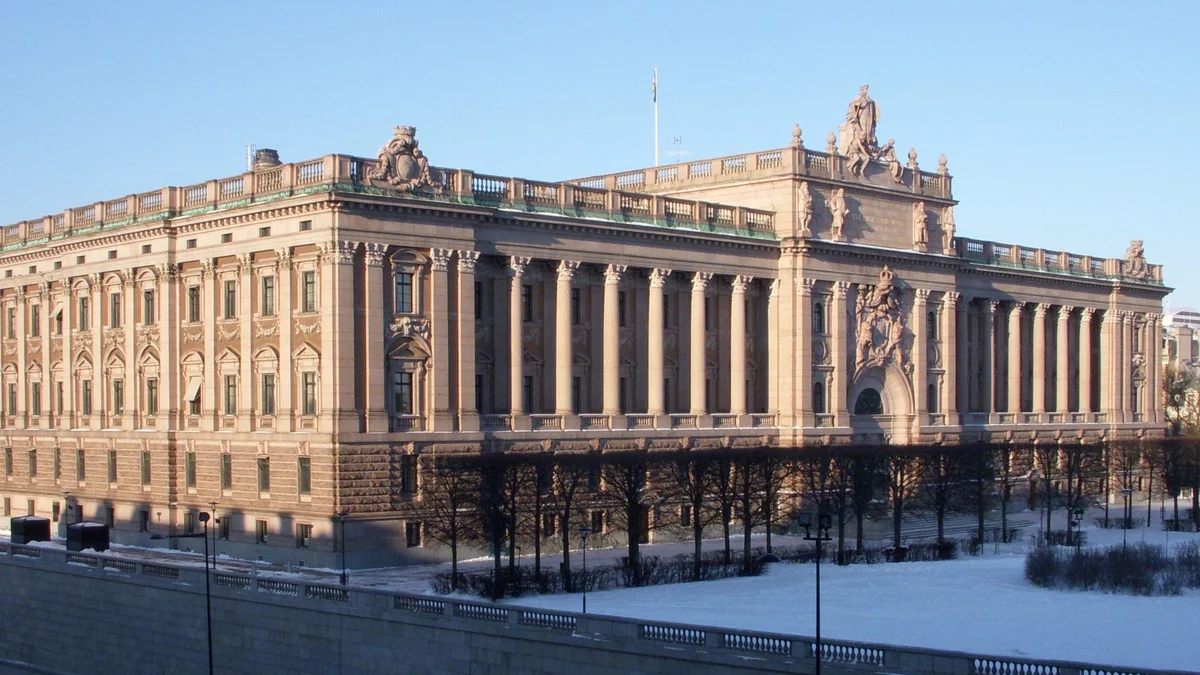
In September 2026, Sweden’s parliamentary arithmetic failed. With 176 seats for the left and 173 for the right, the Riksdag entered a state of negative parliamentarism where a single vote is indistinguishable from zero. As NATO’s newest member faces institutional paralysis, the cost is being measured in stalled defense plans and a 29% drop in regional trade—proving that when great-power architecture lacks a foundation, it is the borderlands that pay the first installment.
In 1992, when speculators set the Swedish krona on fire and the Riksbank was forced to break its exchange rate overnight, the Finance Minister claimed the system was fundamentally sound. Only one wall was cracked—the one that held the roof up. Thirty-four years on, we have entered the same room through a different door.
The Swedish government crisis of late 2026 has finally broken the two-bloc assumption upon which Riksdag politics rested for decades. Following the September elections, the left-wing bloc secured 176 seats against the right’s 173. In a chamber of 349, the threshold for a majority is 175. On paper, the left crossed the line by a single seat. In practice, a single vote is indistinguishable from zero if it cannot be reliably counted toward a budget.
Sweden operates under a system of negative parliamentarism. It allows a government to take office without a positive majority, provided a majority does not actively vote against it. This is an institution built as a temporary fix for dysfunction, not a permanent method of state-building. It was intended to be the decorative molding of the constitution; it has now become the only load-bearing wall left standing.
Behind the political maneuvering, the economy has been working its own logic. The recession of 2024–2025, defined by high inflation and rising interest rates, eroded the mandate of mainstream parties faster than any campaign strategy could repair. Voters did not simply move from one bloc to another; they abandoned the internal logic of the bloc system itself. This is a structural fault, not a momentary fluctuation. The growth of the Sweden Democrats has rendered the old arithmetic unstable—too large to ignore, yet too radioactive for many to accept as a partner.
The Geometry of a Deadlock: Why Andersson Resigned
Ulf Kristersson submitted his resignation on September 17. Formally, the move was a standard concession to the election results. With the left-wing bloc holding 176 seats, Magdalena Andersson received the mandate to form a government. The numbers appeared to work. The reality was less cooperative.
The pivot point proved to be the Center Party. Its leader, Elisabeth Thand Ringqvist, has excluded cooperation with both the Sweden Democrats on the right and the Left Party on the opposite flank. This is a geometric impossibility—a bloc that cannot fit into any stable coalition shape. When Ringqvist chose to support the right-wing candidate for Speaker of the Riksdag, it became clear that Andersson’s mathematics had disintegrated.
Pressure also mounted from the Left Party. Despite lingering allegations of vote-buying and voter intimidation during the campaign, the party demanded cabinet positions as the price of its support. Andersson could not grant them without permanently alienating the Center Party. One door closed another.
On September 28, Andersson announced she could not form a government. The statement was short and precise, as the casualty reports of small nations tend to be—everything important was left out. Specifically, she omitted the fact that while negative parliamentarism allows a government to exist, someone must first have the courage to stand. Andersson did not. The parliamentary sin that has organized Swedish politics for decades no longer offers clear boundaries. This is not the result of a single decision, but a failure of the structure.
The Toxic Role of the Pivot
Elisabeth Thand Ringqvist’s refusal to deal with either extreme is not a tactical position. It is the geometry of a stalemate. The Center Party is a small entity caught between two large blocs, refusing to shake the hand of either.
Ringqvist made this geometry visible during the Speaker elections. By backing the right-wing candidate, she signaled that including the Left Party in a government was a price the Center Party would not pay. I have seen this maneuver before: Brussels, 2010. It is the moment the vågmästarroll—the balance of power—becomes toxic.
As the Sweden Democrats expand on the right and the Left Party increases its demands, Ringqvist’s room for maneuver narrows. She is trapped in a position where every decision alienates half of her remaining electorate. The specific conditions the Center Party is demanding in exchange for supporting the right-wing bloc remain unconfirmed. This is the great unknown of the current crisis. The Speaker will likely turn next to Kristersson, but the price of keeping the Center Party on board is not yet part of the public record.
Watch whether the details of the negotiations with the Center Party are made public before the Riksdag’s vote of confidence. If the terms remain hidden, the resulting coalition will be fragile from the hour of its birth.
Gang Violence and the Ledger of Grievance
The 2026 campaign did not begin in the Riksdag or at a press conference. It began in the statistics of explosions and shootings that the Stockholm police eventually stopped categorizing by year, as the months became indistinguishable. Gang violence became the auditory and visual backdrop of daily life. Voters carried it with them, a fact of existence in the older neighborhoods.
The election should have been about the economy. Sweden had endured two years of recession, high inflation, and interest rates that stripped several percentage points of purchasing power from the average wage earner. Instead, populists were handed a narrative that linked economic pain and street safety in a single sentence. They wrote that sentence repeatedly.
The government’s response—offering "exit grants" for foreign-born residents to leave the country—was a confession. It signaled that the divide is deeper than a single election cycle can mend. The announcement itself served only to confirm the desperation of the mainstream parties. The election measured two things simultaneously: dissatisfaction with the economy and a demand for the state to regain control of its streets. These issues did not provide the parties with solutions; they provided them with a marketplace for votes.
The Cost of a Caretaker NATO Member
Comparisons to the Belgian deadlock of 2010, which lasted 541 days, are lazy and break under scrutiny. When Belgium lacked a government, the cost was primarily felt in fiscal policy. Sweden’s situation is different. Belgium was not a newly integrated NATO member whose regional defense plans required rapid institutional adaptation.
A caretaker government cannot make long-term strategic decisions on defense spending. This is not a legal nuance; it is a load-bearing wall. NATO’s new regional defense plans for the Baltic Sea require binding decisions on resources, infrastructure, and joint exercises. These are decisions for which Kristersson’s transitional administration lacks a mandate.
Kristersson warned during the campaign that a left-wing victory would jeopardize Sweden’s security policy and its NATO commitments. That was a rhetorical weapon at the time, but the structural concern remains after the rhetoric is stripped away. A coalition dependent on the Left Party cannot send a clear signal within the alliance.
From the small-nation floor in Tallinn, this is not a matter of diplomatic politesse, but of geography. Estonian Prime Minister Kristen Michal has emphasized Sweden’s role in Baltic security. When Sweden joined NATO in 2024, the Baltic Sea theoretically became a NATO lake. But that theoretical advantage requires concrete defense cooperation agreements—decisions that an interim government is forced to postpone.
The Estonian Balance Sheet
The impact is already visible in the ledger. Overnight stays by Swedes in Estonia dropped 29% in 2024 compared to 2019. The data from Visit Estonia requires little interpretation: it is one of the sharpest declines in our northern tourism geography. The Swedish recession of 2024–2025 has kept Swedish households at home.
The export side tells a similar story. Estonia’s construction and timber sectors, which live and die by the investment cycles of Sweden and Finland, are at a low point because Swedish domestic demand has not recovered. Political uncertainty delays the implementation of economic stimulus—measures that require a government mandate that does not currently exist.
Sweden is three things to Estonia: an ally, an export market, and a Baltic buffer zone. There is an asymmetry here that Tallinn tends to underestimate. When the Swedish economy stalls and its government enters a stalemate, we pay a portion of the bill. The 29% figure is concrete. Behind it lies the decline of Swedish purchasing power, not merely a change in travel trends. The same logic applies to timber exports; the weakness in the Swedish construction market is structural, not temporary.
The question for Estonian analysts is simple: do our forecasting models account for political risk in our northern neighbor? Thus far, the answer has been no.
The Marker to Watch
Magdalena Andersson gave up her mandate on September 28, 2026. Ulf Kristersson resigned on September 17. These two dates define the vacuum in which Swedish parliamentarism now sits. The Speaker will appoint the next formateur—likely Kristersson—but probability is not an appointment. Until then, the caretaker government operates with a narrow window of authority.
The key remains the Center Party. Elisabeth Thand Ringqvist has excluded both the Sweden Democrats and the Left Party. This leaves the right-wing bloc with 173 seats—two short of the 175 required. Without the Center Party’s active support or tactical abstention, the numbers will not work.
Ignore the summit photographs and watch the wording of the Speaker’s mandate. If the text includes an explicit coalition obligation, the formateur has a contract. If the wording remains open, we are entering a new round of negotiations with no scheduled end. If Kristersson fails, the question of snap elections moves from a hypothesis to a calendar problem.
Watch one concrete marker: whether the next Swedish government confirms a schedule for defense spending targets before the next NATO defense ministers' meeting. If the date slips, the load-bearing wall has more than just a crack. Someone, somewhere, has already updated the spreadsheet.