One Sentence at a Conference in Maryland
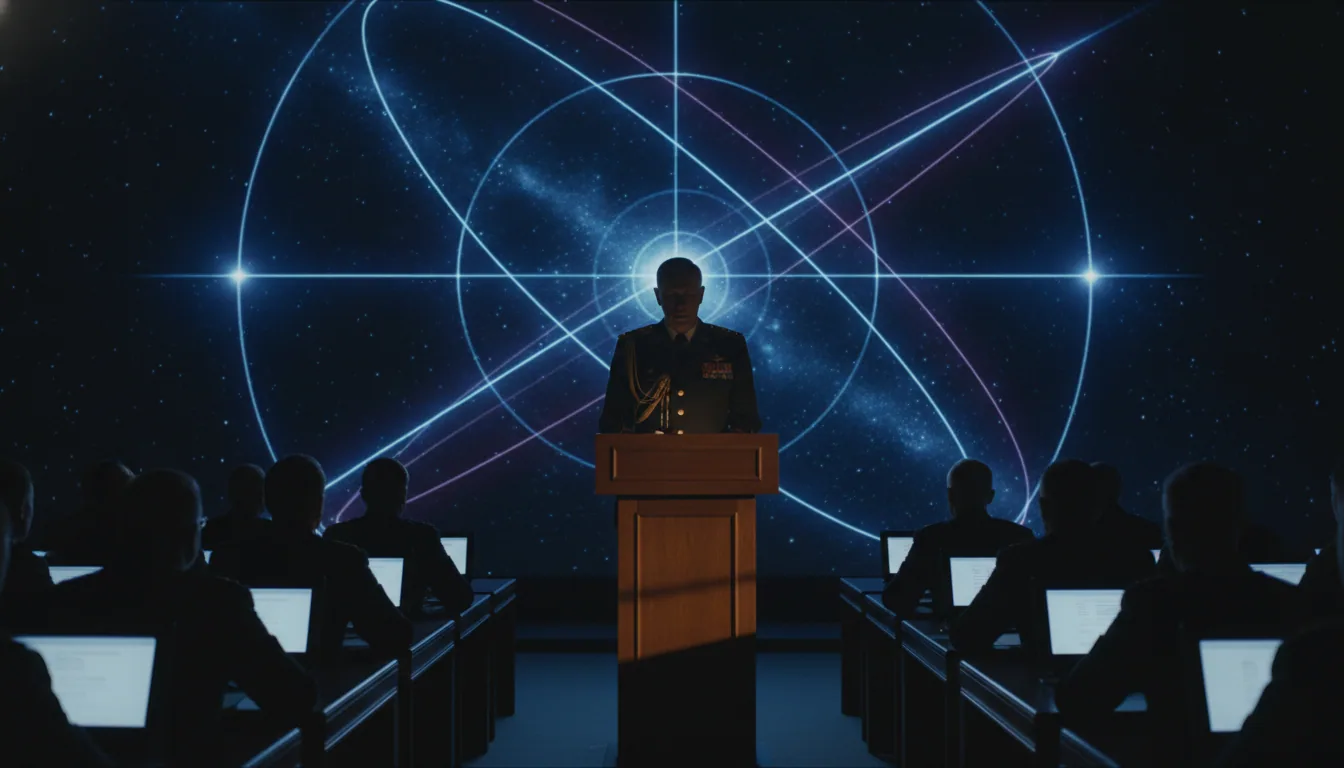
Space weapons moved from rumor to official record on September 14, 2026. Troy Meink said thirteen words, and the room went quiet. "This is why the United States now has on-orbit space control weapons capable of defending the joint force against hostile adversary action." That was at the Air and Space Forces Association conference in National Harbor, Maryland, and it was the first time a senior Pentagon official had stood at a podium and admitted, plainly, that America has weapons in orbit right now.
The phrasing was not accidental. Meink later explained that the language was, in his words, "well thought out" - chosen to communicate just enough for deterrence without revealing anything an adversary could use. That is a very specific kind of sentence: one designed to be heard by Moscow and Beijing as clearly as by the journalists in the room. The Pentagon was not making an announcement so much as sending a signal.
Here is the strange part. What exactly those weapons are, how many orbit overhead, what orbital planes they occupy, and whether they destroy by kinetic impact or by some other mechanism - all of that remains classified. The number is unknown. The mechanism is secret. Meink confirmed the category and the intent, nothing more. Space control, as the military defines it, covers both defensive actions to protect American assets and offensive actions to negate an adversary's capabilities - a deliberate breadth that leaves almost everything unsaid while saying something irreversible.
For sixty years, American policy kept any hint of orbital weapons behind layers of careful ambiguity. That policy ended in thirteen words on a Monday afternoon. What comes next is less certain than what was just admitted.
The Treaty That Was Supposed to Keep Space Peaceful
The Outer Space Treaty of 1967 is frequently described as the cornerstone of international space law. What it actually forbids is narrower than that reputation suggests. The treaty bans weapons of mass destruction in orbit, nuclear bombs parked in space, that kind of catastrophic hardware — and says nothing about conventional weapons.
That gap is not an accident of drafting. It is a reflection of what the negotiators were frightened of in 1967: the spectre of nuclear warheads circling the Earth on permanent deployment. They wrote a rule for the nightmare they could picture. The nightmare that came next — satellite-killing interceptors, high-powered jammers, robotic proximity vehicles capable of physically interfering with another nation's spacecraft — sat largely outside the treaty's language, because nobody had quite pictured it yet.
This is the long human habit of writing rules for the last war. The Geneva Conventions were shaped by the trenches of 1914. The Outer Space Treaty was shaped by the Cuban Missile Crisis.
For decades the United States leaned on deliberate vagueness - acknowledging no orbital weapons, confirming no capabilities, letting ambiguity do the work that deterrence theory usually assigns to disclosed force. The 1985 destruction of the Solwind satellite by a US missile was tested and then quietly shelved from public doctrine. What the treaty banned, the Pentagon avoided. What it did not ban, it did not discuss. The result was sixty years of a legal framework built around a prohibition that left the most operationally useful category of space control weapons entirely unaddressed.
What Russia and China Have Already Sent Up There
The argument that space weaponization is a purely American project dissolves quickly when you look at what the other side has already done. In January 2007, China destroyed one of its own aging weather satellites with a ground-launched missile. The collision was clean in the ballistic sense. The aftermath was not: over 3,500 trackable debris fragments scattered into low Earth orbit, where the fastest of them travel at roughly 7 kilometres per second.
Russia's contribution came in November 2021. A Nudol missile struck Kosmos-1408, a defunct Soviet reconnaissance satellite, shredding it into a cloud of wreckage that passed through the International Space Station's orbital altitude. The seven crew members aboard were woken and told to shelter in their docked capsules. They waited while the debris cloud swept past. No one was hurt. That was luck as much as engineering.
The kinetic tests are the visible edge of a quieter programme. Russian satellites designated "Nivelir" have been conducting proximity operations near American national-security satellites in 2024 and 2025, manoeuvring close enough to shadow, inspect, or in principle interfere. In 2024, US officials alleged that Russia is also developing an orbital nuclear weapon designed not to explode a warhead but to detonate it for the electromagnetic pulse alone, which would fry electronics across a wide swath of orbit without a single piece of shrapnel.
Neither Russia nor China has joined the US moratorium on destructive ASAT testing, declared in 2022. The environment that Meink's thirteen words were responding to was not hypothetical. It was already in motion, already in orbit, already watching.
The Hardware: Jammers, Interceptors, and a Watching Constellation
Space control, as the Pentagon defines it, is two things at once: defending your own assets and denying your adversary the use of theirs. Offence and defence wearing the same uniform. That duality shapes every item on the current American hardware list, and the list has grown considerably in the past twelve months.
Start on the ground. In June 2026, the US Space Force formally commissioned Meadowlands, a counter-communications jamming system built by L3Harris. Its job is elegantly hostile: find an adversary's satellite signal and drown it in noise. No debris, no treaty violation, no shrapnel spiralling through low Earth orbit. Jamming is the scalpel of space warfare, and Meadowlands is now a live instrument.
Look up next. In May 2026, SpaceX won a multibillion-dollar contract to build the first Air-Moving Target Indication constellation, satellites designed to track fast-moving objects, including missiles, from orbit. The first AMTI satellites were scheduled for launch in September 2026 - essentially now. A watching constellation that does not merely observe but enables targeting is, by any honest reading, a weapons-support system.
Then there is Golden Dome. Under that initiative, flight-ready hardware for space-based interceptors already exists. Not blueprints. Not proposals. Hardware that flies.
The backdrop to all of this is a single deliberate restraint. In 2022, the United States declared a unilateral moratorium on destructive kinetic ASAT testing - the kind that turns a satellite into three thousand pieces of trackable shrapnel. Russia and China have not followed. The US chose to stop blowing things up in orbit; it did not choose to stop building things that could.
What a Weapon in Orbit Actually Does to Orbit
Think of low Earth orbit as a river with a current that never stops. Debris enters and then circulates for years, sometimes decades, before drag pulls it down. Unlike a battlefield on the ground, you cannot clear the wreckage once it is made.
China demonstrated this in 2007, when it destroyed its own Fengyun-1C weather satellite with a kinetic kill vehicle. The impact scattered more than 3,500 trackable fragments - plus hundreds of thousands of smaller, untrackable ones - into a band of altitude that is still laced with shrapnel today. That cloud is not a historical footnote. It is still up there, still circling.
This is where the logic of kinetic warfare in orbit becomes self-defeating. Donald Kessler, a NASA scientist, described the risk in 1978: above a certain debris density, each collision triggers new collisions, which trigger more, in a cascade that eventually renders entire orbital shells unusable for generations. The weapons domain contaminates itself. A military that destroys an adversary's satellites with kinetic kill vehicles is simultaneously fouling the orbital lanes it depends on for navigation, targeting, and communications.
That contradiction is one reason serious analysis has shifted toward non-kinetic options: jamming signals, dazzling sensors, manoeuvring close enough to interfere without pulling a trigger. The 2022 US moratorium on destructive ASAT testing was a tacit acknowledgement of this arithmetic. The domain where space control is now being fought is one that both sides, and all the civilians between them, cannot afford to break.
The weapons are real. The rules governing them are not.
The Open Horizon: A Space Weapons Race Nobody Officially Started
In September 2024, four civilians aboard the SpaceX Polaris Dawn capsule climbed to 1,400 kilometres above Earth, the highest altitude any human had reached since the Apollo era. They were tourists and test pilots and a billionaire, conducting the first civilian spacewalk. They were also, unknowingly, sharing an altitude band with military hardware whose existence the United States would not confirm for another two years.
That gap - between what exists and what is acknowledged - is where arms-control frameworks go to die. The 1967 Outer Space Treaty bans weapons of mass destruction in orbit. It says nothing about conventional weapons. What we do not know now is, by any honest accounting, more than what we do: the number of deployed units is classified, their orbital planes undisclosed, their mechanisms - laser, microwave, robotic arm - unspecified, and the total budget invisible.
The historical parallel is instructive. Nuclear weapons went from absolute secret to declared doctrine. Cyber capabilities followed the same arc, from deniable operations to acknowledged strategic tools. Meink's phrasing on September 14 was, by his own description, "well thought out" - deterrence through disclosure, not transparency. The space weapons are real. The rules governing them are not. Whether any arms-control framework can reach orbit before the next test makes the question moot, nobody knows - and that, right there, is where the next chapter begins.